• Commentary
  • Research
  • Experts
  • Events
Carnegie China logoCarnegie lettermark logo
{
  "authors": [
    "Matthew Rojansky"
  ],
  "type": "legacyinthemedia",
  "centerAffiliationAll": "dc",
  "centers": [
    "Carnegie Endowment for International Peace"
  ],
  "collections": [],
  "englishNewsletterAll": "ctw",
  "nonEnglishNewsletterAll": "",
  "primaryCenter": "Carnegie Endowment for International Peace",
  "programAffiliation": "russia",
  "programs": [
    "Russia and Eurasia"
  ],
  "projects": [],
  "regions": [
    "Middle East",
    "Syria",
    "Caucasus",
    "Russia"
  ],
  "topics": [
    "Political Reform",
    "Foreign Policy"
  ]
}
Source: Getty

In The Media

Opposition Rally in Moscow Draws Tens of Thousands

The recent public protests in Moscow differ from those in December and March because so far, they seem centered in Moscow, while the previous protests were widespread throughout the country.

Link Copied
By Matthew Rojansky
Published on Jun 14, 2012

Source: CTV

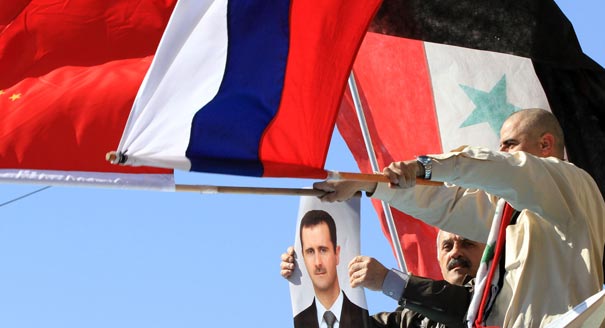
Speaking on CTV, Carnegie’s Matthew Rojansky discussed the Russia-Syria relationship and the domestic situation in Russia.

  • Russian Domestic Protests: Evaluating the recent large protest in Moscow during the national holiday, Rojansky said that unlike the protests in the December and March, which were widespread throughout the country, the current movement is centered in Moscow. “The negative there is that it is isolated, and that it doesn’t speak for the country as a whole,” he said. “The positive for the protesters is that they are in the media spotlight.” He concluded, “The fact that there has not been violence is good for protesters but it is also good for Putin. At a certain point, violence is going to tarnish Putin’s image and reputation and will bring more people out on the streets.”
     
  • Russia’s Relationship with Syria: Recently, U.S. Secretary of State Hillary Clinton suggested that Moscow might be sending attack helicopters to Syria. Rojansky commented on the possibility, saying “if it is true, that is a big if, and if this is an immediate delivery of attack helicopters, then that would be a real departure from Russia’s commitment to Syria.” He added, “it could be because simply one hand doesn’t know what the other hand is doing-that is, sometimes the Russian defense export industry is following through deals they think of as long-term arrangements irrespective of what the state of political play is.” He suggested that there is a third possible interpretation. “Another reason could be that the Russians are playing both sides of the game. We heard a couple of weeks ago that the Russians were prepared to talk about a post-Assad scenario, but obviously if they are supplying Assad with weapons he can use to effectively obliterate the rebels from the air, they are definitely playing for both sides,” he said.

This broadcast originally appeared in CTV.

About the Author

Matthew Rojansky

Former Deputy Director, Russia and Eurasia Program

Rojansky, formerly executive director of the Partnership for a Secure America, is an expert on U.S. and Russian national security and nuclear-weapon policies.

    Recent Work

  • Paper
    An Opportunity for Ambition: Ukraine’s OSCE Chairmanship

      Matthew Rojansky

  • In The Media
    Presiding Over the OSCE: Challenges and Opportunities

      Matthew Rojansky

Matthew Rojansky
Former Deputy Director, Russia and Eurasia Program
Matthew Rojansky
Political ReformForeign PolicyMiddle EastSyriaCaucasusRussia

Carnegie does not take institutional positions on public policy issues; the views represented herein are those of the author(s) and do not necessarily reflect the views of Carnegie, its staff, or its trustees.

More Work from Carnegie China

  • Commentary
    China Sells Stability Amid American Volatility

    U.S. unpredictability has allowed China to capitalize on its positioning as the “responsible great power”. Paradoxically, the more China wins the perception game, the more likely expectations will rise for Beijing to deliver not just words but to demonstrate with its deeds.

      Chong Ja Ian

  • Vietnam's Top Leader To Lam meets with young representatives from China and Vietnam participating in the "Red Study Tours" at the Great Hall of the People on April 15, 2026 in Beijing, China. T
    Commentary
    Why Vietnam Is Swinging in China’s Direction

    Hanoi and Beijing have long treated each other as distant cousins rather than comrades in arms. That might be changing as both sides draw closer to hedge against uncertainty and America’s erratic behavior.

      • Nguyen-khac-giang

      Nguyễn Khắc Giang

  • Commentary
    China’s Energy Security Doesn’t Run Through Hormuz but Through the Electrification of Everything

    Across Asia, China is better positioned to withstand energy shocks from the fallout of the Iran war. Its abundant coal capacity can ensure stability in the near term. Yet at the same time, the country’s energy transition away from coal will make it even less vulnerable during the next shock.


      • Damien Ma

      Damien Ma

  • Commentary
    Malaysia’s Year as ASEAN Chair: Managing Disorder

    Malaysia’s chairmanship sought to fend off short-term challenges while laying the groundwork for minimizing ASEAN’s longer-term exposure to external stresses.

      Elina Noor

  • Commentary
    When It Comes to Superpower Geopolitics, Malaysia Is Staunchly Nonpartisan

    For Malaysia, the conjunction that works is “and” not “or” when it comes to the United States and China.

      Elina Noor

Get more news and analysis from
Carnegie China
Carnegie China logo, white
Keck Seng Tower133 Cecil Street #10-01ASingapore, 069535Phone: +65 9650 7648
  • Research
  • About
  • Experts
  • Events
  • Contact
  • Careers
  • Privacy
  • For Media
Get more news and analysis from
Carnegie China
© 2026 Carnegie Endowment for International Peace. All rights reserved.