

Commentary
Uri Dadush
{
  "authors": [
    "Uri Dadush"
  ],
  "type": "legacyinthemedia",
  "centerAffiliationAll": "",
  "centers": [
    "Carnegie Endowment for International Peace",
    "Carnegie Europe"
  ],
  "collections": [
    "Transatlantic Cooperation"
  ],
  "englishNewsletterAll": "",
  "nonEnglishNewsletterAll": "",
  "primaryCenter": "Carnegie Endowment for International Peace",
  "programAffiliation": "",
  "programs": [],
  "projects": [],
  "regions": [
    "North America",
    "United States",
    "Western Europe",
    "Germany",
    "Europe"
  ],
  "topics": [
    "Economy",
    "Foreign Policy"
  ]
}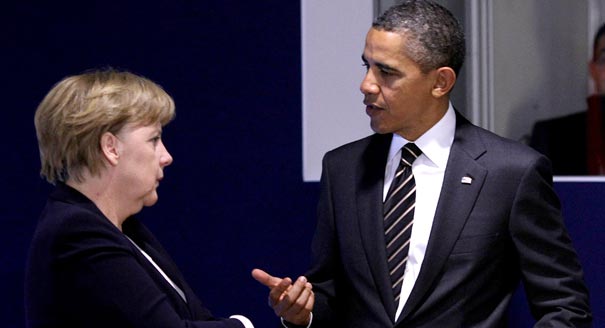
Source: Getty
Propping up the euro through contentious fiscal and banking arrangements, all without adequate guarantees from countries on Europe’s periphery, may not produce the long-term stability that is in the interest of both sides of the Atlantic.
Source: National Interest

Finally, after about twenty attempts, there is a road map that may one day take Washington's most important and troubled economic partner out of its quagmire. Although German chancellor Angela Merkel resolutely vetoed any resort to euro bonds or rescues financed by the European Central Bank (ECB), she agreed to ease conditions under which the new central bailout mechanism, the European Stability Mechanism (ESM), can buy government bonds. Merkel also assented to let the European Commission design proposals for an economic and fiscal union by the end of the year.
Moreover, by allowing the ESM to lend to troubled banks directly (as well as to relinquish its senior debtor status) and identifying the ECB as the new locus for banking regulation, the euro zone took a big step towards a banking union—a step that was already flagged in the G-20 Los Cabos declaration. The so-called growth pact was also agreed. It amounts to 130 billion euro of spending measures, but most of these are not additional and simply reshuffle previous plans. While the growth pact may end up being more cosmetic than real, it certainly signals a change in tone.The increased support to countries in trouble and the reduced emphasis on austerity and structural reforms as the prerequisite for getting this help clearly marks a big course correction. This remarkable shift reflects a sudden transformation of the balance of power within the euro zone. Less than three months ago, the Merkel-Sarkozy hard line on austerity ruled supreme. But today, the new French president François Hollande knows that if the euro-zone safety net is not strengthened, France could also fall into the abyss, especially given his determination to deliver on his anti-austerity election promises. Moreover, Italy and Spain, respectively the third and fourth largest economies of the euro zone, are now squarely in the market’s crosshairs. Steered by credible leaders, these Southern giants are making their weight felt in a way that Greece, a relative minion and the zone’s enfant terrible, never could.
Germany, confronted in Brussels by the combined might of all its largest euro-zone partners—not to mention Obama’s insistent prodding behind the scenes, the UK’s newly found passion for increased integration in the euro zone and pressure from the EU Commission bureaucracy—had to concede significant ground. Alternatively, it eventually would be forced to examine its membership in an arrangement in which it is rapidly becoming the odd man out, with no disrespect intended for members like Austria and Finland that still support the German line.
Many have correctly commented that the Brussels outcome is short on detail and that all depends on how these very general agreements are implemented. But they miss the main point, which is that the anti-Merkel camp now has the upper hand and will play a big role in filling the blanks in the agreement.
Still, more questions remain, and two of the most important issues raised by the Brussels summit have received the least attention.
First, does the 500 billion euro ESM have the firepower to rescue Spain and Italy, whose combined government debt is approaching three trillion euros? The answer, of course, is no. Nor can Germany and the rest of the core realistically foot the gigantic bill even if they wanted to.
With the United States having excused itself from any contribution to Europe’s crisis, through the IMF or otherwise (and thus given an alibi to China and others to do little), the only resort would be large-scale bond purchases and money printing by the ECB. But will euro-zone citizens, including Mrs. Merkel, allow their central bank to take on such huge risks? Are they prepared to pay for inflation? Will they accept letting politicians in the periphery continue with their otherwise impossible spending? The answer remains unknown.
Second, and even more fundamental, is the outcome of the Brussels summit actually a good thing for Europe and for its U.S. ally? Those who believe that at the core of the euro crisis are institutional deficiencies—and fiscal and banking vulnerabilities that can be greatly reduced simply by pooling them—will answer in the affirmative.
Those who, like me, believe instead that the root of the crisis lies elsewhere—the inability of troubled countries to remain competitive with Germany—will be more circumspect. Will the periphery succeed in reducing its cost gap with Germany and expose its many protected sectors to competition, or will the move towards a European fiscal and banking union produce procrastination and continued capture of the state by vested interests? If the latter, it is impossible to see how the euro zone will ever emerge from its imbroglio without paying a higher and higher cost. Unfortunately, there is little in the history of the euro zone since its creation or even (with the possible exception of Ireland) since the outbreak of the crisis, to provide much reassurance that the outcome will be benign.
For the Obama administration, any summit outcome that reduces the likelihood of a global recession before November’s U.S. elections is clearly preferred. But what the United States badly needs is a stable and strong European ally that will help it navigate the rough waters of the new century. Propping up the euro through highly contentious and potentially inflationary fiscal and banking arrangements, all without adequate guarantees from countries on Europe’s periphery, may not produce the long-term stability that is in the interest of both sides of the Atlantic.
Mrs. Merkel was overpowered in Brussels. But only history will tell whether her insistence that tougher reform measures in the periphery should precede a closer union was, in fact, mistaken.
This article was originally published in the National Interest.
Former Senior Associate, International Economics Program
Dadush was a senior associate at the Carnegie Endowment for International Peace. He focuses on trends in the global economy and is currently tracking developments in the eurozone crisis.
Recent Work
Uri Dadush
Uri Dadush
Carnegie does not take institutional positions on public policy issues; the views represented herein are those of the author(s) and do not necessarily reflect the views of Carnegie, its staff, or its trustees.

But their "principal to principal" model will only be as effective as the political strength of each leader back home.

Damien Ma

U.S. unpredictability has allowed China to capitalize on its positioning as the “responsible great power”. Paradoxically, the more China wins the perception game, the more likely expectations will rise for Beijing to deliver not just words but to demonstrate with its deeds.

Chong Ja Ian

Hanoi and Beijing have long treated each other as distant cousins rather than comrades in arms. That might be changing as both sides draw closer to hedge against uncertainty and America’s erratic behavior.

Nguyễn Khắc Giang

Across Asia, China is better positioned to withstand energy shocks from the fallout of the Iran war. Its abundant coal capacity can ensure stability in the near term. Yet at the same time, the country’s energy transition away from coal will make it even less vulnerable during the next shock.
Damien Ma

In the latest Five-Year Plan, the Chinese president cements the shift to an innovation-driven economy over a consumption-driven one.
Damien Ma