

Commentary
But their "principal to principal" model will only be as effective as the political strength of each leader back home.
Damien Ma
{
  "authors": [
    "Matthew Rojansky",
    "Nikolas Gvosdev"
  ],
  "type": "legacyinthemedia",
  "centerAffiliationAll": "dc",
  "centers": [
    "Carnegie Endowment for International Peace",
    "Carnegie Russia Eurasia Center"
  ],
  "collections": [],
  "englishNewsletterAll": "ctw",
  "nonEnglishNewsletterAll": "",
  "primaryCenter": "Carnegie Endowment for International Peace",
  "programAffiliation": "russia",
  "programs": [
    "Russia and Eurasia"
  ],
  "projects": [
    "U.S.-Russia Bilateral Presidential Commission"
  ],
  "regions": [
    "North America",
    "United States",
    "Caucasus",
    "Russia"
  ],
  "topics": [
    "Political Reform",
    "Foreign Policy"
  ]
}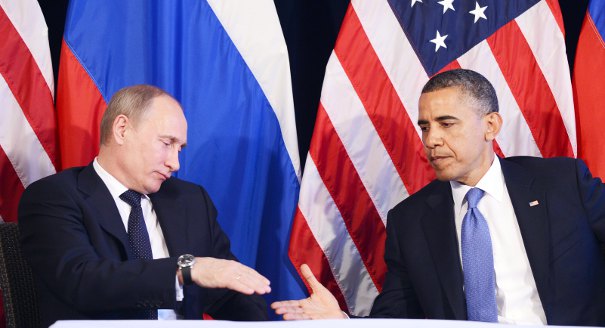
Source: Getty
While it may be morally satisfying for U.S. politicians to criticize Russia, moral outrage without a smart negotiating strategy will do little to advance vital U.S. interests—including democracy and human rights.
Source: New York Times

But a rising tide of anti-Russia rhetoric from Washington and Russia’s bristling response underscore the difficulty of balancing human rights and democracy with other vital national interests in an important international relationship.
The U.S. Congress is already determined to enact new sanctions against Russian officials and businesses as a quid-pro-quo for lifting a Cold War-era ban on normal trading relations with Moscow. Some in the Obama administration have offered the unhelpful alternative of creating a “democracy fund” to channel U.S. money to the very groups the Russian government most fears. Mitt Romney has labeled Russia a geopolitical foe and promised to “dismantle the reset” if he is elected.All of this is cause for concern that, no matter who wins in November, U.S.-Russia relations are drifting toward a more confrontational posture.
This must not happen. Productive relations between Washington and Moscow are important for advancing vital U.S. national interests. Russia disagrees with America’s assessment of the situation in Syria, and exerts its influence in its Eurasian neighborhood in ways that raise concerns for Washington.
But these differences should not conceal the progress that has been made on pressing regional security issues from the Middle East to East Asia. More than 100,000 NATO soldiers in Afghanistan rely for food, fuel and ammunition on a supply route that runs through Russia.
These are not reasons to ignore the Kremlin’s crackdown on political dissent, but they should be reminders that any U.S. response demands a considered and honest assessment of the costs and benefits for the relationship as a whole.
So how can Washington have an impact on Russia’s domestic political problems without poisoning the atmosphere of the relationship or giving up on vital national interests? The answer lies in a venerable foreign policy tradition going back to the Cold War and before: the art of negotiation.
In the 1980s, even after labeling the Soviet Union an “evil empire,” President Ronald Reagan conducted multi-track talks with Moscow in which the United States simultaneously pursued nuclear arms control, managed regional conflicts and liberated Jewish refuseniks, Baltic nationalists and other political dissidents.
The Reagan approach succeeded in no small part because both sides recognized that each of these issues impacted the superpower relationship as a whole — and both sides were willing to put all issues on the table and negotiate a series of bargains that addressed them.
Subsequent U.S. presidents have shown that it is possible to foster a cooperative relationship with a less democratic state that can, in the end, help to advance a wide range of U.S. interests, including human rights.
In the 1990s, the Clinton administration, with strong support from Senator John McCain, normalized relations with Vietnam, moving past the painful legacy of the war in order to find opportunities for cooperation and progress.
Washington could not require Vietnam to abandon its one-party Communist system as a prerequisite for relations, but by using the leverage of trade and aid, the United States was able to make significant progress on hard issues, including the fate of missing servicemen. In this context, the Vietnamese offered concessions on human rights issues, including enhanced religious freedom.
The pragmatic approach of using negotiations to advance both interests and values culminated in a bilateral trade agreement concluded in 2000 — and implemented by Clinton’s successor, George W. Bush.
President Bush also embraced the pragmatic approach with his creation of the President’s Emergency Plan for AIDS Relief (PEPFAR) in 2003. A number of the 15 “focus countries” targeted to receive large amounts of U.S. aid to combat H.I.V./AIDS were not democracies, despite considerable domestic criticism. But the administration found that its offer of cooperation on the urgent problem of H.I.V./AIDS helped to increase its leverage to push for reforms more than a hectoring approach would have.
It is still possible to negotiate with Russia for progress on democracy, rule of law and human rights, especially if Washington makes good use of the tools it already has, such as the Bilateral Presidential Commission, which facilitates high-level official and nongovernmental contacts on issues ranging from counterterrorism to prison reform, and provides a platform to negotiate the issues.
Yet the more that rhetoric from Washington depicts Russia as the problem, the more it discredits an approach that could win concessions in the context of wider partnership. Likewise, legislation that restricts ties between the United States and Russia makes it much harder for either side to respond effectively when problems or opportunities arise.
It may be morally satisfying for U.S. politicians to criticize Russia, but moral outrage without a smart negotiating strategy will do little to advance vital U.S. interests — including democracy and human rights.
This article was originally published in the New York Times.

Former Deputy Director, Russia and Eurasia Program
Rojansky, formerly executive director of the Partnership for a Secure America, is an expert on U.S. and Russian national security and nuclear-weapon policies.
Nikolas Gvosdev
Carnegie does not take institutional positions on public policy issues; the views represented herein are those of the author(s) and do not necessarily reflect the views of Carnegie, its staff, or its trustees.

But their "principal to principal" model will only be as effective as the political strength of each leader back home.

Damien Ma

U.S. unpredictability has allowed China to capitalize on its positioning as the “responsible great power”. Paradoxically, the more China wins the perception game, the more likely expectations will rise for Beijing to deliver not just words but to demonstrate with its deeds.

Chong Ja Ian

Hanoi and Beijing have long treated each other as distant cousins rather than comrades in arms. That might be changing as both sides draw closer to hedge against uncertainty and America’s erratic behavior.

Nguyễn Khắc Giang

Across Asia, China is better positioned to withstand energy shocks from the fallout of the Iran war. Its abundant coal capacity can ensure stability in the near term. Yet at the same time, the country’s energy transition away from coal will make it even less vulnerable during the next shock.
Damien Ma

Malaysia’s chairmanship sought to fend off short-term challenges while laying the groundwork for minimizing ASEAN’s longer-term exposure to external stresses.

Elina Noor