

Commentary
Judy Dempsey
{
  "authors": [
    "Judy Dempsey"
  ],
  "type": "legacyinthemedia",
  "centerAffiliationAll": "",
  "centers": [
    "Carnegie Endowment for International Peace",
    "Carnegie Europe",
    "Carnegie Russia Eurasia Center"
  ],
  "collections": [],
  "englishNewsletterAll": "",
  "nonEnglishNewsletterAll": "",
  "primaryCenter": "Carnegie Europe",
  "programAffiliation": "",
  "programs": [],
  "projects": [],
  "regions": [
    "Russia",
    "Europe"
  ],
  "topics": [
    "Foreign Policy"
  ]
}
Source: Getty
Criticizing President Vladimir Putin's Russia is one thing. Doing something about it is another. And that is Germany's, and Europe's, problem.
Source: New York Times

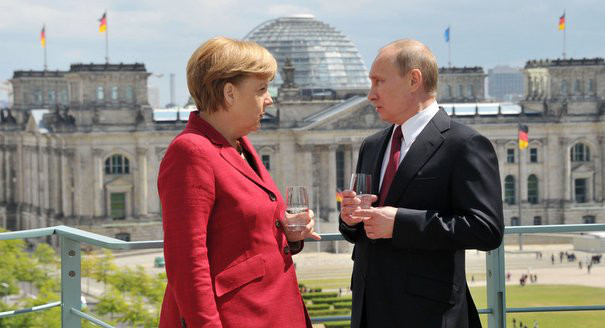
Chancellor Angela Merkel’s center-right coalition has found it difficult to deal with Russia under President Vladimir V. Putin. She dislikes him, which she has made plain during news conferences and a recent podium discussion in Moscow earlier this month.
At one point during the discussion hosted by the Petersburg Dialogue, Ms. Merkel spoke her mind. She clearly had had enough of Mr. Putin’s clampdown on the media and intimidation of editors that dare criticize his increasingly autocratic leadership style.‘‘If I were offended every time I was criticized, I wouldn’t last three days as chancellor,’’ Ms. Merkel said. That did not elicit any response.
Criticizing Mr. Putin’s Russia is one thing. Doing something about it is another. And that is Germany’s, and Europe’s problem.
Because Germany is Russia’s biggest trading partner and because Germany is the most important country in the E.U. by virtue of its size and economy, Berlin needs a security strategy. It would explain, among other things, Germany’s national interests, the role of its armed forces and the connection between interests and values. Yet Germany has no security strategy or doctrine.
This is very unsettling for Germany’s E.U. partners and NATO allies. Neither organization knows where they stand with Germany over basic questions such as strategy, say diplomats. A security strategy would also make clear to Russia where Germany would draw the line.
Thomas de Maizière, Germany’s defense minister, who was Ms. Merkel’s chief of staff from 2005 to 2009, may now try to fill this vacuum.
In a lengthy guest column last week in the daily Frankfurter Rundschau, Mr. de Maizière said it was high time that Germany had a debate about international security and about the role of the Bundeswehr, Germany’s armed forces, in international missions.
‘‘As defense minister I ask myself why we don’t discuss German defense and security policy in schools, universities, churches or any other public forums.’’
It is not certain he will take this further in the coming months as the countdown to the German federal elections begin in earnest. It means that Europe — and Russia — will have to wait until after September 2013 for Berlin to come up a security doctrine, if indeed it will even do that.

Nonresident Senior Fellow, Carnegie Europe
Judy Dempsey is a nonresident senior fellow at Carnegie Europe
Recent Work
Judy Dempsey
Judy Dempsey
Carnegie does not take institutional positions on public policy issues; the views represented herein are those of the author(s) and do not necessarily reflect the views of Carnegie, its staff, or its trustees.

But their "principal to principal" model will only be as effective as the political strength of each leader back home.

Damien Ma

U.S. unpredictability has allowed China to capitalize on its positioning as the “responsible great power”. Paradoxically, the more China wins the perception game, the more likely expectations will rise for Beijing to deliver not just words but to demonstrate with its deeds.

Chong Ja Ian

Hanoi and Beijing have long treated each other as distant cousins rather than comrades in arms. That might be changing as both sides draw closer to hedge against uncertainty and America’s erratic behavior.

Nguyễn Khắc Giang

Across Asia, China is better positioned to withstand energy shocks from the fallout of the Iran war. Its abundant coal capacity can ensure stability in the near term. Yet at the same time, the country’s energy transition away from coal will make it even less vulnerable during the next shock.
Damien Ma

Malaysia’s chairmanship sought to fend off short-term challenges while laying the groundwork for minimizing ASEAN’s longer-term exposure to external stresses.

Elina Noor