

Article
C. Raja Mohan, Darshana M. Baruah
{
  "authors": [
    "C. Raja Mohan"
  ],
  "type": "legacyinthemedia",
  "centerAffiliationAll": "dc",
  "centers": [
    "Carnegie Endowment for International Peace",
    "Carnegie China",
    "Carnegie India"
  ],
  "collections": [],
  "englishNewsletterAll": "ctw",
  "nonEnglishNewsletterAll": "",
  "primaryCenter": "Carnegie India",
  "programAffiliation": "SAP",
  "programs": [
    "South Asia"
  ],
  "projects": [],
  "regions": [
    "North America",
    "United States",
    "Middle East",
    "South Asia",
    "India"
  ],
  "topics": [
    "Security",
    "Military",
    "Foreign Policy"
  ]
}
Source: Getty
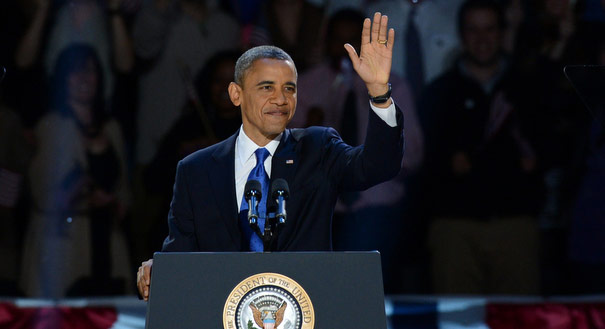
President Obama's second term will likely see America being more selective about where it becomes involved abroad.
Source: Indian Express

The other concerns of the president are gay rights, gun control and immigration reform. The message from Obama is quite clear. Under his watch, America will try and scale down foreign policy adventures and concentrate on nation-building at home.
One particular issue he highlighted was climate change. Obama presented it as a domestic challenge rather than a foreign policy one. "The path towards sustainable energy sources will be long and sometimes difficult," Obama said. "But America cannot resist this transition; we must lead it," he insisted. "We cannot cede to other nations the technology that will power new jobs and new industries; we must claim its promise."Obama's emphasis on the domestic does not mean Yankee is going home. America will carefully select its areas of engagement. Obama declared that "America will remain the anchor of strong alliances in every corner of the globe, and we will renew those institutions that extend our capacity to manage crises abroad."
Obama is emphasising the enduring relevance of the North Atlantic Treaty Organisation and the continuation of America's pivot to Asia that the president had launched in his first term to cope with an assertive China.
The liberal internationalists as well as neo-conservatives, obsessed as they are with the Middle East, would have loved to hear the president's commitment to support the Arab spring, revive the peace process between Israelis and Palestinians, intervene in Syria, confront Iran, and threaten al-Qaeda.
Obama did not take the bait. To be sure, there was a broad reference to America's support for democracy around the world: "We will support democracy from Asia to Africa, from the Americas to the Middle East, because our interests and our conscience compel us to act on behalf of those who long for freedom." This is pro-forma rhetoric from Obama and very different from the clarion call for democracy promotion issued by his predecessor George W. Bush eight years ago at his second inaugural.
Despite the seeming resurgence of al-Qaeda in north Africa, Obama was not willing to sound the drums of the great war on terror. While affirming that the US will remain "vigilant against those who would do us harm," Obama declared that "enduring security and lasting peace do not require perpetual war".
On Iran, Obama signalled conciliation rather than confrontation: "We will show the courage to try and resolve our differences with other nations peacefully not because we are naive about the dangers we face but because engagement can more durably lift suspicion and fear."
Obama had begun his first term by reaching out to Iran, but without much success. In explicitly rejecting the call to use force against Iran now, Obama is suggesting he might be ready to explore again the prospects for a deal with Tehran.
In his speech, Obama offered effusive praise to American armed forces: "Our brave men and women in uniform tempered by the flames of battle are unmatched in skill and courage." While acknowledging their sacrifices in securing America, Obama underlined the importance of diplomacy. "We are also heirs to those who won the peace, and not just the war. Who turn sworn enemies into the surest of friends. And we must carry those lessons into this time as well."
Obama, who has had major differences with the leadership of the armed forces in defining the Afghan strategy over the last four years, is drawing a new line. After a decade of exhausting wars, he will turn to diplomacy to promote reconciliation with adversaries.
As Obama downsizes the US military presence in Afghanistan, seeks negotiations with the Taliban and wants Rawalpindi's support to facilitate the exit, there is no giving up on drone attacks against Pakistan. That is part of Obama's new political realism.
Former Nonresident Senior Fellow, Carnegie India
A leading analyst of India’s foreign policy, Mohan is also an expert on South Asian security, great-power relations in Asia, and arms control.
Recent Work

C. Raja Mohan, Darshana M. Baruah


Alexander Gabuev, Paul Haenle, C. Raja Mohan, …
Carnegie does not take institutional positions on public policy issues; the views represented herein are those of the author(s) and do not necessarily reflect the views of Carnegie, its staff, or its trustees.

But their "principal to principal" model will only be as effective as the political strength of each leader back home.

Damien Ma

U.S. unpredictability has allowed China to capitalize on its positioning as the “responsible great power”. Paradoxically, the more China wins the perception game, the more likely expectations will rise for Beijing to deliver not just words but to demonstrate with its deeds.

Chong Ja Ian

Hanoi and Beijing have long treated each other as distant cousins rather than comrades in arms. That might be changing as both sides draw closer to hedge against uncertainty and America’s erratic behavior.

Nguyễn Khắc Giang

Across Asia, China is better positioned to withstand energy shocks from the fallout of the Iran war. Its abundant coal capacity can ensure stability in the near term. Yet at the same time, the country’s energy transition away from coal will make it even less vulnerable during the next shock.
Damien Ma

Malaysia’s chairmanship sought to fend off short-term challenges while laying the groundwork for minimizing ASEAN’s longer-term exposure to external stresses.

Elina Noor