

In The Media
John Judis
{
  "authors": [
    "John Judis"
  ],
  "type": "legacyinthemedia",
  "centerAffiliationAll": "",
  "centers": [
    "Carnegie Endowment for International Peace",
    "Malcolm H. Kerr Carnegie Middle East Center"
  ],
  "collections": [
    "Arab Awakening"
  ],
  "englishNewsletterAll": "",
  "nonEnglishNewsletterAll": "",
  "primaryCenter": "Carnegie Endowment for International Peace",
  "programAffiliation": "",
  "programs": [],
  "projects": [],
  "regions": [
    "North America",
    "United States",
    "North Africa",
    "Egypt"
  ],
  "topics": [
    "Political Reform",
    "Democracy",
    "Foreign Policy",
    "Global Governance"
  ]
}
Source: Getty
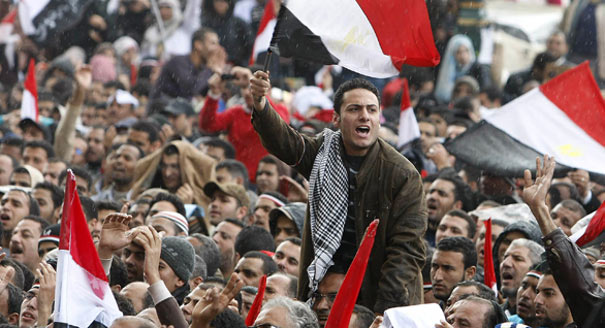
Voting could deepen existing divisions in Egypt if the United States pressures the country into elections before the Egyptians have healed the conflict within the country.
Source: New Republic
How should the United States respond to the Egyptian military’s ouster of elected President Mohamed Morsi? On one side, Senator John McCain, along with Robert Kagan and other foreign policy experts, is calling for cutting off all aid of Egypt until there is a “new constitution and a free and fair election.” On the other side, Senator Robert Menendez, the chairman of the Senate Foreign Relations, wants to use the threat of suspending military aid as “leverage” to persuade the military to effect “a transition to civilian rule as quickly as possible.” House Intelligence Committee chair Mike Rogers thinks the military, which is the prime beneficiary of American aid, should “continue to be rewarded” for encouraging stability in Egypt.
If you break down these arguments, there are two disagreements: One is over whether the United States should immediately suspend aid to Egypt—which for some includes American support for an International Monetary Fund loan; the other is over what America’s objective should be—encouraging “free and fair elections” or “civilian government” and stability? I find myself falling somewhere in between these alternatives. I would like to see the Obama administration suspend or loudly threaten to suspend aid to Egypt’s military, especially in the wake of the recent massacre of Morsi supporters. But I don’t think that the United States should condition the resumption of aid on Egypt holding a “free and fair election.” What it should seek instead is a government in which all the leading forces are represented and in which they can learn to work together.
Many American politicians and policy-makers see elections as a panacea—as not just a necessary, but a sufficient condition of a full-fledged democracy, as the ultimate unifying force in a country. That’s how many of our policy-makers envisaged elections in Iraq or Afghanistan. But as these instances demonstrated, elections can simply reinforce and deepen existing divisions within a country. They can make a country less governable. That could happen in Egypt if the United States, using its considerable clout, pressures the country into elections before the Egyptians have done anything to heal the divisions that are tearing the country apart.The key actor in Egyptian politics since 1952 has been the military. As Steven Cook of Council of Foreign Relations has argued, the military—first under Gamel Abdel Nasser, then Anwar Sadat, and then Hosni Mubarak—has ruled Egypt without directly governing it. Egypt’s ruling politicians have come out of the military and owe their position to it. And since the 1970s, the military has become a prime force in Egypt’s economy as well. As Cook writes, Egypt’s military is active in “everything from weapons production and procurement to the manufacture of appliances and footwear, agriculture, food processing, and services related to aviation, security, engineering, land reclamation, and tourism.”
When the military’s power has been challenged, it has eventually moved against its opponents. In the late 1990s, Mubarak began to privatize state industries by selling them off to a circle of businessmen around his son Gamal, an investment banker who had no connection with the military and whom he was grooming to be his successor. That posed a threat to the military, and helped account for its willingness to avert its gaze from and then support the popular rebellion against Mubarak, which began in January 2011 in the wake of Tunisia’s revolution. When Mubarak fled a month later, the military, with the support of the demonstrators, took control of the country.
The military promised a transition, but only acceded to elections after a resumption of popular protests. It barred some of the most popular candidates from running, and adopted a constitutional rule that drastically reduced the power of the president. But after Morsi, the Muslim Brotherhood’s candidate, was elected president in June 2012, he rejected the military’s attempt to limit his power. He also removed the upper levels of the Supreme Council of the Armed Forces and appointed Colonel General Abdel Fattah al-Sisi, whom he thought he could control, as the new Minister of Defense.
In November, Morsi went even farther, removing any judicial oversight of his decisions, and granting himself legislative as well as executive power. That sparked the wave of popular protests. If the military had strongly opposed these protests, and stood behind Morsi, they might well have fizzled, just as a year before, the protests against Mubarak might have lost momentum, but the military used the threat to order opposed by the protests to oust Morsi and reclaim control over the government. Egypt now has another transitional government controlled by the military.
There is a temptation, to which I previously succumbed, to say that Egypt’s power structure remains the same today as it did when Nasser and the Free Officers seized power in 1952. But it has changed. The January protests brought to the fore a new center of political power in Egypt. It is politically liberal and secular (in advocating a separation of church and state); it is largely urban and includes many of Egypt’s college-education unemployed or under-employed. Its main organizations are Tamarod, which sponsored the anti-Morsi rally and former UN inspector Mohammed el-Baradei’s National Salvation Front. But it lacks a compelling leadership and central organization.
The protests and the fall of Mubarak also allowed Egypt’s Islamist movements, led by the Muslim Brotherhood, but also including the Salafist Al-Nour Party, to surface and contest for political power. These Islamist groups have already proven adept at organizing for elections, but their years underground and their sectarian orientation left them unable to govern a diverse nation. These two centers of political power—liberal and Islamist—have provided a counterweight to the military that didn’t exist before. They haven’t created a revolution—the military remains predominant—but they have created the potential for upending the old power structure. They have also created the potential for political chaos.
The trouble with Egypt right now is that neither of these alternative centers of power is capable of governing on its own—or to put it another way, working with each other. They are not polarized along class lines like, say, the Tories and Labour parties in Great Britain, but along sectarian lines. That is largely the result of the Islamist parties, which unlike their counterparts in Tunisia are not ready to govern in a coalition with non-religious parties, but it is also due to the intransigence of the liberal forces, which was displayed in the debate over the Constitution, which eschewed extreme forms of Islamism. As long as the parties are polarized along the lines of religion, elections will simply reinforce divisions in the country. That was clearly the result last year of the Egyptian elections.
Short of elections, the only hope of getting these two forces to work together is a superior third party that can force them to do so. In Egypt, that would be the military, but in the current crisis, the military appears more bent on exacerbating than removing divisions. It seems intent on recreating the conditions of 1952—on holding rather than sharing power. If it continues on what seems like its current course, it could turn Egypt into Pakistan. The United States may not be able to do anything to stop this. It’s one thing to tip the scales in a way and another to meddle in a country’s politics. But what it might try to do is use its leverage to persuade the military to play a genuine mediating role in the crisis. That would mean some form of coalition government that would include all three centers of power. In the short run, that could lead to stability—which is essential, among other things, to Egypt’s economic recovery—but in the long run, it could lay the basis for democracy and “free and fair elections.”
This article was originally published by New Republic.

Former Visiting Scholar
As a visiting scholar at Carnegie, Judis wrote The Folly of Empire: What George W. Bush Could Learn from Theodore Roosevelt and Woodrow Wilson.
Recent Work
John Judis
John Judis
Carnegie does not take institutional positions on public policy issues; the views represented herein are those of the author(s) and do not necessarily reflect the views of Carnegie, its staff, or its trustees.

But their "principal to principal" model will only be as effective as the political strength of each leader back home.

Damien Ma

U.S. unpredictability has allowed China to capitalize on its positioning as the “responsible great power”. Paradoxically, the more China wins the perception game, the more likely expectations will rise for Beijing to deliver not just words but to demonstrate with its deeds.

Chong Ja Ian

Hanoi and Beijing have long treated each other as distant cousins rather than comrades in arms. That might be changing as both sides draw closer to hedge against uncertainty and America’s erratic behavior.

Nguyễn Khắc Giang

Across Asia, China is better positioned to withstand energy shocks from the fallout of the Iran war. Its abundant coal capacity can ensure stability in the near term. Yet at the same time, the country’s energy transition away from coal will make it even less vulnerable during the next shock.
Damien Ma

Malaysia’s chairmanship sought to fend off short-term challenges while laying the groundwork for minimizing ASEAN’s longer-term exposure to external stresses.

Elina Noor