

In The Media
Lilia Shevtsova
{
  "authors": [
    "Lilia Shevtsova"
  ],
  "type": "commentary",
  "centerAffiliationAll": "",
  "centers": [
    "Carnegie Endowment for International Peace",
    "Carnegie Russia Eurasia Center"
  ],
  "collections": [],
  "englishNewsletterAll": "",
  "nonEnglishNewsletterAll": "",
  "primaryCenter": "Carnegie Russia Eurasia Center",
  "programAffiliation": "",
  "programs": [],
  "projects": [],
  "regions": [
    "Caucasus",
    "Azerbaijan",
    "Armenia",
    "Georgia"
  ],
  "topics": []
}
Source: Getty
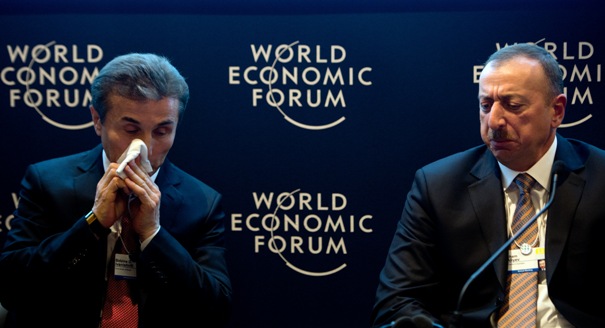
The October elections in Azerbaijan and Georgia seem to mean different things for those two countries. In Azerbaijan, there is a continuity of Aliev rule that is moving toward sultanism. In Georgia, one could observe the end of one epoch and the beginning of another.
Does the South Caucasus have a chance? I mean a chance for a real, not fake independence and an open society? This is a natural question when one starts to deliberate on the forthcoming presidential elections in Azerbaijan (October 9) and Georgia (October 27). The Armenia case does not give much ground for optimism. Armenians went through their presidential elections in February, demonstrating how electoral authoritarianism works, with its key axiom being “uncertain rules of the game and a certain outcome.” The incumbent Serzh Sargsyan was the winner—who would have doubted! Several presidential candidates withdrew, one was shot, and the 60 percent turn-out resembled the Soviet times. Armenia also proved to be a litmus test indicating the extent of freedom for maneuver that the South Caucasus has. Yerevan was immediately punished for its attempt to court the EU: Moscow showed its displeasure by providing a $4 billion arms supply to Azerbaijan.
Could the October presidential elections in Azerbaijan and Georgia change the pattern? These elections seem to mean different things for those two countries. In the first case, there is a continuity of Ilham Aliev rule that is moving toward sultanism. No need to discuss the outcome of the forthcoming Azeri elections which is already known. One could only debate how repressive the same sultan will be during his new tenure.
In Georgia, one could observe the end of one epoch and the beginning of another. The era of Saakashvili’s modernization “from the top” and an open pro-Western vector is definitely over. Its greatest legacy was a peaceful transfer of power. But there is no guarantee that this legacy will become a new tradition in Georgia. The current balance of forces and even more importantly, the changes in the Georgian constitution orchestrated by the current ruling team—that give key political resources to the prime minister and the government—create a new power monopoly which could acquire taste for reproducing itself indefinitely. In any case, one could safely bet that the representative of the ruling Georgian Dream party Giorgi Margvelashvili will get the presidential job, that has become more of a decoration. The real power will remain with Bidzina Ivanishvili. Will he fulfill his promise to leave politics as soon as Saakashvili moves out of his presidential palace? I would not bet on that. Anyway, Georgian politics is hardly moving toward an open society paradigm.
Could Tbilisi and Baku succeed with their foreign policy project—to have a cozy relationship with both Russia and the West? Recent history shows that some leaders of the new independent states were pretty successful in riding two horses in opposite directions. I have in mind Kuchma, the former leader of Ukraine, Shevardnadze of Georgia, and Aliev father. Alas, the times of duality and uncertain loyalty are gone. Firstly, because of the paralysis of the EU that has failed to give energy to its Eastern Partnership, and the failure of the Obama America to lead the West. Secondly, because the Putin’s Kremlin has endorsed a new foreign policy strategy—“those who are not with us are against us” and openly declared the goal of building in the post-Soviet space a new galaxy, with Russia as its pole and satellites around.
Sadly, the South Caucasus remains the hostage of geography. This could be anticipated in times when civilization built on values is retrenching…
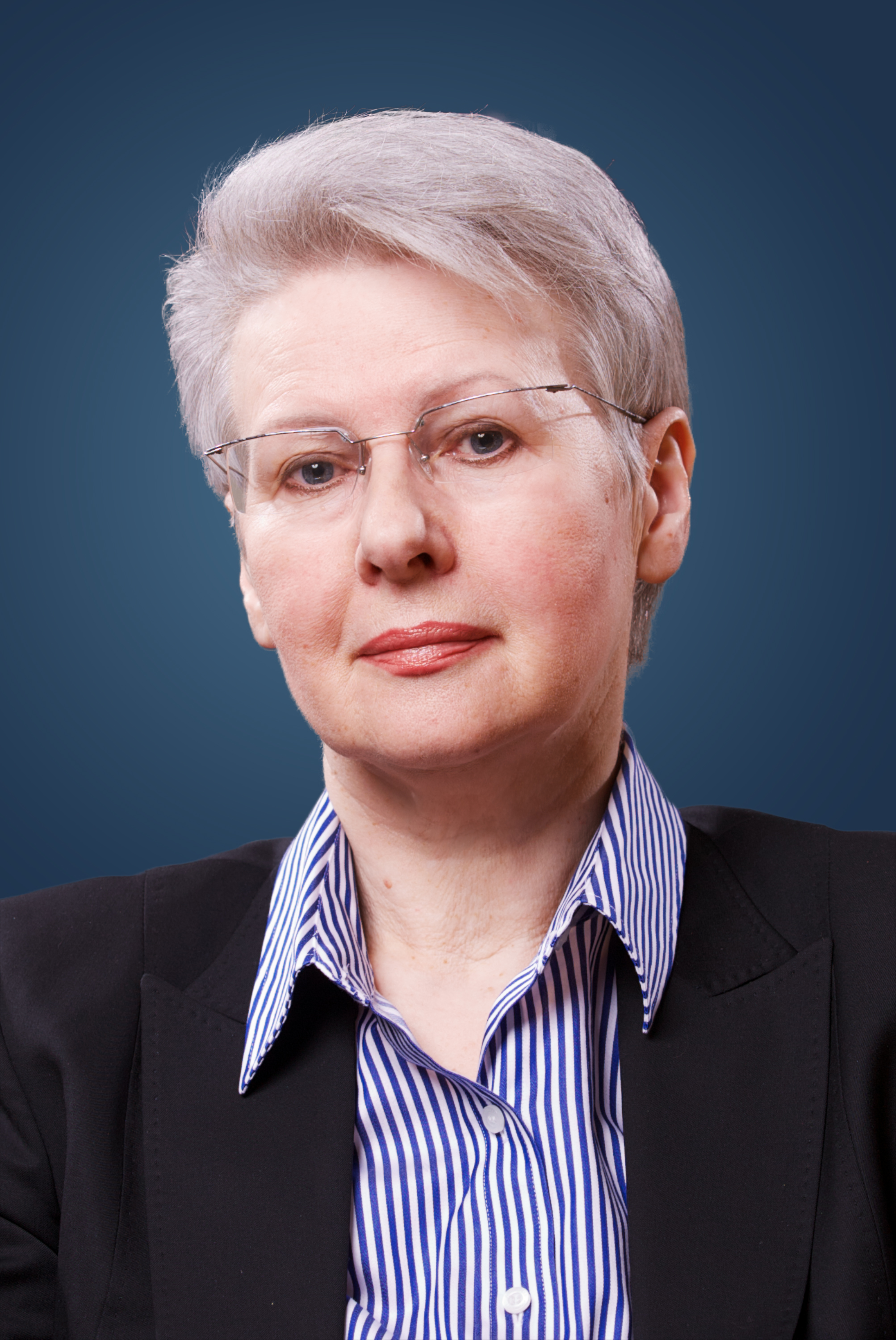
Former Senior Associate, Russian Domestic Politics and Political Institutions Program, Moscow Center
Shevtsova chaired the Russian Domestic Politics and Political Institutions Program at the Carnegie Moscow Center, dividing her time between Carnegie’s offices in Washington, DC, and Moscow. She had been with Carnegie since 1995.
Recent Work
Lilia Shevtsova
Lilia Shevtsova
Carnegie does not take institutional positions on public policy issues; the views represented herein are those of the author(s) and do not necessarily reflect the views of Carnegie, its staff, or its trustees.
It’s about managing oil prices, bread prices, and strategic partnerships.



Amr Hamzawy, Karim Sadjadpour, Aaron David Miller, …
As North Korea continues to stall talks with the United States and South Korea, there is a greater need for China to play a more assertive role to help break the impasse.

Tong Zhao
Pitched as a new Silk Road sweeping from Asia to Europe, China’s enormous Belt and Road Initiative is an ambitious, multinational infrastructure project. Experts from four Carnegie global centers explain other countries’ perspectives.


Paul Haenle, Dmitri Trenin, Alexander Gabuev, …
Despite the BRI’s prevalence in discussions of China’s global engagement, many experts are divided on how to interpret it. Is it a global strategy or just an interregional initiative? How can countries and international companies participate in its growth and development?
Feng Yujun, Alexander Gabuev, Paul Haenle, …
With the threat of nuclear war growing, China, Russia, and the United States should not wait until political relations improve before making efforts to manage new technologies.

James M. Acton, Tong Zhao, Li Bin