

Commentary
Dmitri Trenin
{
  "authors": [
    "Dmitri Trenin"
  ],
  "type": "legacyinthemedia",
  "centerAffiliationAll": "",
  "centers": [
    "Carnegie Endowment for International Peace",
    "Carnegie China",
    "Carnegie Russia Eurasia Center"
  ],
  "collections": [
    "China’s Foreign Relations"
  ],
  "englishNewsletterAll": "",
  "nonEnglishNewsletterAll": "",
  "primaryCenter": "Carnegie Endowment for International Peace",
  "programAffiliation": "",
  "programs": [],
  "projects": [],
  "regions": [
    "East Asia",
    "China",
    "Russia",
    "Caucasus"
  ],
  "topics": [
    "Climate Change",
    "Foreign Policy",
    "Arms Control"
  ]
}
Source: Getty
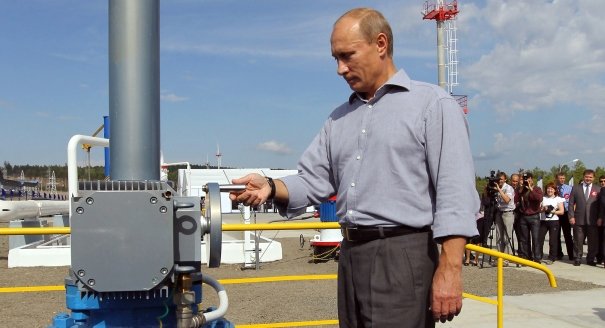
The Chinese-Russian energy alliance is a product of growing bilateral relations, but it also reflects developments in the global energy market and in non-energy geopolitics.
Source: China Daily
Dmitri Medvedev's first visit to China as Russia's prime minister will further cement Beijing-Moscow energy relationship. This alliance rests on a simple formula: substantial Chinese credits for long-term Russian energy supplies. Thus, cash-rich China buys a measure of energy security, and Russia gets much-needed cash for its budget. In the current geopolitical setting, however, this essentially pragmatic relationship acquires features of an energy alliance.
Since 2009, China has been Russia's biggest trading partner. The two-way trade, which stood at $88 billion last year, is finely balanced between exports and imports. There is a huge imbalance, however, as far as the trade structure is concerned. About 90 percent of Russian exports are hydrocarbons; machinery accounts for less than 1 percent. Despite the Russian government's professed desire to diversify the country's exports, the energy element has only grown in the past few years. Russia has become one of China's energy bases.
Russia's advantage as an energy source, in Chinese eyes, is that its supplies cross into China over land, and directly. Unlike sea routes, they are essentially protected from third-country interference. Pipelines also tie Russia to the Chinese market, and give Beijing leverage in case of a dispute.The fact that China has other similar continental sources besides Russia, such as Myanmar and Central Asia, further increases Beijing's power. China these days is very much a buyers' market.
Russian-Chinese energy deals are complex. Beijing places a big order with Moscow and expects to get a discount. This has worked for oil, with Rosneft concluding a series of agreements with China National Petroleum Corporation, and now also with China Petroleum and Chemical Corporation (or Sinopec) - in an attempt at in-country diversification of partners. It has not yet worked for gas. And although a final agreement on the gas price is expected before the end of this year, it has been "imminent" since mid-2011.
Also, China has been able to engage Russia's largest private gas producer, Novatek, in a long-term deal. The deal, concluded last June, marks a new milestone. Russia, until recently reluctant to allow China's State-owned companies direct access to its energy resources, has softened its stance. Thanks to the Novatek deal, CNPC will now have a direct stake in a gas field on the Yamal Peninsula.
The deal struck in Beijing with Rosneft promises even more: joint exploration and exploitation of oil and gas reserves in eastern Siberia. Such agreements effectively turn the Chinese-Russian energy trade into an energy alliance.
The alliance is a product of growing bilateral relations, but it also reflects developments in the global energy market. The shale gas revolution in the United States has caused serious changes in international energy flows. Europe's energy diversification policies have resulted in Russian natural gas giant Gazprom's share of the European Union market diminishing. China, which Gazprom until recently didn't regard as a potential market but as leverage against Europe, is being considered more seriously - even if the Russians will have to give their Chinese partners some discount on price.
Non-energy geopolitics also plays a role. Since being elected Russia's president in 2012, Vladimir Putin has focused on Eurasian integration. The latest iteration of his "Greater Europe" idea foresees a binary relationship between the EU and a Moscow-led "Eurasian Union", not, as a decade before, Russia's growing integration with the EU.
Putin has also focused on the Russian Far East and Siberia, and has been experimenting with different bureaucratic models to launch its development. Through the Far East, Putin is looking for an opening to Asia and the Pacific, which, because of its dynamism, he regards as more important than Europe.
In this context, China is Russia's key partner. It is also an ally in implementing Putin's vision of a world order based on big-power consensus, without an obvious hegemony. Putin, however, has made it clear that he sees Russia as nobody's junior partner. This overtly applies to the US. It also applies, if less overtly, to China.
Even though the balance of national might in the past 30 years has been inexorably moving in Beijing's favor, Moscow will only accept co-equality in the relationship. Co-equal relations between unequal powers - such is the formula behind Moscow's policies toward partners which are bigger powers than Russia: the US, China, and (in economic terms) Europe. It is easier said than done, as the Russian-Chinese energy alliance illustrates, but Putin will persevere.
Former Director, Carnegie Moscow Center
Trenin was director of the Carnegie Moscow Center from 2008 to early 2022.
Recent Work
Dmitri Trenin
Dmitri Trenin
Carnegie does not take institutional positions on public policy issues; the views represented herein are those of the author(s) and do not necessarily reflect the views of Carnegie, its staff, or its trustees.

The Plaza Accord was not an externally imposed punishment of Japan but part of a broader restructuring that Japanese economists and policymakers themselves recognized was necessary. Its effects were undermined, however, when Tokyo responded to the resulting slowdown with policies that exacerbated investment, credit expansion, and the very imbalances the adjustment was intended to resolve.

Michael Pettis

The nuclear relationship between China and the United States is increasingly shaped by widening perception gaps rather than deliberate strategic design.

Tong Zhao
China’s banking crisis in the 2000s was resolved by transferring the costs to households through financial repression—a decision that recapitalized the banks while exacerbating the structural imbalances that continue to shape the Chinese economy today.
Michael Pettis

Chinese biotech companies have been on the receiving end of U.S. economic coercion. Yet their responses have differed significantly because firm and state interests are not uniformly aligned. For Washington, treating all Chinese tech firms the same, irrespective of their actual interests, risks pushing them farther into Beijing’s corner.

Xue Gong
China’s latest energy plan explicitly calls for integrating data centers into the electricity system, particularly connecting them to green energy. It appears Beijing wants to use compute as a source of domestic demand to absorb renewables excess capacity.

Damien Ma