

In The Media
John Judis
{
  "authors": [
    "John Judis"
  ],
  "type": "legacyinthemedia",
  "centerAffiliationAll": "dc",
  "centers": [
    "Carnegie Endowment for International Peace",
    "Malcolm H. Kerr Carnegie Middle East Center"
  ],
  "collections": [
    "Iranian Proliferation"
  ],
  "englishNewsletterAll": "menaTransitions",
  "nonEnglishNewsletterAll": "",
  "primaryCenter": "Carnegie Endowment for International Peace",
  "programAffiliation": "MEP",
  "programs": [
    "Middle East"
  ],
  "projects": [],
  "regions": [
    "Middle East",
    "Iran",
    "Israel",
    "Levant"
  ],
  "topics": [
    "Political Reform",
    "Security",
    "Nuclear Policy",
    "Arms Control",
    "Foreign Policy"
  ]
}
Source: Getty
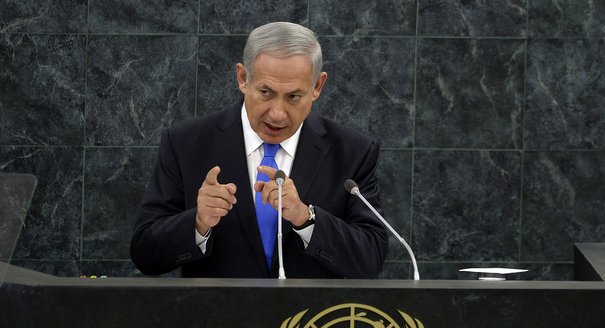
Netanyahu’s speech to the UN General Assembly was inflammatory, deeply one-sided, and hyperbolic in its assessment of Iran’s recent history.
Source: New Republic
Iran’s new President Hassan Rouhani has revived talks with the five permanent members of the United Nations Security Council and Germany over its nuclear program. "Nuclear weapons and other weapons of mass destruction,” Rouhani said in his September 24 speech to the UN General Assembly, "have no place in Iran's security and defense doctrine, and contradict our fundamental religious and ethical convictions.” In his address today to the General Assembly, Israel’s Prime Minister Benjamin Netanyahu denounced Rouhani as a “wolf in sheep’s clothing” and threatened to go to war to prevent Iran from developing nuclear weapons.
Over the next year, Netanyahu could be proven correct in his apocalyptical assessment of Rouhani and the Iranians. But his speech was inflammatory, deeply one-sided, and hyperbolic in its assessment of Iran’s recent history. If there is a genuine chance for fruitful negotiations between the G5+1 and Iran over Iran’s nuclear program—and President Obama clearly thinks there is—then Netanyahu’s bellicose rhetoric probably made success less likely by giving credence to the fears of Iran’s hardliners. In its tenor, Netanyahu’s denunciation of Iran and its new president echoed former Iranian President Mahmoud Ahmadinejad’s denunciation of the United States and Israel before the UN in September 2011.Here is the substance of Netanyahu’s argument. According to the Israeli Prime Minister, Iran’s presidents since 1979 “have come and gone. Some presidents were considered moderates, others hard-liners. But they’ve all served that same forgiving creed” of “death of the Jews.” “The only waves that Iran has generated over the last 30 years are waves of violence and terrorism.” Iran’s is a “fanatic regime” that “pledges to wipe Israel off the map.” Iran “is developing nuclear weapons” and is using the promise of negotiations as a “ruse” to buy time just as North Korea did. “Iran wants to be in a position to rush forward to build nuclear bombs before the international community can detect it and much less prevent it.” In other words, Iran’s various regimes have all pursued the same objective, but done so under different outward guises. “Ahmadinejad was a wolf in wolf’s clothing. Rouhani is a wolf in sheep’s clothing, a wolf who thinks he can the pull the wool over the eyes of the international community.”
First, the overall history. Are there no distinctions to be made among Iran’s presidents and their policies? One need only look back at the presidency of Mohammad Khatami, who served from 1997 to 2005. Khatami was no angel—and neither is Netanyahu—but beginning in 1998, he made several overtures to the United States and cooperated with the Bush administration during the war in Afghanistan. The most important overture was in May 2003, when Khatami’s government sent a proposal to the United States through the Swiss ambassador. In exchange for the United States dropping sanctions and ceasing to support regime change in Iran, Khatami’s government offered to cut its support for Hamas, disarm Hezbollah in Lebanon, and allow intrusive inspections of its nuclear program. The Bush administration ignored the proposal.
And what about Rouhani then and now? Rouhani was Khatami’s nuclear negotiator in 2003, and after the failure of the May overture, Rouhani convinced Ayatollah Khamenei to suspend nuclear enrichment in hopes of reaching an agreement with the U.S. and European Union. When the talks broke down, Rouhani was ousted from the regime’s inner circles. Khatami and Rouhani’s failure to win a nuclear agreement with the United States was a reason for Khatami’s defeat in 2005 and his replacement by Ahmadinejad.
And what about the present? Netanyahu dismissed Rouhani’s current overtures as merely part of a “charm offensive.” But there were more than gestures involved. Upon taking office, Rouhani transferred authority over nuclear negotiations from the hardline Supreme National Security Council to the Foreign Ministry, which was run by Mohammad Javad Zarif, who, like Rouhani, worked with Khatami. Zarif was Khatami’s UN Ambassador and helped draft the May 2003 proposal to the United States. But gestures are also important. Think of how Ping-Pong diplomacy laid the basis for Richard Nixon’s opening to China. And there have been many significant gestures from Rouhani and Zarif, including a tweet from Rouhani's staff wishing Jews a happy Rosh Hoshana.
Netanyahu’s speech was also rife with questionable claims. He contended that Iran is developing intercontinental ballistic missiles “whose sole purpose is to deliver nuclear warheads.” And he warned that these missiles would be able to reach New York “in three or four years.” True? Greg Thielmann of the Arms Control Association wrote this July after Netanyahu aired similar claims on Meet the Press, "So far, Iran has never flight-tested a long-range ballistic missile—neither a 5,500 km range ICBM nor a 3,000-5,500 km range intermediate-range ballistic missile (IRBM). Moreover, in striking contrast to its active pursuit of short- and medium-range missiles, Iran has never declared or demonstrated an interest in developing longer-range systems. It would be appropriate to at least bring these facts into the discussion of when (or if) an Iranian ICBM threat might eventually appear."
Netanyahu’s speech was filled with head-scratching hypocrisy that must have amused those UN delegates that it didn’t enrage. Israel, of course, has nuclear weapons, which it developed secretly 50 years ago, but which it has never acknowledged possessing. And unlike Iran, it is not a signatory of the Nuclear Non-Proliferation Treaty. Yet there was Netanyahu denouncing Rouhani and the Iranians for “deceit and secrecy” in developing nuclear weapons.
Netanyahu threatened to attack Iran if it were to develop nuclear weapons. “Israel will never acquiesce to nuclear arms in the hands of a rogue regime that repeatedly promises to wipe us off the map,” Netanyahu stated. “Israel not allow Iran to get nuclear weapons.” Netanyahu failed to set a threshold for an Israeli attack, but his demands on Iran—including the end of a “residual capacity to enrich uranium”—probably go beyond what the United States and the other negotiators would be willing to agree to.
Obama’s approach to Rouhani has been much different from Netanyahu’s, and Netanyahu’s speech was implicitly a criticism of Obama, but the Obama administration must take some responsibility for Netanyahu’s fighting words. It didn’t inspire them, but over the last two years, it has done little to discourage them. And it may have already gotten itself into trouble by doing so.
Economic sanctions were very important, if not decisive, in getting Iran to offer to negotiate its nuclear ambitions in 2003 and again this fall. To be sure, the Bush administration’s penchant for invading Middle Eastern countries may have scared Iran, and American and Israeli threats of military action may be a factor now. But as the Obama administration should have learned from its Syria fiasco, these kind of “red line” threats have to done very carefully. If they work, and get the country to comply, that’s wonderful—and it would be far better for the world if Iran does not develop nuclear weapons. But if they don’t work, then the country that makes the threats is faced with a very difficult situation.
As Kenneth Pollack and others have argued, a military assault by the United States or by Israel on Iran’s nuclear facilities might not end the threat of a nuclear Iran, and could involve us in still another quagmire in the Middle East. And as the debate over the much more modest strike against Syria shows, the American people have no stomach for a war in the Middle East where the American interests are not clearly and directly at stake. In addition, there is a good argument to be made that even if Iran were to develop a nuclear weapon, it could be “contained” as the Soviet Union, China, and other nuclear powers have been. That’s not an argument for acquiescing to Iran acquiring a nuclear weapon, but for setting a limit on what can be done to prevent it from acquiring one.
I don’t know exactly why the Obama administration began threatening military action against Iran, but I fear that it was prompted by a desire to calm Netanyahu, who in 2011 was already threatening military action. The timing makes it appear that way. What’s worse is that Obama and Vice President Joe Biden have continued to voice this rhetoric. After his White House meeting with Netanyahu yesterday, Obama stated, “I've said before and I will repeat that we take no options off the table, including military options, in terms of making sure that we do not have nuclear weapons in Iran that would destabilize the region and potentially threaten the United States of America.” And speaking at the J Street conference, Biden repeated Netanyahu’s canard that Iran poses an “existential threat” to Israel. As Pollack writes in Unthinkable, "Iran's senior-most leaders -- particularly Khamenei -- have been careful to indicate only that they would retaliate for any Israeli attack, avoiding any indication that they want nuclear weapons to attack Israel. Ahmadinejad's stupid and disciplined comments are the exceptions that prove the rule." The Obama administration needs to back away from this kind of rhetoric and to distance itself from Netanyahu’s harangues against Rouhani and Iran. Obama needs to give peace a chance.
One final footnote to Netanyahu’s speech and American policy in the Middle East. In his United Nations speech, Obama said that the United States had two goals in the Middle East: reaching an agreement with Iran on its nuclear program and resolving the conflict between Israel and the Palestinians. Obama doesn’t need Netanyahu’s help in reaching an agreement with Iran—he may need Netanyahu to stop threatening war—but he does need Israel’s help in the negotiations with the Palestinians. Is Netanyahu ready to make a deal?
Those who wanted to hear Netanyahu’s opinions on this subject had to wait until the very end after he had finished his tirade against Rouhani. The speech itself was 3,138 words. Of these, Netanyahu devoted 53 words at the end to declaring his willingness to deal with the Palestinians. He devoted another 94 words to setting conditions that the Palestinians are not ready to accept. Is Netanyahu serious about making an “historic compromise” with Palestinians? Or could he be less serious about this than Rouhani is about making a deal on Iran’s nuclear program? Who is the deceiver here? Time will tell.

Former Visiting Scholar
As a visiting scholar at Carnegie, Judis wrote The Folly of Empire: What George W. Bush Could Learn from Theodore Roosevelt and Woodrow Wilson.
Recent Work
John Judis
John Judis
Carnegie does not take institutional positions on public policy issues; the views represented herein are those of the author(s) and do not necessarily reflect the views of Carnegie, its staff, or its trustees.

China’s political future will be shaped between now and next October. As the Communist Party enters its intense “campaign season” to prepare for a major political transition in 2027, reading Beijing's actions and responses may become more difficult as domestic politics weigh on its behavior more than usual.

Damien Ma

China has showcased its engineering prowess with small modular reactor demonstration projects. But turning these technological achievements into commercial success will be a greater challenge.

Tong Zhao

The nuclear relationship between China and the United States is increasingly shaped by widening perception gaps rather than deliberate strategic design.
Tong Zhao

But their "principal to principal" model will only be as effective as the political strength of each leader back home.
Damien Ma

U.S. unpredictability has allowed China to capitalize on its positioning as the “responsible great power”. Paradoxically, the more China wins the perception game, the more likely expectations will rise for Beijing to deliver not just words but to demonstrate with its deeds.

Chong Ja Ian