

Commentary
Alexey Malashenko
{
  "authors": [
    "Alexey Malashenko"
  ],
  "type": "commentary",
  "centerAffiliationAll": "",
  "centers": [
    "Carnegie Endowment for International Peace",
    "Carnegie Russia Eurasia Center"
  ],
  "collections": [],
  "englishNewsletterAll": "",
  "nonEnglishNewsletterAll": "",
  "primaryCenter": "Carnegie Russia Eurasia Center",
  "programAffiliation": "",
  "programs": [],
  "projects": [
    "Eurasia in Transition"
  ],
  "regions": [
    "North America",
    "United States",
    "Middle East",
    "Iran",
    "South Asia",
    "India",
    "Afghanistan",
    "Pakistan",
    "East Asia",
    "China",
    "Central Asia",
    "Tajikistan",
    "Uzbekistan",
    "Russia"
  ],
  "topics": [
    "Political Reform",
    "Security",
    "Military",
    "Foreign Policy"
  ]
}
Source: Getty
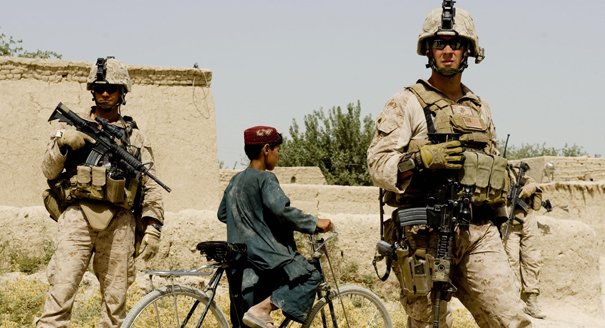
The U.S. withdrawal from Afghanistan in 2014 equates with an unquestionable strengthening of the Taliban movement or even with its actual coming to power. The external actors will have to adjust to the new situation and the future Afghan coalition leadership which will include the Taliban.
The issue of how the withdrawal of the U.S. troops from Afghanistan will affect this country’s neighbors is generally discussed with “fear and trembling.” Something horrible is commonly expected to happen—something that is going to bring even greater instability to the country, the region, and the Muslim community, as well as the world at large.
But what can actually happen that will be so unexpected and horrible?
Let us first try to envision who will rule Afghanistan after the “fateful” 2014? On the one hand, the upcoming presidential elections will not provide a definitive answer to this question, at least insofar as, according to varying estimates, from 40 to 60 percent of the Afghan territory is controlled by the Taliban. I even heard 80 percent mentioned at a conference in Herat this October. The elections in these areas can be described as nominal. The above numbers are not likely to change after these elections. Thus, having been left alone to face the Taliban, any elected president will have to strike some sort of a deal with the Taliban, or more specifically with its pragmatic segment. As a result, a new government coalition will come into existence in Afghanistan. The alternatives are either the total destruction of the Taliban by the Afghan National Army, which is impossible, or Taliban coming to power alone, which is unlikely. If the latter happens however, this will render the entire American mission to install order in Afghanistan effectively meaningless.
I am not going to discuss the possible scenarios of Afghanistan’s internal development. But any forces that will come to power in Afghanistan will first and foremost be concerned with domestic issues, primarily with the issue of strengthening national statehood. As paradoxical as it may sound, it appears that under any regime that may install in Afghanistan, the consequences for the states directly or indirectly involved in the Afghan conflict will be similar.
It is lamentable for the United States and its prestige that it has to withdraw from Afghanistan without securing an unconditional victory or leaving behind a stable—not necessarily democratic—regime capable of governing the country. Americans have not fully accomplished their mission, if at all.
On the other hand, Moscow will win under any regime after the coalition troops leave. First, the American departure is a clear indication of the weakness of the United States and its inability to act as the main center of power. Second, the instability in Afghanistan once again underscores the importance of Russia’s military and political presence in Central Asia as a guarantor of stability. The unpredictable situation at the Central Asian region’s southern borders and the threat—whether real or imaginary—that comes from the region helps Russia’s integration projects; in this case, it strengthens the Collective Security Treaty Organization (CSTO).
The American troop withdrawal also benefits the Central Asian authoritarian regimes. First, they become more valuable to Washington as partners in its struggle against radical Islam and terrorism. Second, the instability in Afghanistan remains a convenient pretext for these regimes to prove their significance in maintaining internal stability in their countries. Thus they will portray any political system in Afghanistan as a security threat.
The influx of refugees from Afghanistan, which may result from the heightened interethnic tensions during the power redistribution within the new Afghan government, may create a problem for Tajikistan and, to a lesser extent, for Uzbekistan.
Iran, which makes no secret of its skepticism with regard to the current Afghan politicians—both the Karzai supporters and his Taliban opponents—will focus on protecting the lives and interests of the Hazara people. Depending on how the U.S.-Iran relations will develop, the American withdrawal from Afghanistan may be interpreted either as the “collapse of American imperialism” or as quite a reasonable move by Washington. It is possible that under President Rouhani, the Afghan problem will prompt the U.S.-Iran interaction, which apparently both sides are ready for now.
Pakistan will find itself in a difficult position after 2014. It is going to bear greater responsibility for the situation in Afghanistan and will most probably be influencing the processes within the ruling coalition in Kabul. Pakistan will, thus, find itself between the Taliban’s rock and the post-Karzai’s hard place and will have to resort to complicated political maneuvering.
As for India, its policies are unlikely to seriously change, although it has been a player on the Afghan political field for quite a while already. Its position, then, will remain passive as it has been before. New Delhi will continue to focus on humanitarian projects. The “Talibanization” of power in Afhanistan may restrain India’s active participation, and this will strengthen Pakistan’s positions.
China’s policies vis-à-vis Afghanistan are also unlikely to undergo cardinal changes. Just as it has been doing, Beijing will continue to quietly increase its economic penetration into Afghanistan while staying away from local political intrigues. No regime in Kabul will want to create obstacles for this; quite to the contrary, it will welcome the cooperation with China.
The political community worldwide generally de facto equates the American withdrawal from Afghanistan is with an unquestionable strengthening of the Taliban movement or even with its actual coming to power. The situation inside the country is not likely to change significantly, although some escalation of tensions is inevitable in the first few months. The external actors will have to adjust to the new situation and the coalition leadership. For its part, the external support and assistance will be required from a whole host of different states.
The Soviet and American experiences in Afghanistan have demonstrated that military intervention leads nowhere. Every party involved in Afghan affairs will have to operate under a presumption that external influence on the country’s internal situation will be more limited. The external actors will have to deal with the forces that command greatest authority in Afghan society, and the Taliban is one of them.

Former Scholar in Residence, Religion, Society, and Security Program
Malashenko is a former chair of the Carnegie Moscow Center’s Religion, Society, and Security Program.
Recent Work
Alexey Malashenko
Alexey Malashenko
Carnegie does not take institutional positions on public policy issues; the views represented herein are those of the author(s) and do not necessarily reflect the views of Carnegie, its staff, or its trustees.

But their "principal to principal" model will only be as effective as the political strength of each leader back home.

Damien Ma

U.S. unpredictability has allowed China to capitalize on its positioning as the “responsible great power”. Paradoxically, the more China wins the perception game, the more likely expectations will rise for Beijing to deliver not just words but to demonstrate with its deeds.

Chong Ja Ian

Hanoi and Beijing have long treated each other as distant cousins rather than comrades in arms. That might be changing as both sides draw closer to hedge against uncertainty and America’s erratic behavior.

Nguyễn Khắc Giang

Across Asia, China is better positioned to withstand energy shocks from the fallout of the Iran war. Its abundant coal capacity can ensure stability in the near term. Yet at the same time, the country’s energy transition away from coal will make it even less vulnerable during the next shock.
Damien Ma

In the latest Five-Year Plan, the Chinese president cements the shift to an innovation-driven economy over a consumption-driven one.
Damien Ma