

Research
- +10
Rosa Balfour, Frances Z. Brown, Yasmine Farouk, …
{
  "authors": [
    "Moisés Naím"
  ],
  "type": "legacyinthemedia",
  "centerAffiliationAll": "",
  "centers": [
    "Carnegie Endowment for International Peace",
    "Malcolm H. Kerr Carnegie Middle East Center"
  ],
  "collections": [
    "Iranian Proliferation"
  ],
  "englishNewsletterAll": "",
  "nonEnglishNewsletterAll": "",
  "primaryCenter": "Carnegie Endowment for International Peace",
  "programAffiliation": "",
  "programs": [],
  "projects": [],
  "regions": [
    "North America",
    "United States",
    "Middle East",
    "Iran"
  ],
  "topics": [
    "Security",
    "Nuclear Policy",
    "Arms Control"
  ]
}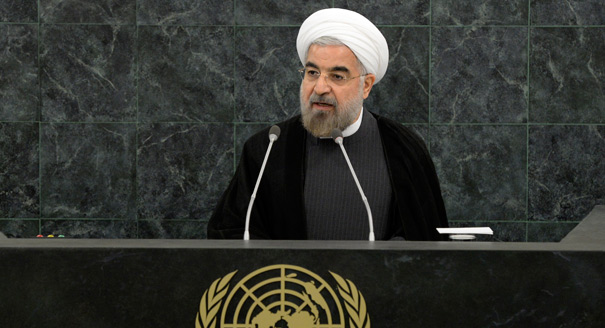
Source: Getty
The big strategic question is whether testing Iran’s intentions through negotiations is riskier than continuing to sanction and threaten to bomb it.
Source: Atlantic
Hassan Rouhani, Iran’s president, has more cabinet members with Ph.D. degrees from U.S. universities than Barack Obama does. In fact, Iran has more holders of American Ph.D.s in its presidential cabinet than France, Germany, Italy, Japan, Russia, or Spain—combined.
Take, for example, Rouhani’s chief of staff, Mohammad Nahavandian. He spent many years in the United States and has a Ph.D. in economics from George Washington University. Or Javad Zarif, the foreign affairs minister and chief negotiator in the recent nuclear deal between Iran and six global powers. He studied at the University of San Francisco and completed his doctorate at the University of Denver. For five years, he lived in New York and was Iran’s ambassador to the United Nations. Ali Akbar Salehi, head of Iran’s Atomic Energy Organization, has a Ph.D. in nuclear engineering from MIT. Mahmoud Vaezi, the communication minister, studied electrical engineering at Sacramento and San Jose State Universities and was enrolled in the Ph.D. program at Louisiana State University (he ultimately earned a doctorate in international relations at Warsaw University). Other cabinet members have advanced degrees from universities in Europe and Iran. Abbas Ahmad Akhoundi, the transportation minister, has a Ph.D. from the University of London, while President Rouhani got his from Glasgow Caledonian University in Scotland. The new government in Tehran, in other words, might well be one of the most technocratic in the world.Does this matter? On the surface, perhaps not much. We all know how often the governments of the “best and the brightest” disappoint. And it’s important to keep in mind that many of these highly credentialed cabinet members were also active participants in former Iranian administrations and backed policies that earned Iran’s theocracy its bad name.
And let’s not forget that it is Ali Khamenei, the supreme leader, who really reigns supreme. He can initiate or stop any initiative. There’s also Major General Qassem Suleimani, who offers a sober counterpoint to the scholarly crowd in the cabinet. Suleimani is a product of a rural town in Iran’s interior and acquired a vast education in the battlefields and the dark alleys of terrorist plots, rather than in classrooms. He is enormously respected by his allies, admirers, and staunchest enemies both in and outside Iran. For the past 15 years, he has commanded the Quds Force, a division of the Iranian Islamic Revolutionary Guard Corps that answers directly to the supreme leader. The group’s official mission is to export the Islamic revolution and take care of “extra-territorial operations.” Among other achievements, Suleimani is recognized for successfully turning Hezbollah into a feared military force, for organizing the armed resistance that killed thousands of American soldiers in Iraq, and for his effective support of the forces loyal to the Syrian government as they sought to regain ground lost to the armed insurgency. Former CIA officer John Maguire told New Yorker journalist Dexter Filkins that “Suleimani is the single most powerful operative in the Middle East today.”
Like that of all other countries, Iran’s foreign policy is the outcome of the complex interaction of multiple actors with differing backgrounds, ideologies, interests, and power. Who, then, is driving Tehran’s policy these days: the theocrats or the technocrats? The generals or the diplomats? These are the crucial questions that feed the intense speculation about Iran’s real intention in signing the Geneva accord on its nuclear program. Is this just one more trick by the Iranians to buy time for their continued race toward the bomb while also getting some relief from economic sanctions? Or is this really a momentous strategic change in the Iranian foreign policy of past decades? It is too soon to tell, and nobody can say for certain what will arise from this process. Nobody, except of course Israel, Saudi Arabia, and other neighboring countries in the Persian Gulf. Or members of the U.S. Congress who are keen to boost Iran sanctions while negotiations are ongoing. They’re all certain that the Geneva accord is a huge—indeed historic—mistake. Then there are the skeptics who, while wary and unsure of Iran’s intentions, know that the status quo is far more dangerous than seeking change, despite the risks involved.
The probability that the Geneva accord—called a “first step”—will derail because of the actions of extremists on both sides is high, and the deadline is only six months away. After that, there is the option of extending the talks for another six months in the hopes of attaining the big prize: permanent limits on and reliable verification of Iran’s nuclear program.
For critics, such a prize does not exist. They believe the hope that Rouhani and his team can fend off fundamentalists is naive, and that Iran is bent on getting nuclear weapons and continuing to use terror as a tool to mold the Middle East and eventually achieve its oft-stated aim of destroying the state of Israel. Tehran’s reformists have a similar worry: Will Barack Obama and his international allies be able to limit the bellicose positions of radicals in their midst?
For now, the answers are speculative. But the big strategic question is whether testing Iran’s intentions through negotiations is riskier than continuing to sanction and threaten to bomb it. As naive as assuming that everyone in the Iranian government is ready for a more peaceful integration of their country with the rest of the world is to assume that the status quo—the combination of stringent economic sanctions, sabotage, and the threat of military action—is sustainable and desirable. The latter strategy is as risky, if not more, as one of giving a controlled and cautious chance to Tehran’s doctors to change Iran’s dangerous and ruinous policies—and redefine the politics of the Middle East. They deserve that chance. Let’s hope they succeed.

Distinguished Fellow
Moisés Naím is a distinguished fellow at the Carnegie Endowment for International Peace, a best-selling author, and an internationally syndicated columnist.
Recent Work



Rosa Balfour, Frances Z. Brown, Yasmine Farouk, …
Moisés Naím
Carnegie does not take institutional positions on public policy issues; the views represented herein are those of the author(s) and do not necessarily reflect the views of Carnegie, its staff, or its trustees.

The nuclear relationship between China and the United States is increasingly shaped by widening perception gaps rather than deliberate strategic design.

Tong Zhao

But their "principal to principal" model will only be as effective as the political strength of each leader back home.

Damien Ma

U.S. unpredictability has allowed China to capitalize on its positioning as the “responsible great power”. Paradoxically, the more China wins the perception game, the more likely expectations will rise for Beijing to deliver not just words but to demonstrate with its deeds.

Chong Ja Ian

For Malaysia, the conjunction that works is “and” not “or” when it comes to the United States and China.

Elina Noor

Regulation, not embargo, allows Beijing to shape how other countries and firms adapt to its terms.
Alvin Camba