

In The Media
Shahram Chubin
{
  "authors": [
    "Shahram Chubin"
  ],
  "type": "legacyinthemedia",
  "centerAffiliationAll": "dc",
  "centers": [
    "Carnegie Endowment for International Peace"
  ],
  "collections": [],
  "englishNewsletterAll": "ctw",
  "nonEnglishNewsletterAll": "",
  "primaryCenter": "Carnegie Endowment for International Peace",
  "programAffiliation": "NPP",
  "programs": [
    "Nuclear Policy"
  ],
  "projects": [],
  "regions": [
    "Middle East",
    "Iran"
  ],
  "topics": [
    "Nuclear Policy",
    "Foreign Policy"
  ]
}
Source: Getty
Even if the interim deal with Iran is successfully extended into a comprehensive agreement during the next twelve months, Tehran’s conduct in the Middle East will remain largely unregulated.
Source: International Institute for Strategic Studies
Iran is often seen as an aspirant regional hegemon whose immediate aim is to weaken and eliminate America’s influence and presence in the Middle East. It is also depicted as a military threat whose power to intimidate its neighbours could be amplified by its nascent but ambitious nuclear programme. As the largest Shia state and the leader of the ‘Islamic resistance front’, the country is seen as a menace by Israel and many Sunni Arab nations.
The interim nuclear agreement concluded by Iran and the P5+1 states makes no reference to the country’s regional behaviour. Even if the deal is successfully extended into a comprehensive agreement during the next 12 months, Tehran’s conduct in the Middle East will remain largely unregulated. In the meantime, the Iranian leadership will continue to actively support its resistance-front ally Syria through the provision of arms, advice, trainers and money.As in Hizbullah’s war with Israel in 2006, Iran is carefully following the conflict on the ground in Syria for tactical insights and military lessons. Tehran has been emboldened by the West’s timidity and stepped up its assistance to Syrian President Bashar al-Assad. Support for the Assad regime has an obvious strategic rationale: preserving Iran’s link to the Levant and buoying its only Arab friend, besides Nuri al-Maliki’s Iraq. But it is also useful as a potential bargaining chip if Tehran decides to seek a ‘grand bargain’ with the West.
Iran’s influence in Syria comes not from its military strength but from its flexibility and adaptability. Tehran has domestic experience in putting down popular discontent and identifying dissident ring leaders. Its Quds Force has also supervised allies’ use of simple technology, such as improvised explosive devices, to offset opponents’ superior forces and technology.
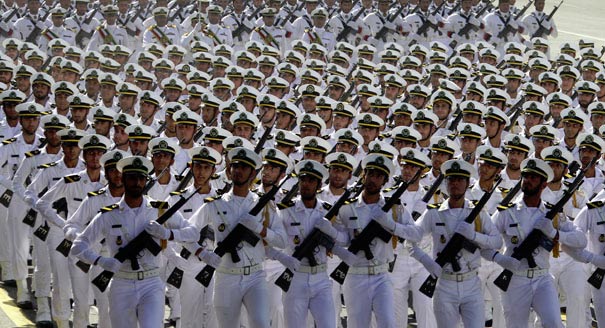
None of this indicates that Iran is confident about its military power. The country has simply inserted itself into a messy civil war because it has the strategic imperative to do so and sees the risk of a Western reaction as being minimal. Had the message from the West been different, Iran would have been more hesitant because, apart from the Quds Force, its military is focused on defence and deterrence, not power projection.
This article was originally published on the International Institute for Strategic Studies.
Former Nonresident Senior Fellow, Nuclear Policy Program
Chubin, who is based in Geneva, focuses his research on nonproliferation, terrorism, and Middle East security issues. He was director of studies at the Geneva Centre for Security Policy, Switzerland, from 1996 to 2009.
Recent Work
Shahram Chubin
Shahram Chubin
Carnegie does not take institutional positions on public policy issues; the views represented herein are those of the author(s) and do not necessarily reflect the views of Carnegie, its staff, or its trustees.

The nuclear relationship between China and the United States is increasingly shaped by widening perception gaps rather than deliberate strategic design.

Tong Zhao

But their "principal to principal" model will only be as effective as the political strength of each leader back home.

Damien Ma

U.S. unpredictability has allowed China to capitalize on its positioning as the “responsible great power”. Paradoxically, the more China wins the perception game, the more likely expectations will rise for Beijing to deliver not just words but to demonstrate with its deeds.

Chong Ja Ian

Hanoi and Beijing have long treated each other as distant cousins rather than comrades in arms. That might be changing as both sides draw closer to hedge against uncertainty and America’s erratic behavior.

Nguyễn Khắc Giang

Across Asia, China is better positioned to withstand energy shocks from the fallout of the Iran war. Its abundant coal capacity can ensure stability in the near term. Yet at the same time, the country’s energy transition away from coal will make it even less vulnerable during the next shock.
Damien Ma