

In The Media
Lilia Shevtsova
{
  "authors": [
    "Lilia Shevtsova"
  ],
  "type": "legacyinthemedia",
  "centerAffiliationAll": "",
  "centers": [
    "Carnegie Endowment for International Peace",
    "Carnegie Russia Eurasia Center"
  ],
  "collections": [],
  "englishNewsletterAll": "",
  "nonEnglishNewsletterAll": "",
  "primaryCenter": "Carnegie Russia Eurasia Center",
  "programAffiliation": "",
  "programs": [],
  "projects": [],
  "regions": [
    "Russia",
    "Eastern Europe",
    "Ukraine"
  ],
  "topics": [
    "Political Reform",
    "Foreign Policy"
  ]
}
Source: Getty
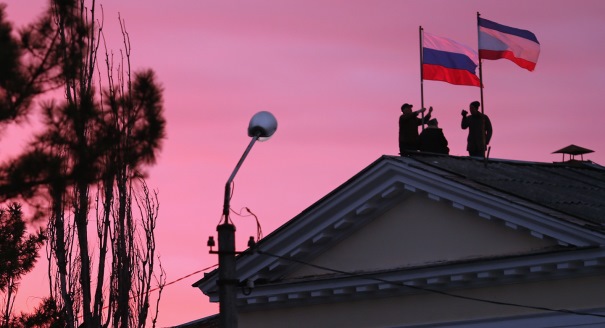
All of Putin’s actions, such as annexation of Crimea, trying to suffocate Ukraine, and trying to contain the United States and West in general, are a response to his domestic agenda. To survive, Putin wants to return to the old militaristic Russia and to become a war president.
Source: NPR’s All Things Considered
ROBERT SIEGEL, HOST: What motivates Vladimir Putin? And how should the West respond to him? Well, we're going to pose the first question now to political scientist Lilia Shevtsova. She's with the Carnegie Moscow Center, and she's in Washington this week. Welcome to the program.
LILIA SHEVTSOVA: Thank you for having me.
SIEGEL: In a nutshell, how do we best understand Vladimir Putin's annexation of Crimea?
SHEVTSOVA: Well, Robert, I would say that everything Putin does - annexation of Crimea, trying to suffocate Ukraine, trying to contain the United States and West in general - everything is a servant to domestic agenda. The problem is that he wants to survive, and he understands that he cannot survive when Russia has a dissent within the society, when Russia has Internet community. So he would like to return to the old, traditional metrics and to Russia turning into the war nation and him turning into a war president.SIEGEL: Into a militaristic society.
SHEVTSOVA: Absolutely.
SIEGEL: But how do you square that with what we hear as his popularity in Russia? He seems to be as secure as any leader of a major country in the world today.
SHEVTSOVA: And this is natural. And he understands. He's very savvy. He's very shrewd. And he's a great political technologist. He is rational, despite of the fact that Angela Merkel allegedly said that he's out of this world. He understands that war can make him really popular.
SIEGEL: Well, here are two possibilities. Number one, Crimea was, as they say, low-hanging fruit. It had only been connected to Ukraine for a few decades. There weren't that many Ukrainians there and it was already an autonomous republic within Ukraine. Other parts of Ukraine would be much more difficult to annex. So he'll stand pat with Crimea. Or will he try to take more of Ukraine?
SHEVTSOVA: Well, it seems to me that Crimea for him is not that important, and land grab is not that important. Even Ukraine is not that important. What is important is to create a permanent zone instability around and to have, constantly, enemies whom he would like to contain, to restrain. That means he cannot stop. He is in a bobsled mode. He has to run down without thinking about the consequences.
SIEGEL: If, in fact, Putin is, as you say, now in bobsled mode, he's headed down the track, you're saying that doesn't necessarily mean he will invade Ukraine. It means he will endeavor to destabilize the region around him in such a way so that a powerful Russia is the only force that can be counted on for relative stability. Do I have that right?
SHEVTSOVA: Yes. You have it right. And there are other means to destabilize the whole system of the international relations. In fact, he has unraveled post-Cold War settlement. And he cannot return the world to the post-Yalta settlement because his major goal is there are no rules of the game, or I am allowed to break the rules of the game.
SIEGEL: Lilia Shevtsova of the Carnegie Moscow Center. Thank you very much for talking with us.
SHEVTSOVA: Thank you.
Former Senior Associate, Russian Domestic Politics and Political Institutions Program, Moscow Center
Shevtsova chaired the Russian Domestic Politics and Political Institutions Program at the Carnegie Moscow Center, dividing her time between Carnegie’s offices in Washington, DC, and Moscow. She had been with Carnegie since 1995.
Recent Work
Lilia Shevtsova
Lilia Shevtsova
Carnegie does not take institutional positions on public policy issues; the views represented herein are those of the author(s) and do not necessarily reflect the views of Carnegie, its staff, or its trustees.

But their "principal to principal" model will only be as effective as the political strength of each leader back home.

Damien Ma

U.S. unpredictability has allowed China to capitalize on its positioning as the “responsible great power”. Paradoxically, the more China wins the perception game, the more likely expectations will rise for Beijing to deliver not just words but to demonstrate with its deeds.

Chong Ja Ian

Hanoi and Beijing have long treated each other as distant cousins rather than comrades in arms. That might be changing as both sides draw closer to hedge against uncertainty and America’s erratic behavior.

Nguyễn Khắc Giang

Across Asia, China is better positioned to withstand energy shocks from the fallout of the Iran war. Its abundant coal capacity can ensure stability in the near term. Yet at the same time, the country’s energy transition away from coal will make it even less vulnerable during the next shock.
Damien Ma

Malaysia’s chairmanship sought to fend off short-term challenges while laying the groundwork for minimizing ASEAN’s longer-term exposure to external stresses.

Elina Noor