

Q&A
Eugene Rumer
{
  "authors": [
    "Eugene Rumer"
  ],
  "type": "commentary",
  "centerAffiliationAll": "",
  "centers": [
    "Carnegie Endowment for International Peace",
    "Carnegie Russia Eurasia Center"
  ],
  "collections": [],
  "englishNewsletterAll": "",
  "nonEnglishNewsletterAll": "",
  "primaryCenter": "Carnegie Endowment for International Peace",
  "programAffiliation": "",
  "programs": [],
  "projects": [],
  "regions": [
    "Russia",
    "Eastern Europe",
    "Ukraine"
  ],
  "topics": [
    "Political Reform",
    "Security",
    "Military",
    "Foreign Policy"
  ]
}
Source: Getty
One could only guess what Russia’s real goal in Ukraine is. However, sooner or later Moscow will need to deal with someone in Kyiv, and will need a political strategy to end the crisis.
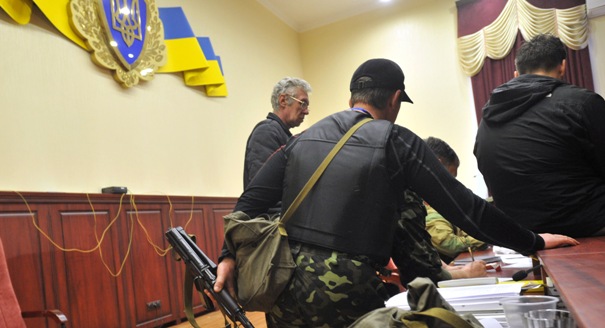
The crisis in Ukraine is well into a new phase. The annexation of Crimea is in the past, and a new reality is emerging on the ground in Eastern and Southeastern Ukraine. Reports of joint actions by Russian military personnel in unmarked uniforms—denied by Russian officials in Moscow—and local pro-Russian activists suggest that Eastern and Southeastern Ukraine is slipping away from Kyiv. The Kyiv government has threatened to use force to restore its control of the territory, but evidently has neither the will nor the means to move decisively against the separatists. The threat of Moscow ordering its regular troops massed at the border into Ukraine in retaliation for Kyiv’s use of force against the separatists appears to have a powerful deterrent effect on the government of Ukraine. As a result, the separatists are proceeding largely unopposed.
Then something unexpected happened on Sunday, April 6: a new wave of separatist uprisings began in major cities in Eastern Ukraine. Highly unlikely to have been launched spontaneously, presumably with Moscow’s consent and probably encouragement, these uprisings raised the prospect of Ukrainian military reprisals against the separatists and a full-scale invasion of Ukraine by the Russian military to aid fellow Russians under siege. Russia and Ukraine once again moved to the brink of a full-fledged war.
Everyone watching the crisis in Ukraine has always assumed that an invasion and military occupation of Eastern Ukraine by Russia was not Moscow’s preferred option because of the risks to the Russian military, as it would probably encounter opposition from Ukrainian regular troops, as well as guerilla fighters. The April 6 round of tensions that raised the chances of the Russian army move into Ukraine to protect the separatists also left everyone once again guessing about Moscow’s political strategy.
The good news so far is that there is no full-scale war between Russia and Ukraine. The bad news is that portions of Eastern and Southeastern Ukraine are slipping away from Kyiv. What is Moscow’s goal here?—To create a chain of separatist enclaves throughout Eastern and Southeastern Ukraine? To destabilize Ukraine to the point that its government is completely dysfunctional? To create conditions that will make it impossible to conduct the May 25 election in large portions of Ukraine, thus undercutting the legitimacy of any future government of Ukraine?—At this point it is anybody’s guess. However, sooner or later Moscow will need to deal with someone in Kyiv, and will need a political strategy to end the crisis. Obviously, it will want to end the crisis on its own terms, but that too requires a goal and a strategy to get to it. A permanent revolution in Ukraine can’t be in Russia’s interest. But an alternative to it has yet to emerge.
Director and Senior Fellow, Russia and Eurasia Program
Rumer, a former national intelligence officer for Russia and Eurasia at the U.S. National Intelligence Council, is a senior fellow and the director of Carnegie’s Russia and Eurasia Program.
Recent Work
Eugene Rumer
Eugene Rumer
Carnegie does not take institutional positions on public policy issues; the views represented herein are those of the author(s) and do not necessarily reflect the views of Carnegie, its staff, or its trustees.

But their "principal to principal" model will only be as effective as the political strength of each leader back home.

Damien Ma

U.S. unpredictability has allowed China to capitalize on its positioning as the “responsible great power”. Paradoxically, the more China wins the perception game, the more likely expectations will rise for Beijing to deliver not just words but to demonstrate with its deeds.

Chong Ja Ian

Hanoi and Beijing have long treated each other as distant cousins rather than comrades in arms. That might be changing as both sides draw closer to hedge against uncertainty and America’s erratic behavior.

Nguyễn Khắc Giang

Across Asia, China is better positioned to withstand energy shocks from the fallout of the Iran war. Its abundant coal capacity can ensure stability in the near term. Yet at the same time, the country’s energy transition away from coal will make it even less vulnerable during the next shock.
Damien Ma

Malaysia’s chairmanship sought to fend off short-term challenges while laying the groundwork for minimizing ASEAN’s longer-term exposure to external stresses.

Elina Noor