

Commentary
Dmitri Trenin
{
  "authors": [
    "Dmitri Trenin"
  ],
  "type": "commentary",
  "centerAffiliationAll": "",
  "centers": [
    "Carnegie Endowment for International Peace",
    "Carnegie Russia Eurasia Center"
  ],
  "collections": [],
  "englishNewsletterAll": "",
  "nonEnglishNewsletterAll": "",
  "primaryCenter": "Carnegie Russia Eurasia Center",
  "programAffiliation": "",
  "programs": [],
  "projects": [],
  "regions": [
    "North America",
    "United States",
    "East Asia",
    "China",
    "Japan",
    "Russia"
  ],
  "topics": [
    "Foreign Policy"
  ]
}
Source: Getty
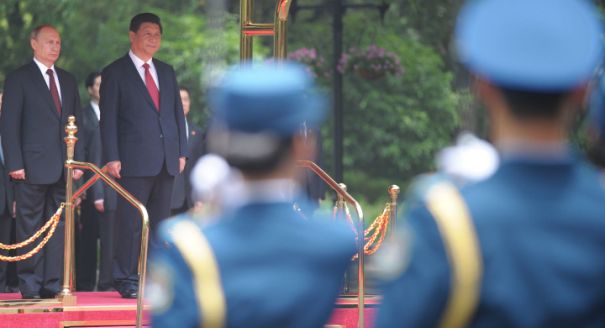
In mid-2014, the United States' relations with China and Russia are substantially worse than those two countries' bilateral relations. The unique position that the United States has held since the 1990s as the dominant power in Eurasia is now history.
From Ukraine to the South and East China Seas, the international system experiences new turbulence, even as it searches a new balance. Ostensibly, the United States and Russia are in a conflict over Ukraine. In reality, they are in a conflict over the fundamentals of the post-Cold War settlement. Russia, pushing back against expanding Western influence, is labeled revisionist and "resurgent." China is not yet in a conflict with the United States, but the Sino-U.S. relationship, too, is experiencing increasing strains. As its power grows, China advances its interests in the maritime zones east and south of its shores, for which it is termed "assertive." Worried, China's smaller neighbors in Asia, like Russia's in Europe, are flocking to seek U.S. protection, thus re-invigorating Cold War-era alliances and creating new informal ones.
In mid-2014, for the first time in four decades, the United States' relations with China and Russia are substantially worse than those two countries' bilateral relations. The lopsided triangle now being formed and probably ignored in Washington, where Russia is heavily discounted as a factor, has Beijing in a more advantageous position than ever before. This position would allow China access to more resources, and would make its strategic rear in the north even more secure as it deals with the issues south and east of its shores. The result is that the unique position that the United States has held since the 1990s as the dominant power in Eurasia is now history. Symbolically, the Pentagon's quiet departure last month from the Manas air base in Kyrgyzstan closes the book on that era.
Former Director, Carnegie Moscow Center
Trenin was director of the Carnegie Moscow Center from 2008 to early 2022.
Recent Work
Dmitri Trenin
Dmitri Trenin
Carnegie does not take institutional positions on public policy issues; the views represented herein are those of the author(s) and do not necessarily reflect the views of Carnegie, its staff, or its trustees.

The Plaza Accord was not an externally imposed punishment of Japan but part of a broader restructuring that Japanese economists and policymakers themselves recognized was necessary. Its effects were undermined, however, when Tokyo responded to the resulting slowdown with policies that exacerbated investment, credit expansion, and the very imbalances the adjustment was intended to resolve.

Michael Pettis

The nuclear relationship between China and the United States is increasingly shaped by widening perception gaps rather than deliberate strategic design.

Tong Zhao
China’s banking crisis in the 2000s was resolved by transferring the costs to households through financial repression—a decision that recapitalized the banks while exacerbating the structural imbalances that continue to shape the Chinese economy today.
Michael Pettis

Chinese biotech companies have been on the receiving end of U.S. economic coercion. Yet their responses have differed significantly because firm and state interests are not uniformly aligned. For Washington, treating all Chinese tech firms the same, irrespective of their actual interests, risks pushing them farther into Beijing’s corner.

Xue Gong

China’s latest energy plan explicitly calls for integrating data centers into the electricity system, particularly connecting them to green energy. It appears Beijing wants to use compute as a source of domestic demand to absorb renewables excess capacity.

Damien Ma