

Commentary
Sarah Chayes
{
  "authors": [
    "Sarah Chayes"
  ],
  "type": "legacyinthemedia",
  "centerAffiliationAll": "dc",
  "centers": [
    "Carnegie Endowment for International Peace",
    "Malcolm H. Kerr Carnegie Middle East Center"
  ],
  "collections": [
    "Democracy and Governance"
  ],
  "englishNewsletterAll": "democracy",
  "nonEnglishNewsletterAll": "",
  "primaryCenter": "Carnegie Endowment for International Peace",
  "programAffiliation": "DCG",
  "programs": [
    "Democracy, Conflict, and Governance",
    "Middle East"
  ],
  "projects": [],
  "regions": [
    "North America",
    "United States",
    "Middle East",
    "Iran",
    "Iraq",
    "Syria",
    "Saudi Arabia",
    "Gulf",
    "Levant"
  ],
  "topics": [
    "Security",
    "Democracy",
    "Military",
    "Foreign Policy"
  ]
}
Source: Getty
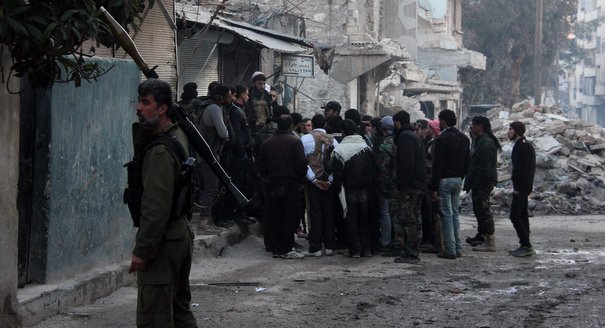
For a successful U.S. strategy, military action must be tailored to support diplomatic efforts and goals. The United States needs to understand and reduce the motivations for people to join the Islamic State.
Source: Defense One
Secretary of State John Kerry is channeling all his high-octane diplomatic intensity into the effort to consolidate an international coalition to combat the Islamic State (aka ISIS or ISIL). But a flurry of consultations in Ankara, Cairo, Jedda and the United Nations General Assembly — not to mention the U.S. senate — does not add up to the non-military effort that many insist is required to “degrade and ultimately destroy” ISIS. It is diplomacy in support of the use of force. For a real strategy, the roles should be reversed: military action should be tailored to support diplomatic efforts and goals.
While it is too late to substantially influence the U.S. government’s approach to this crisis, it provides the opportunity to sketch out what such a strategy might look like.
Above all, it must aim to erode the adversary’s “will to fight.” As Director of National Intelligence James Clapper recently put it to David Ignatius of the Washington Post, the intelligence community has consistently miscalculated that factor. “We underestimated the Viet Cong and the North Vietnamese and overestimated the will of the South Vietnamese. In this case, we underestimated ISIL and overestimated the fighting capability of the Iraqi army…It boils down to predicting the will to fight, which is an imponderable.”Except that it’s not such an imponderable. Governments run by self-dealing cliques — be they South Vietnam’s or Iraq’s — do not inspire the will to fight.
When a prime minister, whose corrupt and sectarian practices prompted repeated warnings from U.S. commanders, replaces well-trained officers with cronies on the take, the collapse of the security force should be predictable. When a formerly ruling minority is stripped not just of power, but of access to power or resources or the redress of grievances, or even protection from death squads, its willingness to fight for those things should be predictable.
After all, ISIS is not fighting alone in Iraq. Without support from thousands of Sunnis, including community leaders and seasoned military officers, the militants could never have achieved what they have.
So the first element of a strategy must be to assign significant intelligence assets to the task of understanding the motivations and drivers of violent resistance to Baghdad. How was the military being de-structured in the wake of the U.S. withdrawal? What functional roles in the capture of revenue streams were occupied by which members of the Maliki network? How are these changing under Abadi? What grievances or aspirations are motivating most Sunnis?
Then, alongside efforts to dissuade people from joining the violent resistance, must come a parallel effort to modify offensive Iraqi government structures and practices that are driving them into its arms.
President Barack Obama was right to hold off on providing U.S. military support to Baghdad so long as former Prime Minister Nouri al-Maliki remained in power. But his mere removal will not address Sunni concerns. New Prime Minister Haidar Abadi – a former member of Maliki’s inner circle – has still to identify a defense and an interior minister who are competent and acceptable to both Sunnis and a newly energized radical Shiite fringe. And even if he does come up with some names, the appointment of two individuals still is insufficient. Corrupt and nepotistic regimes from Afghanistan to Syria and beyond typically co-opt a few elite members of the “out-group” elite into the ruling network as a way of buying them off. The aggrieved population – the type of people who join violent movements – remains disgruntled.
The second and main element of the U.S. strategy should be to deploy all of Kerry’s talent and energy on behalf of a serious process to hammer out the framework of a sustainable Iraq political settlement. Issues to be taken up would likely include the distribution of oil revenues, internal boundaries and the makeup and prerogatives of the armed forces. The credibility of that process and the strength of the international coalition that is committed to shepherding it will be more important than the specific outcome it might reach, at least at first.
Instead of focusing exclusively on cajoling allies to join in with military action against ISIS, Kerry should be urging some to sponsor and host such a process. Most of the world’s most talented mediators are not American. U.S. kinetic efforts should be conditional on Abadi’s acceptance of such a process and good faith participation. Gen. John Allen, who knows Sunni leaders better than almost anyone, should be working not only to cobble together anti-ISIS militias but also to identify reasonable concerns and to enlist participants in the process.
As for Iran, its real value isn’t in joining the fight against a Sunni group, no matter how nefarious. Its participation is only likely to further inflame Sunni extremists, stoking their perception of their own beleaguered religious purity. The unique asset Iran brings is its influence over Shiites in both Iraq and Syria. The Iranian leadership must understand that sadistic, maximalist behavior on the part of Syrian President Bashar al-Assad and the Iraqi government is dangerous not just to local Sunnis and perhaps to the West, but ultimately to Iran itself. And if Iranian leaders want to regain the international stature they believe they deserve, they must make use of their leverage in constructive ways.
The U.S. is poorly positioned to have this conversation with Iranian President Hassan Rouhani, let alone with the clerics who hold much of the power in Teheran. But other U.S. allies or individuals may have better channels.
None of these actions seems to be in the cards. And, rather than reducing the motivations for joining ISIS, the U.S. military plan seems bound to add to them. Saudi Arabia – whose regime is detested across the Arab world – is a prized member of the coalition. The ISIS-controlled areas likely to be bombed are in fact largely controlled by non-ISIS Sunnis. As they get killed, their cousins and fathers will be even less likely to shift their allegiance back to Baghdad. Finally, by enlisting a vast international coalition to go all in behind Abadi, Washington has decreased his incentive to compose with Iraqi Sunnis.
In the end, in order for the intelligence community, the secretary of state and others to devise the kind of alternate approach outlined above and throw themselves into it, the president needs to demand it and then lay it out for the American people. But in spite of his own recognition that absent “a strategy that reduces the wellsprings of extremism, a perpetual war…will prove self-defeating,” Obama has yet to do so.
Former Senior Fellow, Democracy, Conflict, and Governance Program
Sarah Chayes is internationally recognized for her innovative thinking on corruption and its implications. Her work explores how severe corruption can help prompt such crises as terrorism, revolutions and their violent aftermaths, and environmental degradation.
Recent Work
Sarah Chayes
Carnegie does not take institutional positions on public policy issues; the views represented herein are those of the author(s) and do not necessarily reflect the views of Carnegie, its staff, or its trustees.

But their "principal to principal" model will only be as effective as the political strength of each leader back home.

Damien Ma

U.S. unpredictability has allowed China to capitalize on its positioning as the “responsible great power”. Paradoxically, the more China wins the perception game, the more likely expectations will rise for Beijing to deliver not just words but to demonstrate with its deeds.

Chong Ja Ian

Hanoi and Beijing have long treated each other as distant cousins rather than comrades in arms. That might be changing as both sides draw closer to hedge against uncertainty and America’s erratic behavior.

Nguyễn Khắc Giang

Across Asia, China is better positioned to withstand energy shocks from the fallout of the Iran war. Its abundant coal capacity can ensure stability in the near term. Yet at the same time, the country’s energy transition away from coal will make it even less vulnerable during the next shock.
Damien Ma

Malaysia’s chairmanship sought to fend off short-term challenges while laying the groundwork for minimizing ASEAN’s longer-term exposure to external stresses.

Elina Noor