

Paper
Kawa Hassan
{
  "authors": [
    "Kawa Hassan"
  ],
  "type": "legacyinthemedia",
  "centerAffiliationAll": "dc",
  "centers": [
    "Carnegie Endowment for International Peace",
    "Malcolm H. Kerr Carnegie Middle East Center"
  ],
  "collections": [],
  "englishNewsletterAll": "menaTransitions",
  "nonEnglishNewsletterAll": "",
  "primaryCenter": "Malcolm H. Kerr Carnegie Middle East Center",
  "programAffiliation": "MEP",
  "programs": [
    "Middle East"
  ],
  "projects": [],
  "regions": [
    "Gulf",
    "Levant",
    "Syria",
    "Iraq",
    "Middle East"
  ],
  "topics": [
    "Political Reform",
    "Security",
    "Foreign Policy"
  ]
}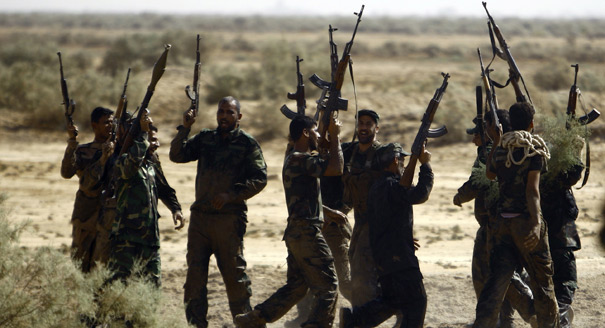
Source: Getty
Arab failed states allowed the Islamic State to grow and shamelessly used it for their own purposes long before anyone had ever heard of Abu Bakr al-Baghdadi.
Source: Annahar English Edition
To understand the recent advances and gains by the Islamic State (IS, formerly Islamic State in Iraq and Syria or ISIS) in both Iraq and Syria in June and August 2014, we need to go back to the beginning of 2000. After 9/11 and 2003, both the Syrian and Iranian regimes saw and used al-Qaeda as a ‘potential ally’ in their conflict with the United States but, simultaneously, viewed it as a dangerous enemy. But Damascus and Tehran were not the only capitals that used al-Qaeda franchises as a political instrument to advance strategic interests. After the eruption of the Syrian revolution, Riyadh, Ankara, and Doha entered into this dangerous ‘geostrategic game’ with disastrous consequences for Syria, the Middle East, and beyond.
The political order that emerged in Iraq after the fall of Saddam Hussein dismally failed to produce an inclusive political pact in which all groups and citizens see the state as their Iraq. The Iraq’s national budget for 2014 is over $141 billion, and from August 2006 to March 2014, more than $38 billion was invested in Iraqi Kurdistan. Ruling elites in the federal government in Baghdad and the Kurdistan Regional Government (KRG) in Erbil have used these billions to enrich themselves and their cronies, strengthening party militias instead of building inclusive national institutions including professional armies. The fall of Mosul in June and Sinjar in August to IS fighters without a shot being fired demonstrated this bitter reality. Simply put, post-Saddam authoritarianism embodied by, but not only limited to Prime Minister Maliki, led to a sectarianization of politics, a collapse of state institutions, including the army, a marginalization of the Sunnis, a deepening of disputes with the Kurds, a frightening fragmentation between and within religious and ethnic groups, crony capitalism, and corruption at the top in both Bagdad and Erbil.The outrageous carelessness and scandalous double-standards of the international community towards the Syrian conflict has led to Syrian heartbreak, the worst refugee crisis since World War II and a protracted violence with no end in sight. Al-Assad’s chemical weapons are being destroyed by the U.N., but his barrel bombs are left untouched only to wreak death and destruction in Syrian cities. Thus, it is of no surprise that IS and other radical groups are mushrooming in such a conducive and ideal habitat.
The Wahhabism that forms the foundation of Saudi Arabia and the five post-independence failed states of Syria, Somalia, Libya, Yemen, and Iraq, have proved to be the ideal teaching grounds and ‘top universities’ from which Abu Bakr al-Baghdadi, the leader of IS, and his ilk graduated. Islamic State is only the public face of Iraqi Sunni discontent, the Iraqi jihadi jack-in-the-box and a strategic tool of international and regional rivalries.
Five fundamental factors form and sustain the socioeconomic, cultural, and political roots of radicalism (they are not listed in order of importance). First, geopolitical manipulation and facilitation of terrorist groups by ‘secular’ and religious authoritarianism alike. Second, dogmatic history books and school curricula that canonize the ‘infallible’ historic caliphate. Third, decades of horrible human rights violations and impunity, intolerant discourse and hate speech against ‘others’ nurtured by ‘secular’ and religious autocrats, influential organizations, and personalities.
The brutalities of the henchmen of al-Baghdadi do not originate from a vacuum. They build on, are logical conclusions of and take to the ultimate unimaginable barbarism the official public beheadings in Saudi Arabia, official public executions and public stoning to death in Iran, and the razing to the ground of entire cities and communities by Ba’ath parties in al-Assad’s Syria and Saddam’s Iraq as well as Gaddafi’s barbarism against Libyans. Third, a lack of social justice and genuine citizenship, crony capitalism, and ubiquitous corruption at the highest levels of authority. This led to the collapse of state institutions, the exclusion of groups, and, as a result, has provided a sort of ‘social base’ and recruits for radical groups. Fourth and finally, an instrumentalization of IS and the like by some regional and international powers since the days of jihad against the Soviet occupation of Afghanistan in the 1980s to date. The toxic finishing product of the totality of these factors is this twenty-first century apocalyptic menace called Islamic State.
Unless these root causes are addressed, it appears ‘the caliphate’ and the powerful narrative of Abu Bakr al-Baghdadi, will be around, in one form or another, under other acronyms and leadership or other aliases, for an unpredictable length of time. This comprehensive context analysis, rather than simplistic and superficial reading of the IS’ advances and atrocities helps us better comprehend the current catastrophe and puts it in the right regional and international perspective. Therefore the recurrent lesson is that counter-terrorism and anti-radicalization initiatives should target structures that sustain terrorism and not only its symptoms.
This article was originally published by Annahar English Edition.
Former Nonresident Scholar, Middle East Center
Hassan is a nonresident scholar at the Carnegie Middle East Center, where his research focuses on Kurdish and Iraqi politics, civil society and democratization, donor assistance, and transition processes, especially in the Middle East.
Recent Work
Kawa Hassan
Carnegie does not take institutional positions on public policy issues; the views represented herein are those of the author(s) and do not necessarily reflect the views of Carnegie, its staff, or its trustees.

But their "principal to principal" model will only be as effective as the political strength of each leader back home.

Damien Ma

U.S. unpredictability has allowed China to capitalize on its positioning as the “responsible great power”. Paradoxically, the more China wins the perception game, the more likely expectations will rise for Beijing to deliver not just words but to demonstrate with its deeds.

Chong Ja Ian

Hanoi and Beijing have long treated each other as distant cousins rather than comrades in arms. That might be changing as both sides draw closer to hedge against uncertainty and America’s erratic behavior.

Nguyễn Khắc Giang

Across Asia, China is better positioned to withstand energy shocks from the fallout of the Iran war. Its abundant coal capacity can ensure stability in the near term. Yet at the same time, the country’s energy transition away from coal will make it even less vulnerable during the next shock.
Damien Ma

Malaysia’s chairmanship sought to fend off short-term challenges while laying the groundwork for minimizing ASEAN’s longer-term exposure to external stresses.

Elina Noor