

Article
C. Raja Mohan, Darshana M. Baruah
{
  "authors": [
    "C. Raja Mohan"
  ],
  "type": "legacyinthemedia",
  "centerAffiliationAll": "dc",
  "centers": [
    "Carnegie Endowment for International Peace",
    "Carnegie India"
  ],
  "collections": [],
  "englishNewsletterAll": "ctw",
  "nonEnglishNewsletterAll": "",
  "primaryCenter": "Carnegie India",
  "programAffiliation": "SAP",
  "programs": [
    "South Asia"
  ],
  "projects": [],
  "regions": [
    "South Asia",
    "India"
  ],
  "topics": [
    "Economy",
    "Trade",
    "Security",
    "Foreign Policy"
  ]
}
Source: Getty
With Xi’s determination to expand China’s defense cooperation with Sri Lanka and Colombo backing his Maritime Silk Road initiative, Modi can no longer ignore concerns about Beijing’s role there.
Source: Indian Express
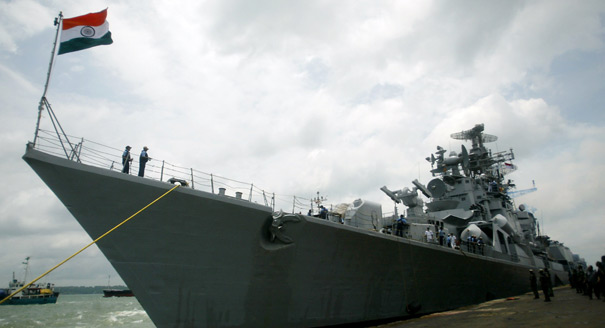
Reports that India has objected to Sri Lanka hosting a Chinese submarine last month are not surprising. In September, a submarine of the Chinese navy docked at the Colombo port just days before President Xi Jinping arrived in Sri Lanka. Last December, there were reports that a Chinese nuclear submarine had surfaced in the waters of Sri Lanka.
With Xi making public his determination to expand China’s defence cooperation with Sri Lanka and Colombo backing his Maritime Silk Road initiative, New Delhi can no longer downplay concerns about Beijing’s role in the waters to the south. The issue of Sri Lanka’s military ties to Beijing was apparently flagged last week by Defence Minister Arun Jaitley when he met the visiting Lankan defence secretary, Gotabaya Rajapaksa, who happens to be the brother of President Mahinda Rajapaksa.
As it bowed to political pressures from Chennai, the UPA found it hard to balance India’s genuine concerns about the rights of the Tamil minority in Sri Lanka and Delhi’s other national security interests in the island republic. Whether it was voting on Sri Lanka’s human rights record in Geneva, training Lankan defence personnel in Tamil Nadu, or the prime minister’s travel to Colombo to attend the Commonwealth Summit, the Congress leadership simply caved in to pressures from Chennai.The NDA government is in a much better position to cope with the competing imperatives in Sri Lanka. That Narendra Modi is less vulnerable to Chennai was reflected in his decision to invite President Rajapaksa for his swearing-in ceremony in end-May against the objections of the Tamil parties.
This, in turn, has given Modi a little more space to deal more purposefully with Lanka; but not a lot. For, Modi senses the huge opportunity to expand the BJP’s influence in Tamil Nadu. He is also conscious of the fact that Tamil concerns are very much part of India’s overall approach to Sri Lanka. Modi has begun well by expanding engagement with all the stakeholders involved in the Lanka conflict, including Chennai, Jaffna and Colombo.
India has long opposed the military presence of foreign powers in the subcontinent. This is a geopolitical legacy of the British Raj that was the paramount power in the Indian subcontinent and the guarantor of peace and stability in the Indian Ocean. The Raj ensured that no rival European power would get too close to the subcontinent on the land frontiers or establish a threatening naval presence in the Indian Ocean. As the successor state to the Raj, independent India adopted this position in its entirety. India’s first prime minister, Jawaharlal Nehru, vigorously opposed Pakistan’s bilateral and multilateral military alliances with the United States.
While seeking to keep other powers out of the region, Nehru recognised the importance of providing security to its smaller neighbours. He signed security treaties with Bhutan and Nepal after China gained control over Tibet and offered valuable military cooperation to Burma when it faced the threat of a domestic insurgency. Nehru had also initiated defence cooperation with key countries in the extended neighbourhood, such as Egypt and Indonesia.
Yet, Nehru and his successors have found it impossible to sustain the twin security legacies of the Raj. India could neither prevent foreign military presence in the subcontinent nor offer substantive military assistance to its neighbours. And, as India’s relations with the neighbours frayed over the decades, many of them turned to outside powers to counter an India they saw as overbearing and politically insensitive to their concerns.
Initially, India’s neighbours turned to the Anglo-American powers, much to the irritation of Delhi. Recall the 1980s, when Indira and Rajiv Gandhi told Colombo not to host American bases or facilities on its soil. Now, as a rising China becomes the most important extra-regional partner for India’s neighbours, India cannot simply wish away the Chinese influence in the subcontinent.
Drawing red lines or mounting public pressure on neighbours will not work. The only way to limit the scope and structure of China’s security profile in South Asia is to expand India’s own cooperation, including in the defence domain, with all neighbours.
The UPA had indeed sought to deepen defence ties with India’s neighbours. But it was not a strategic priority for the foreign office, the defence ministry or the armed forces. Modi must now try and make India the defence partner of choice for its smaller neighbours. This will take a while, but the policies and institutional framework to get there must be put in place now.
This article was originally published in the Indian Express.
Former Nonresident Senior Fellow, Carnegie India
A leading analyst of India’s foreign policy, Mohan is also an expert on South Asian security, great-power relations in Asia, and arms control.
Recent Work

C. Raja Mohan, Darshana M. Baruah


Alexander Gabuev, Paul Haenle, C. Raja Mohan, …
Carnegie does not take institutional positions on public policy issues; the views represented herein are those of the author(s) and do not necessarily reflect the views of Carnegie, its staff, or its trustees.

China’s banking crisis in the 2000s was resolved by transferring the costs to households through financial repression—a decision that recapitalized the banks while exacerbating the structural imbalances that continue to shape the Chinese economy today.

Michael Pettis

But their "principal to principal" model will only be as effective as the political strength of each leader back home.

Damien Ma

U.S. unpredictability has allowed China to capitalize on its positioning as the “responsible great power”. Paradoxically, the more China wins the perception game, the more likely expectations will rise for Beijing to deliver not just words but to demonstrate with its deeds.

Chong Ja Ian

Hanoi and Beijing have long treated each other as distant cousins rather than comrades in arms. That might be changing as both sides draw closer to hedge against uncertainty and America’s erratic behavior.

Nguyễn Khắc Giang

Across Asia, China is better positioned to withstand energy shocks from the fallout of the Iran war. Its abundant coal capacity can ensure stability in the near term. Yet at the same time, the country’s energy transition away from coal will make it even less vulnerable during the next shock.
Damien Ma