

Commentary
Dmitri Trenin
{
  "authors": [
    "Dmitri Trenin"
  ],
  "type": "commentary",
  "centerAffiliationAll": "",
  "centers": [
    "Carnegie Endowment for International Peace",
    "Carnegie China",
    "Carnegie Russia Eurasia Center"
  ],
  "collections": [],
  "englishNewsletterAll": "",
  "nonEnglishNewsletterAll": "",
  "primaryCenter": "Carnegie Russia Eurasia Center",
  "programAffiliation": "",
  "programs": [],
  "projects": [],
  "regions": [
    "North America",
    "United States",
    "East Asia",
    "China",
    "Russia"
  ],
  "topics": [
    "Economy",
    "Trade",
    "Foreign Policy"
  ]
}
Source: Getty
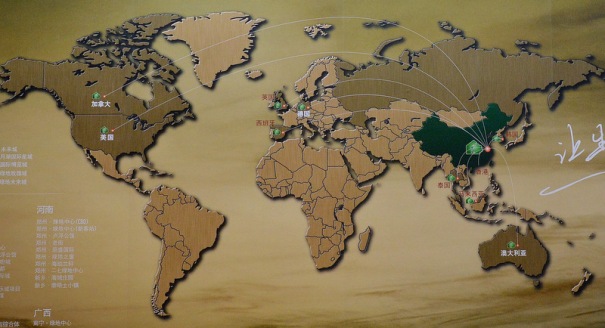
Regionalization may indeed be the future or at least the new stage of globalization. Competition among the super-regions, in this scenario, will become the essence of global geoeconomics and geopolitics.
At an event in Beijing last week, a leading Chinese academic said that the vision of a multipolar world so central to Beijing's foreign policy doctrine was in fact unrealistic—for the lack, now and in the foreseeable future, of multiple poles. In fact, he said, there were only two poles available: the United States and China. All other countries would need to decide with which they want or have to align. Many in the audience nodded and some even suggested that the Chinese leadership's thinking was much closer to that of the professor than to its own formal doctrine.
Several fundamental geoeconomic trends point in the same direction. As Konstantin Simonov put it in his October 21 column in Vedomosti newspaper, the re-industrialization of the United States powered by cheap energy and helped by raising labor costs in Asia leads to the emergence of a pan-American economic space, from Canada to Chile, with the United States at its center. Europe, Japan and Australia are already aligning themselves with the U.S. through Transatlantic and Transpacific partnerships. In response, China is already working on expanding its own domestic consumption and consolidating its ties with neighboring countries in Asia.
President Xi Jinping's initiatives, announced in 2013, about the Silk Road Economic Belt in continental Asia and the Maritime Silk Road point to the two main axes of China's geoeconomic expansion. Beijing eyes Central and South-East Asia as prime areas for boosting trade and investment. South Asia and Eurasia are next. If these plans are implemented, the future economic Sinosphere, which might be more politely called Greater Asia, may extend all the way to the Gulf, the Black Sea and the Baltics, and embrace countries such as India, Indonesia, Iran, Pakistan, and Russia.
Regionalization may indeed be the future or at least the new stage of globalization. Competition among the super-regions, in this scenario, will become the essence of global geoeconomics and geopolitics. Unlike in the early stages of globalization, the main players' norms and principles, the values and ideas will be actively contested. It is not a given that this contest will always be peaceful. Geoeconomics, by itself, will not just build a new and stable world order. Again, as the developments of the past nine months have shown, geopolitics is not far behind, and can throw a wrench into the process, particularly when it is ignored. A world of roughly equal multiple poles is not in the offing. But do not bank on a Sino-American bi-hegemony, either. It is going to be messier, but also more diverse and more interesting than that.
Former Director, Carnegie Moscow Center
Trenin was director of the Carnegie Moscow Center from 2008 to early 2022.
Recent Work
Dmitri Trenin
Dmitri Trenin
Carnegie does not take institutional positions on public policy issues; the views represented herein are those of the author(s) and do not necessarily reflect the views of Carnegie, its staff, or its trustees.

China’s banking crisis in the 2000s was resolved by transferring the costs to households through financial repression—a decision that recapitalized the banks while exacerbating the structural imbalances that continue to shape the Chinese economy today.

Michael Pettis

Chinese biotech companies have been on the receiving end of U.S. economic coercion. Yet their responses have differed significantly because firm and state interests are not uniformly aligned. For Washington, treating all Chinese tech firms the same, irrespective of their actual interests, risks pushing them farther into Beijing’s corner.

Xue Gong

China’s latest energy plan explicitly calls for integrating data centers into the electricity system, particularly connecting them to green energy. It appears Beijing wants to use compute as a source of domestic demand to absorb renewables excess capacity.

Damien Ma

But their "principal to principal" model will only be as effective as the political strength of each leader back home.
Damien Ma

U.S. unpredictability has allowed China to capitalize on its positioning as the “responsible great power”. Paradoxically, the more China wins the perception game, the more likely expectations will rise for Beijing to deliver not just words but to demonstrate with its deeds.

Chong Ja Ian