

Commentary
But their "principal to principal" model will only be as effective as the political strength of each leader back home.
Damien Ma
{
  "authors": [
    "Nikolay Kozhanov"
  ],
  "type": "commentary",
  "centerAffiliationAll": "",
  "centers": [
    "Carnegie Endowment for International Peace",
    "Carnegie Russia Eurasia Center"
  ],
  "collections": [
    "Iranian Proliferation"
  ],
  "englishNewsletterAll": "",
  "nonEnglishNewsletterAll": "",
  "primaryCenter": "Carnegie Endowment for International Peace",
  "programAffiliation": "",
  "programs": [],
  "projects": [],
  "regions": [
    "North America",
    "United States",
    "Middle East",
    "Iran",
    "Russia"
  ],
  "topics": [
    "Foreign Policy",
    "Nuclear Policy"
  ]
}
Source: Getty
The experience gained in Vienna may be useful in future talks. In order to make the further negotiations effective, both Obama and Rouhani need to find a way to achieve a consensus of support for their actions within their own political establishments.
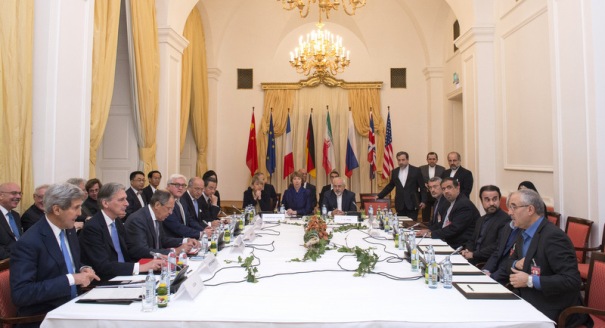
Although all sides involved in the P5+1 Iran nuclear negotiations have expressed satisfaction with the results of the most recent meetings in Vienna, the ultimate goal of these talks was not achieved. Tehran and the West are still far from reaching a satisfactory, final agreement.
It is always easy to predict the past. Today, most experts believe that an agreement to continue negotiations was the only feasible (and most logical) outcome of the talks. They argue that, from the very beginning, differences between Iran’s and the P5+1 group’s approaches to the nuclear and sanctions issues forged a divide that the negotiators would not be able to bridge. Only weeks ago, however, the same analysts suggested that the parties involved in the negotiation process would be able to sign some kind of agreement regarding the future of the Tehran’s nuclear program. With this in mind, it is important to understand what led analysts to believe a positive outcome could be achieved, and why they were wrong.
First of all, the outsized expectations for the talks stemmed from the publicly stated desire of American and Iranian presidents’ administrations to reach a comprehensive agreement. For Hassan Rouhani and Barak Obama, the formal settlement of the nuclear issue was and is a question of personal prestige. For the Iranian president, a deal would mean the fulfillment of his main election pledge. This, in turn, would strengthen his chances of being reelected for the second term. As for Rouhani’s American counterpart, he probably believed that a nuclear settlement in Vienna would improve his mixed diplomatic record. Apart from that, the men could also hope to undermine the positions of U.S. and Israeli hawks. Finally, a nuclear deal would open up a number of options for dialogue and, in theory, cooperation between the countries on other regional issues such as Afghanistan, Iraq, and Syria.
Yet, presidential resolve was not enough to make negotiations in Vienna successful. Although both sides were eager to reach a deal, neither Iran nor the United States was ready to make the concessions necessary to come to an agreement. The failure of the talks can, in part, be explained by the existence of very strong opposition in both countries to any deal that would involve compromise. In the Islamic Republic, this opposition is composed of conservatives who see any concessions made to the Americans as Iranian defeat, as well as members of the Iranian elite who profit from the current sanctions. Ali Khamenei, the Supreme Leader of Iran, could leverage the situation in the favor of the president. However, he was very cautious, leaving Rouhani out on a limb. Rouhani’s success or failure to reach an agreement with the P5+1 group would not affect the political positions of Khamenei: in either case, the president would be the scapegoat.
Obama’s position was and, still, is even weaker. Given his low popularity, the American president lacks the political capital to make any substantial concessions to Iran. Any initiative will inevitably face direct opposition from Congress, as the anti-Iran lobby will portray any concession as capitulation to the Iranian regime. Initiatives that do not require the involvement of U.S. legislators will probably be less appealing to Tehran because they will have little to do with easing the sanctions regime.
However, the experience gained in Vienna may be useful in future talks. The last meeting in Austria clearly demonstrated that the main sticking points for Tehran and Washington are not only related to the technical details of the agreement (such as the number of centrifuges that Iran will be allowed to keep or the information about its alleged military program). In order to make the further negotiations effective, both Obama and Rouhani need to find a way to achieve a consensus of support for their actions within their own political establishments.
Nikolay Kozhanov is a senior lecturer in political economy of the Middle East at the St.-Petersburg State University and an expert of the Institute of the Middle East (Moscow).

Nikolay Kozhanov
Former nonresident scholar, Foreign and Security Policy Program, Moscow Center
Kozhanov is a former nonresident scholar at the Carnegie Moscow Center and a contributing expert to the Moscow-based Institute of the Middle East.
Carnegie does not take institutional positions on public policy issues; the views represented herein are those of the author(s) and do not necessarily reflect the views of Carnegie, its staff, or its trustees.

But their "principal to principal" model will only be as effective as the political strength of each leader back home.

Damien Ma

U.S. unpredictability has allowed China to capitalize on its positioning as the “responsible great power”. Paradoxically, the more China wins the perception game, the more likely expectations will rise for Beijing to deliver not just words but to demonstrate with its deeds.

Chong Ja Ian

Hanoi and Beijing have long treated each other as distant cousins rather than comrades in arms. That might be changing as both sides draw closer to hedge against uncertainty and America’s erratic behavior.

Nguyễn Khắc Giang

Across Asia, China is better positioned to withstand energy shocks from the fallout of the Iran war. Its abundant coal capacity can ensure stability in the near term. Yet at the same time, the country’s energy transition away from coal will make it even less vulnerable during the next shock.
Damien Ma

Malaysia’s chairmanship sought to fend off short-term challenges while laying the groundwork for minimizing ASEAN’s longer-term exposure to external stresses.

Elina Noor