Alexey MalashenkoScholar in residence, Carnegie Moscow Center’s Religion, Society, and Security Program
The status of Donbas remains uncertain. Russia still insists that it is in favor of the region being part of Ukraine. However, Russian politicians and, of particular importance, President Vladimir Putin himself, already refer to Lugansk and Donetsk as republics rather than regions. In other words, their statements demonstrate that they effectively consider the regions to be state-like entities.
Still, it’s not viable for Russia to implement the Abkhazian scenario in Donetsk People’s Republic (DNR) and Lugansk People’s Republic (LNR). No one knows what percentage of the population in the separatist regions is actually ready for independence, nor whether independence might in fact lead to a civil war. What’s more, Russia simply lacks the funds to finance an additional pair of “sovereign states.”
The annexation of Lugansk and Donetsk regions is even less probable, even if some particularly agitated and irresponsible Russian politicians occasionally frighten Ukraine—and, incidentally, Russia as well—with such a prospect.
What is left for Donbas then? It is reduced to being Moscow’s bargaining chip, a tool for pressuring Kyiv. This active manipulation is particularly evident at the present moment. The latest statements made by DNR head Aleksandr Zakharchenko, whom the Kremlin has demonstratively given more room to maneuver, clearly illustrate this development. He said, for instance, that his forces would take no prisoners.
Thus, Donbas is to remain an instrument of Russian politics for a long haul.
From a tactical standpoint, this pressure seeks to extract more concessions from Kyiv. However, the Kremlin might well have a strategic goal too—the defeats in Donbas might be used to expose Kyiv’s military and political weakness to Ukrainians and point to the fact that Ukraine has no allies in the West that are prepared to take extreme steps on its behalf. This, in turn, may trigger anti-Maidan protests in Ukraine and bring a more pro-Moscow government to power. Such a development would cause the pendulum of Russian-Ukrainian relations to swing in the opposite direction.
Balázs JarábikVisiting scholar, Russia and Eurasia Program at the Carnegie Endowment
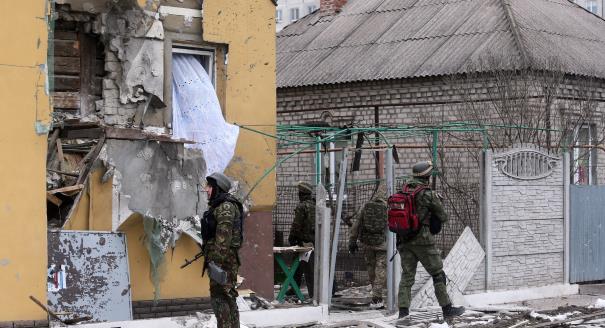
Donbas is in a downward spiral. With Russia’s support, the conflict has been worsening: this weekend’s shelling of Mariupol cost over thirty lives, and another deadly fight is waging around Debaltsevo. People continue to flee the self-declared republics: there are almost a million registered IDPs across Ukraine, and over 600,000 refugees in neighboring countries, overwhelmingly in Russia.
Although it is clear that the Russian-supported rebels went on the offensive, the logic for increasing sanctions on Russia assumes that it is possible for Kyiv to regain authority over those territories or for Russia to abandon them. But the Kremlin’s relationship with the rebels appears to be more ambivalent than that: it “neither live with nor without.” Moscow’s current tactical goal seems to be to alter the original Minsk agreement in the rebels’ favor and push Kyiv into yet another defeat. Such an outcome would certainly bring with it an increase in conflicts among Ukraine’s ruling elites. Moreover, if the border were placed under Russian and OSCE control instead of under Ukrainian control it would legitimize Russian presence on the ground, potentially giving Russia more control over the rebels. Moscow sees this increased control as necessary, because conflicts between rebels are brewing in both republics.
So far the main beneficiaries of the war have been the two “People’s Republics.” At the same time both the “republics” and Kyiv have been able to mobilize their constituents using nationalistic wartime propaganda. Kyiv is caught between a rock (austerity/reforms) and a hard place (war), and will have a difficult time justifying social welfare cuts to the Ukrainian people and lack of reforms to the IMF. The recently introduced state of emergency in Donetsk and Lugansk regions taken together with the ongoing mobilization indicates that Kyiv has decided to take up the military challenge. The battle for Debaltsevo will be the first test of how solid—and efficient—its efforts are.
Andrei KolesnikovMember of the board, Yegor Gaidar Foundation
It’s clear that Donbas has joined the ranks of the unrecognized republics like South Ossetia. Each case is different, of course, but the typology of such quasi-state formations is almost identical.
Donbas is headed for a protracted existence in the state of a “frozen conflict.” The flames of an underground fire will burn through to the surface with various degrees of intensity. That’s indeed what has happened in the case of the Volnovakha bus shooting, the civilian deaths in Donetsk, and the offensive on Mariupol.
The ruins of the Donetsk Airport, which was and remains a scene of fierce combat, serve as a symbol of the current predicament. The situation is still mainly characterized by a hybrid war, with all of its surprises, excesses, and multiple facets of conflict, as when field commanders feud with the “legitimate” authorities of the Donetsk and Lugansk People’s Republics (DNR and LNR). Such power vacuums recall the Russian Civil War of the early 1920s—similar situations can be found in the pages Red Cavalry (Konarmiya), Isaac Babel’s short story collection about that period.
The economy is on the brink of disaster, as is the level of competence in the government. The DNR head Aleksandr Zakharchenko demonstrates his cluelessness when he asserts that Donetsk’s coal supply will enable the republic to introduce its own currency.
The coal industry is in a deep slump and requires restructuring even on territory that is not under the separatists’ control, to say nothing of the territory occupied by them, where the coal industry can only exist in the “gray sector.”
Russia’s position on Donbas has become evident of late: Russia will exert political influence and provide limited military aid, but will not contribute to restoring the region’s economy. Obviously, this position obstructs the peace process, but it is in sync with views about how to handle the situation in the southeast of Ukraine held in the Russian establishment and by some Russian citizens. These views are partly fueled by the Donbas’s mythology—Stalin’s era cinematic images of exemplary workers and “saboteurs” in the mines of Donbas that have been passed down from generation to generation.