

Article
C. Raja Mohan, Darshana M. Baruah
{
  "authors": [
    "C. Raja Mohan"
  ],
  "type": "legacyinthemedia",
  "centerAffiliationAll": "dc",
  "centers": [
    "Carnegie Endowment for International Peace",
    "Carnegie India"
  ],
  "collections": [],
  "englishNewsletterAll": "ctw",
  "nonEnglishNewsletterAll": "",
  "primaryCenter": "Carnegie India",
  "programAffiliation": "SAP",
  "programs": [
    "South Asia"
  ],
  "projects": [],
  "regions": [
    "United States",
    "Asia",
    "South Asia",
    "Afghanistan",
    "North America",
    "India",
    "East Asia",
    "China"
  ],
  "topics": [
    "Security",
    "Military",
    "Foreign Policy"
  ]
}
Source: Getty
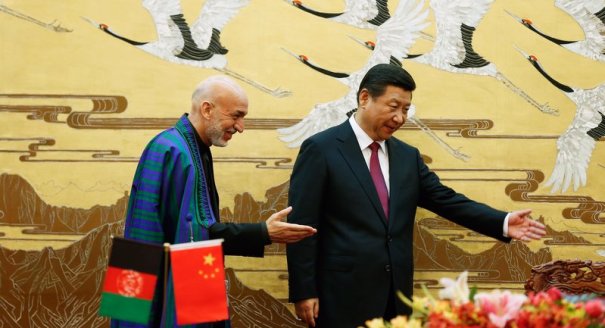
As America reduces its military burden in Afghanistan, China’s deepening involvement there was marked by the launch of a new official forum in Kabul last week.
Source: Indian Express
As America reduces its military burden in Afghanistan, China’s deepening involvement there was marked by the launch of a new official forum in Kabul last week. Called the ‘China-Pakistan-Afghanistan Strategic Dialogue’, the triangular engagement is likely to emerge as a major force shaping India’s north western frontiers.
The trilateral consultations were initiated by Beijing at a low-key track two level a couple of years ago. Beijing has now elevated it into an official framework. China’s Assistant Foreign Minister Liu Jianchao, Afghanistan’s Deputy Foreign Minister Hekmat Khalil Karzai and Pakistan’s Foreign Secretary Aizaz Ahmad Chaudhry of Pakistan co-chaired the Dialogue.
The first round of the forum saw China announce some major commitments to promote regional cooperation. Beijing is now ready to finance a 1500 MW hydro-electric power project in the Kunar province in eastern Afghanistan. To be managed jointly by Pakistan and Afghanistan and the project will feed into the power grids of both countries.China has signaled the intent to promote two important trans-border transport corridors—a motorway linking Kabul with Peshawar and a rail link between Quetta and Kandahar. These infrastructure projects nicely complement China’s ambitious Silk Road projects in inner Asia and its massive investments in developing the China-Pakistan Economic Corridor.
China’s audacious effort to integrate the economic spaces of Afghanistan and Pakistan follows Beijing’s recent initiative to facilitate political reconciliation between the Afghan government in Kabul and the Taliban. While the Taliban has not explicitly supported the Chinese led peace process, its delegations have been travelling frequently to Beijing.
Over the last decade, the United States had tried hard on both these fronts—internal reconciliation in Afghanistan and greater cooperation between Kabul and Islamabad. Sceptics will say China is unlikely to succeed where America and the West have failed despite pumping in massive military and economic resources. They would suggest that China like so many great powers before—including America, Russia and the British Raj—will find it near impossible to manage deep contradictions that govern strategic life across the Hindu Kush.
Since the late 1970s when it embarked on reform and opening up, China been wary of being drawn into regional conflicts any where in the world and emphasized the principle of non-intervention.
China under Xi Jinping looks far more self-confident today and is prepared to take risks in the pursuit of its interests around. If Deng Xiaoping cautioned China against claiming a leadership role in the world a quarter century ago, Xi seems ready to take a calculated political shot at it.
“As the common friend and neighbor of Afghanistan and Pakistan”, China said last week in Kabul that it “sincerely welcomes the positive progress” in the trilateral dialogue and “welcomes Afghanistan and Pakistan to increase mutual strategic trust as well as enhance mutually beneficial cooperation.”'
The three sides also reaffirmed that “terrorism, extremism and separatism pose a major threat to the security and stability” of the region and agreed to “deepen counter-terrorism and security cooperation.”
One reason why China might succeed where others have failed in Afghanistan is the apparent convergence of its interests with that of Pakistan, its all-weather friend. If Rawalpindi had deliberately sabotaged American plans in Afghanistan, the Pakistan Army believes China might help it achieve its long standing objective of securing political primacy across the Durand Line. As it comes to terms with American withdrawal, Kabul is betting that Beijing offers the last and only hope of getting the Pakistan Army to be reasonable.
Russia, which has drawn steadily closer to China in recent years and is warming up to Pakistan, is likely to back Beijing’s leadership role in Afghanistan. The U.S., which is rushing to the exits, is happy to welcome China or any one else, who is ready to hold the even for a little while.
All this leaves India staring, in the near term, at a potential diminution of its role in Afghanistan that flourished when the U.S. dominated India’s north western flank since 911. Delhi now needs a realistic adaptation to the unfolding power shift in the Great Game.
This article was originally published in the Indian Express.
Former Nonresident Senior Fellow, Carnegie India
A leading analyst of India’s foreign policy, Mohan is also an expert on South Asian security, great-power relations in Asia, and arms control.
Recent Work

C. Raja Mohan, Darshana M. Baruah


Alexander Gabuev, Paul Haenle, C. Raja Mohan, …
Carnegie does not take institutional positions on public policy issues; the views represented herein are those of the author(s) and do not necessarily reflect the views of Carnegie, its staff, or its trustees.

The Plaza Accord was not an externally imposed punishment of Japan but part of a broader restructuring that Japanese economists and policymakers themselves recognized was necessary. Its effects were undermined, however, when Tokyo responded to the resulting slowdown with policies that exacerbated investment, credit expansion, and the very imbalances the adjustment was intended to resolve.

Michael Pettis

The nuclear relationship between China and the United States is increasingly shaped by widening perception gaps rather than deliberate strategic design.

Tong Zhao
China’s banking crisis in the 2000s was resolved by transferring the costs to households through financial repression—a decision that recapitalized the banks while exacerbating the structural imbalances that continue to shape the Chinese economy today.
Michael Pettis

Chinese biotech companies have been on the receiving end of U.S. economic coercion. Yet their responses have differed significantly because firm and state interests are not uniformly aligned. For Washington, treating all Chinese tech firms the same, irrespective of their actual interests, risks pushing them farther into Beijing’s corner.

Xue Gong

China’s latest energy plan explicitly calls for integrating data centers into the electricity system, particularly connecting them to green energy. It appears Beijing wants to use compute as a source of domestic demand to absorb renewables excess capacity.

Damien Ma