

Commentary
But their "principal to principal" model will only be as effective as the political strength of each leader back home.
Damien Ma
{
  "authors": [
    "Nikolay Kozhanov"
  ],
  "type": "commentary",
  "centerAffiliationAll": "",
  "centers": [
    "Carnegie Endowment for International Peace",
    "Carnegie Russia Eurasia Center"
  ],
  "collections": [],
  "englishNewsletterAll": "",
  "nonEnglishNewsletterAll": "",
  "primaryCenter": "Carnegie Russia Eurasia Center",
  "programAffiliation": "",
  "programs": [],
  "projects": [
    "Eurasia in Transition"
  ],
  "regions": [
    "Middle East",
    "Saudi Arabia",
    "Russia"
  ],
  "topics": [
    "Foreign Policy"
  ]
}
Source: Getty
Currently, Russia and Saudi Arabia are neither friends nor foes, and the status of bilateral relations and their future remain obscure. This, in turn, is clearly reflected in the polyphony of views on Saudi Arabia existing in Russian society.
The death of King Abdullah bin Abdul Aziz al-Saud on January 23, 2015 gave new impulse to discussion in Russian society regarding Riyadh’s role in the international arena and the future of Russian-Saudi relations.
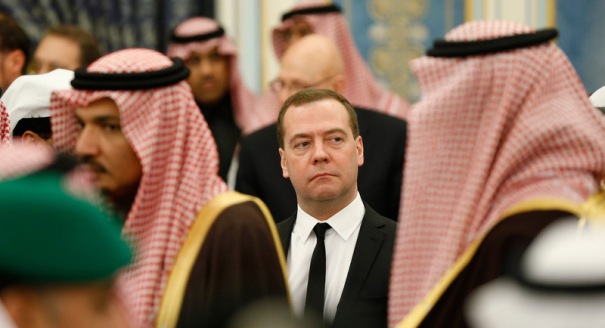
President Vladimir Putin’s official condolences to the authorities of Saudi Arabia demonstrated his warm attitude toward the late monarch and Russia’s general recognition of Riyadh as an important regional player. The president characterized the death of King Abdullah as an irretrievable loss. He emphasized that the late ruler of Saudi Arabia was well-known as “a wise and consistent statesman and politician, a leader who enjoyed the love and respect of his subjects and a well-deserved reputation in the international arena.” Putin recognized King Abdullah’s achievements in the socio-economic and political development of the kingdom. The Russian president also praised the late monarch’s efforts in the struggle against terrorism and his contribution in the settlement of the Arab-Israeli conflict. Putin argued that his meetings with King Abdullah were important steps in strengthening Russian-Saudi relations which he characterized as “traditionally friendly.” Prime Minister Dmitry Medvedev, in turn, headed the Russian delegation to visit Saudi Arabia to express official condolences.
Currently, Russia and #Saudi Arabia are neither friends nor foes.Tweet This
Unfortunately, the negative image of the kingdom is relatively popular among Moscow experts and some members of the Russian political elite. Although this negative perception of Saudi Arabia as a dictatorial state that pursues an anti-Russian foreign policy has little to do with reality, it creates additional ground for general Russian mistrust and hostility toward Riyadh during periods when the Kremlin’s relations with Saudi Arabia are cooling down. Moscow’s tradition of blaming external forces for Russia’s problems also cannot be ignored; over the last six months, the fall in oil prices have made the Russian political elite speculate that the volatility of the market is the result of a Saudi-American plot to handicap the Russian economy by limiting Moscow’s income from oil exports.
The coexistence of positive and negative images of Saudi Arabia in Russian public opinion and the fact that both images are propagated at the highest levels demonstrate the absence of a cohesive understanding among Russian decisionmakers about the role of the kingdom in the modern system of international relations. Thus far, the proponents of the negative image of Saudi Arabia have failed to distract the Russian authorities from their intention to develop positive contacts with Riyadh. Of course, calling Saudi-Russian relations “friendly” is a stretch. There is a wide gap in the approaches of the two countries toward the outcomes of the Arab Spring, the situation in Syria, and Iran’s role in the region. However, political and economic challenges faced by both states in the last decade also demonstrate that Moscow and Riyadh have mutual interests such as the promotion of regional political stability, counterterrorism efforts, and bilateral cooperation in the fields of energy and space.
Apart from that, over the last two years, certain tensions in U.S.-Saudi relations have compelled Riyadh to look for potential partners outside of the region. As a result, the Saudis have turned their attention to Moscow, and, in spite of all the existing contradictions, the kingdom’s authorities were able to maintain dialogue with Russia. The visits of Saudi prince Bandar Bin Sultan to Moscow on July 31 and December 3, 2013 are the most evident examples of this dialogue. Moreover, in November 2013, the Saudis offered to help Egyptian authorities buy Russian weapons in order to compensate for the decrease in U.S. arms exports to Cairo. Russia and Saudi Arabia reaffirmed their intention to develop bilateral relations during the recent visit of the Saudi Minister of Foreign Affairs Saud bin Faisal bin Abdulaziz Al Saud to Moscow on November 21, 2014.
Under these circumstances, Russian experts and politicians have yet to answer the main question: whether Moscow and Riyadh are to be friends or existing contradictions will bring them to political confrontation? Currently, the two countries are neither friends nor foes. While it seems that Moscow and Riyadh are willing to maintain a certain level of exchange, and even cordiality, irreconcilable differences on Syria will remain an obstacle to any significant cooperation. The status of bilateral relations and their future remain obscure. This, in turn, is clearly reflected in the polyphony of views on Saudi Arabia existing in Russian society.

Nikolay Kozhanov
Former nonresident scholar, Foreign and Security Policy Program, Moscow Center
Kozhanov is a former nonresident scholar at the Carnegie Moscow Center and a contributing expert to the Moscow-based Institute of the Middle East.
Carnegie does not take institutional positions on public policy issues; the views represented herein are those of the author(s) and do not necessarily reflect the views of Carnegie, its staff, or its trustees.

But their "principal to principal" model will only be as effective as the political strength of each leader back home.

Damien Ma

U.S. unpredictability has allowed China to capitalize on its positioning as the “responsible great power”. Paradoxically, the more China wins the perception game, the more likely expectations will rise for Beijing to deliver not just words but to demonstrate with its deeds.

Chong Ja Ian

Hanoi and Beijing have long treated each other as distant cousins rather than comrades in arms. That might be changing as both sides draw closer to hedge against uncertainty and America’s erratic behavior.

Nguyễn Khắc Giang

Across Asia, China is better positioned to withstand energy shocks from the fallout of the Iran war. Its abundant coal capacity can ensure stability in the near term. Yet at the same time, the country’s energy transition away from coal will make it even less vulnerable during the next shock.
Damien Ma

Malaysia’s chairmanship sought to fend off short-term challenges while laying the groundwork for minimizing ASEAN’s longer-term exposure to external stresses.

Elina Noor