

Commentary
But their "principal to principal" model will only be as effective as the political strength of each leader back home.
Damien Ma
{
  "authors": [
    "Frederic Wehrey",
    "Richard Sokolsky"
  ],
  "type": "legacyinthemedia",
  "centerAffiliationAll": "dc",
  "centers": [
    "Carnegie Endowment for International Peace",
    "Malcolm H. Kerr Carnegie Middle East Center"
  ],
  "collections": [
    "Iranian Proliferation"
  ],
  "englishNewsletterAll": "menaTransitions",
  "nonEnglishNewsletterAll": "",
  "primaryCenter": "Carnegie Endowment for International Peace",
  "programAffiliation": "MEP",
  "programs": [
    "Middle East"
  ],
  "projects": [],
  "regions": [
    "North America",
    "United States",
    "Middle East",
    "Iran",
    "Saudi Arabia",
    "United Arab Emirates",
    "Gulf"
  ],
  "topics": [
    "Political Reform",
    "Security",
    "Foreign Policy",
    "Nuclear Policy"
  ]
}
Source: Getty
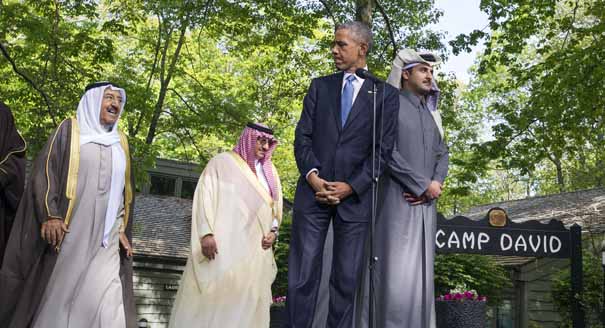
Now that a nuclear deal has been reached, the United States and its GCC allies need to focus on constructive engagement with Iran and a new and more inclusive Gulf security architecture.
Source: Foreign Affairs
Well before the ink was dry on the historic nuclear deal between the P5+1 negotiating partners and Iran, opponents of the Obama administration’s policy were advocating strategies to roll back Iran and thwart its ambitions for regional hegemony. Although the agreement will reduce the chances of Iran going nuclear for at least the next decade or more, this drumbeat will only grow louder as Tehran’s coffers, nearly empty after years of sanctions, begin to swell again. Although Iran is certainly playing an extremely dangerous role in Syria and its support for Iraqi militias is troubling, the most vocal champions of rollback often exaggerate the extent of Iran’s actual control over its proxies and downplay the more localized roots of conflict in the Levant. But they are right to underscore the need for the United States and its partners to counter Iranian actions that threaten important U.S. interests in the region.
What is missing from their prescription for rollback is any notion that constructive engagement with Iran—and integrating it into a new and more inclusive Gulf security architecture—could help to restrain its dangerous behavior. In fact, since the 1990s, Iran’s behavior in the Gulf has been relatively tame when compared to its militancy in Iraq and the Levant. Arab Gulf diplomats themselves appear to implicitly recognize that their competition with the Islamic Republic can be compartmentalized. “Engage in the Gulf, contain in Iraq, and rollback in the Levant,” said one Saudi diplomat in 2007.The Gulf Cooperation Council (GCC)—made up of Bahrain, Kuwait, Oman, Qatar, Saudi Arabia, and the United Arab Emirates—is the region’s only multilateral security forum. However, it excludes Iraq and Iran. In fact, it is a de facto collective defense alliance aimed at Iran. It also shuts out outside powers with a strong stake the region’s security and its vast energy resources, including China, India, Japan, the European Union, Russia, and the United States.
More importantly, the existing GCC security architecture provides no multilateral mechanism to manage crises and prevent conflict, reduce tensions, regulate competition among the Gulf countries, improve predictability and stability, or expand mutual cooperation on the volatile region’s many ills. Even worse, it doesn’t even give the major stakeholders in regional security a chance for frank and open exchange of views on their threat perceptions and security concerns. With the signing of the nuclear agreement with Iran, this should change.
A new, more inclusive regional security forum in the Gulf can help remedy existing deficiencies in the GCC and provide opportunities to build confidence with Iran. The more tangible benefits Iran derives from this new security order and the more it has to lose if its behavior puts these gains at risk, the greater the stake it will have in regional stability, at least in the Gulf.
With U.S. encouragement, the Gulf Arabs and Iran should first work toward a dialogue on less controversial and more technical issues. These would include combatting drug trafficking and other forms of illegal smuggling, earthquake monitoring and disaster relief, environmental remediation, natural resource management, collaboration on medical and health problems, and maritime security cooperation.The December gathering of the annual Manama Dialogue would be a good place to jumpstart these discussions. In time, if dialogue yields concrete forms of cooperation and greater trust among the parties, the forum could be made more formal and the agenda could be broadened to include more significant confidence and security building measures, and possibly even arms reduction arrangements.
The Gulf countries will need to take ownership of this process, but outside stakeholders will certainly have to cajole, coerce, and incentivize cooperation. To provide a counterweight to Iran and to convince reluctant GCC countries, most of all Saudi Arabia, to participate, the United States will need to be a member of these talks. However, Gulf security cannot be “Made in America” and so Washington will need to be careful about not getting out ahead of Saudi Arabia and its GCC partners.
That said, the next meeting of the U.S.–GCC Strategic Cooperation Forum, which will likely take place in September on the margins of the annual UN General Assembly meetings, is a perfect opportunity for the United States to begin difficult discussions with its Gulf partners. This venue could also be used for quiet discussions between U.S. Secretary of State John Kerry and his Saudi counterpart on this initiative and, depending on how these talks go, for direct or indirect trilateral diplomacy between Iran, Saudi Arabia, and the United States. A draft declaration of principles that would underpin a new security architecture could be a focal point of these discussions.
U.S. policymakers should be under no illusions about the difficulty of overcoming decades of ingrained mistrust in the Gulf: Imagining a new security order is one thing, implementing it is quite another. Much will hinge on the balance of power between the hardliners and pragmatists within Tehran and, especially, the calculus of the Supreme Leader. It will also depend on the Saudis dialing down sectarian vitriol in the media and their threat-mongering of Iran, which has so far produced an unhealthy level of Sunni nationalism.
But a post-deal policy that focuses exclusively on rollback will produce confrontation rather than diminish or end it. A policy that includes a parallel effort to build a more inclusive structure in the Gulf—while simultaneously signaling a hard line on Iranian malfeasance in Syria and the Levant—stands a better chance of achieving the sort of stability the people of this region deserve.
Senior Fellow, Middle East Program
Frederic Wehrey is a senior fellow in the Middle East Program at the Carnegie Endowment for International Peace, where his research focuses on governance, conflict, and security in Libya, North Africa, and the Persian Gulf.

Nonresident Senior Fellow, Russia and Eurasia Program
Richard Sokolsky is a nonresident senior fellow in Carnegie’s Russia and Eurasia Program. His work focuses on U.S. policy toward Russia in the wake of the Ukraine crisis.
Carnegie does not take institutional positions on public policy issues; the views represented herein are those of the author(s) and do not necessarily reflect the views of Carnegie, its staff, or its trustees.

But their "principal to principal" model will only be as effective as the political strength of each leader back home.

Damien Ma

U.S. unpredictability has allowed China to capitalize on its positioning as the “responsible great power”. Paradoxically, the more China wins the perception game, the more likely expectations will rise for Beijing to deliver not just words but to demonstrate with its deeds.

Chong Ja Ian

Hanoi and Beijing have long treated each other as distant cousins rather than comrades in arms. That might be changing as both sides draw closer to hedge against uncertainty and America’s erratic behavior.

Nguyễn Khắc Giang

Across Asia, China is better positioned to withstand energy shocks from the fallout of the Iran war. Its abundant coal capacity can ensure stability in the near term. Yet at the same time, the country’s energy transition away from coal will make it even less vulnerable during the next shock.
Damien Ma

Malaysia’s chairmanship sought to fend off short-term challenges while laying the groundwork for minimizing ASEAN’s longer-term exposure to external stresses.

Elina Noor