

Report
- +3
James M. Acton, Alexey Arbatov, Vladimir Dvorkin, …
{
  "authors": [
    "Petr Topychkanov"
  ],
  "type": "legacyinthemedia",
  "centerAffiliationAll": "",
  "centers": [
    "Carnegie Endowment for International Peace",
    "Carnegie Russia Eurasia Center"
  ],
  "collections": [],
  "englishNewsletterAll": "",
  "nonEnglishNewsletterAll": "",
  "primaryCenter": "Carnegie Russia Eurasia Center",
  "programAffiliation": "",
  "programs": [],
  "projects": [],
  "regions": [
    "South Asia",
    "India",
    "Russia"
  ],
  "topics": [
    "Economy",
    "Security",
    "Military",
    "Foreign Policy",
    "Nuclear Policy"
  ]
}
Source: Getty
Military-technical collaboration between India and Russia has been most productive in building India’s strategic naval capabilities. While India has a variety of defense partners, only Russia has provided it with a strategic dimension.
Source: Russia & India Report
If we compare the three areas where there is military-technical cooperation between Russia and India; for the Army, the Air Force, and Naval requirements; the Navy’s is distinguished from the first two by its strategic character. It is quite clear that the cooperation began to take on this character during the Cold War years.
As early as the 1970s, India initiated a project to build strategic nuclear submarines. It was divided into three parts: reactor development, body design, and building nuclear warheads to place on submarine-launched ballistic missiles (SLBM) fitted on nuclear submarines.
The official launch of the Indian project to build nuclear submarines, also known as Advanced Technology Vessels (ATVs), however, happened only in 2009, when the dry dock in which the submarine had been built was filled with water; the submarine was called Arihant. Starting in 2012 and continuing through the present, this submarine has been undergoing a number of sea-trials. It may enter into service of the Indian Navy in 2016.Soviet engineers were able to participate in the R&D for building the Indian nuclear-powered submarine insofar as they were engaged in the construction of the dockyard in Visakhapatnam (Vizag).
The Arihant was, to all appearances, among the first projects within the framework of which cooperation between Russia and India began in development and production not only of weapons for India’s Navy but also for India’s strategic system in general.
Russia and India are continuing to cooperate in the construction of this project’s next submarines. The laying of the second submarine, called Aridhaman, happened in 2011. The new sub may be launched into the water in 2015. The construction of two more submarines is underway (six are planned in all).
The knowledge that India gained by leasing of the Russian multi-purpose Project 971 Shchuka-B K-152 nuclear submarine ‘Shchuka-B’ (Chakra), which entered into service of the Indian Navy in 2012, plays a key role in their obtaining experience for the nuclear submarine fleet. Personnel are being trained on it who will serve on submarines of Indian manufacture in the future.
This is the second submarine that India has leased from Russia. The first was the Project 670 Shchuka-B Skat K-43 submarine, and it was also called “Chakra” in the Indian Navy. It was leased in 1988-1991.
It became known in late 2014 that Russia and India were negotiating the lease of a second K-322 Kashalot nuclear submarine of Project 971 Shchuka-B, which was in the Pacific Fleet in 1989-2003. After an upgrade at the Amur Shipyard, it may be transferred to India in 2018.
In the 1990s and 2000s, Russia and India also collaborated in other major projects for the Indian Navy. In 1997, Russia and India signed a construction contract for the supply of three Project 11356 frigates (patrol ships according to the Russian classification). These vessels are equipped with 100mm artillery installations, Klub-N attack anti-ship missile systems, Shtil medium-range anti-aircraft missile systems, torpedo launching tubes and rocket launchers.
The Talwar, Trishul and Tabar frigates entered the Indian Navy in 2003-2004. In 2006, Russia and India signed an agreement for the supply of three Project 11356 ships. The Teg, Tarkash and Trikand frigates entered the Navy in 2012-2013. The major difference between the second set and the first is the inclusion of launchers for Brahmos missiles.
Russian-Indian collaboration culminated in significant success with an aircraft carrier fleet. Russia and India signed a contract in 2004 on the transfer of the last aircraft carrier, the Admiral Gorshkov, after extensive modernization. The ship got a new name, Vikramaditya, and began first sea-trials in December 2012 and the second in June 2013. The aircraft carrier arrived in India in June 2014, when the official ceremony was held to induct it into the Indian Navy.
Along with extensive financial and organizational issues arising during the Vikramaditya’s refit, the main problem related to meeting all the Indian requests. State and private companies from both countries participated in the outfitting of the ship.
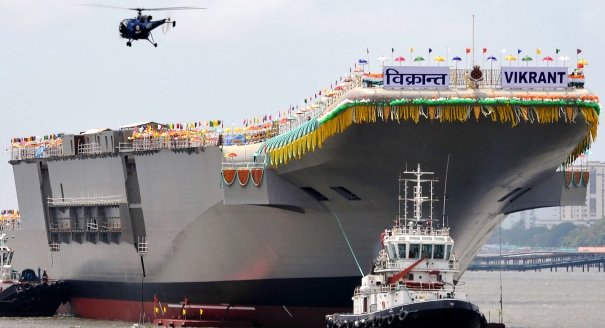
The experience of Russian-Indian cooperation in the process of building the aircraft carrier Vikramaditya helped India initiate work on building the Vikrant aircraft carrier, which began in 2009 (Nevskoe Design Bureau participated in its design). Vikrant was finally launched in the water on 10 June 2015. Its sea-trials may begin in 2017.
According to V. Komardin, Deputy General Director of Rosoboronexport, Russia cooperated with India in the construction of the Vikrant for everything related to aviation equipment.
For the Indian Navy’s marine aviation, Russia is supplying the ship-based multipurpose fighters MiG-29K and MiG-29KUB. The first contract for the supply of 16 jets of both modifications was signed in 2004, the second in 2010. The Russian Aviation Corporation MiG will supply the second batch in 2016.
These examples are nowhere near representative of all the projects implemented by Russia and India within the framework of military-technical cooperation for the Indian navy. These examples show the exclusivity of relations between Russia and India. India also has other partners. But none of them are prepared to develop strategic projects in the interests of India's nuclear submarine or aircraft carrier fleets.
Former Fellow, Nonproliferation Program, Moscow Center
Topychkanov was a fellow in the Carnegie Moscow Center’s Nonproliferation Program.
Recent Work


James M. Acton, Alexey Arbatov, Vladimir Dvorkin, …
Petr Topychkanov
Carnegie does not take institutional positions on public policy issues; the views represented herein are those of the author(s) and do not necessarily reflect the views of Carnegie, its staff, or its trustees.

China’s banking crisis in the 2000s was resolved by transferring the costs to households through financial repression—a decision that recapitalized the banks while exacerbating the structural imbalances that continue to shape the Chinese economy today.

Michael Pettis

But their "principal to principal" model will only be as effective as the political strength of each leader back home.

Damien Ma

U.S. unpredictability has allowed China to capitalize on its positioning as the “responsible great power”. Paradoxically, the more China wins the perception game, the more likely expectations will rise for Beijing to deliver not just words but to demonstrate with its deeds.

Chong Ja Ian

Hanoi and Beijing have long treated each other as distant cousins rather than comrades in arms. That might be changing as both sides draw closer to hedge against uncertainty and America’s erratic behavior.

Nguyễn Khắc Giang

Across Asia, China is better positioned to withstand energy shocks from the fallout of the Iran war. Its abundant coal capacity can ensure stability in the near term. Yet at the same time, the country’s energy transition away from coal will make it even less vulnerable during the next shock.
Damien Ma