

Research
- +5
Alper Coşkun, Fatih Ceylan, Tacan İldem, …
{
  "authors": [
    "Sinan Ülgen"
  ],
  "type": "other",
  "centerAffiliationAll": "dc",
  "centers": [
    "Carnegie Endowment for International Peace",
    "Carnegie Europe",
    "Malcolm H. Kerr Carnegie Middle East Center"
  ],
  "collections": [
    "Iranian Proliferation"
  ],
  "englishNewsletterAll": "ctw",
  "nonEnglishNewsletterAll": "",
  "primaryCenter": "Carnegie Europe",
  "programAffiliation": "EP",
  "programs": [
    "Europe"
  ],
  "projects": [],
  "regions": [
    "Middle East",
    "Europe",
    "Iran",
    "Western Europe"
  ],
  "topics": [
    "Foreign Policy",
    "Political Reform",
    "Nuclear Policy"
  ]
}
Source: Getty
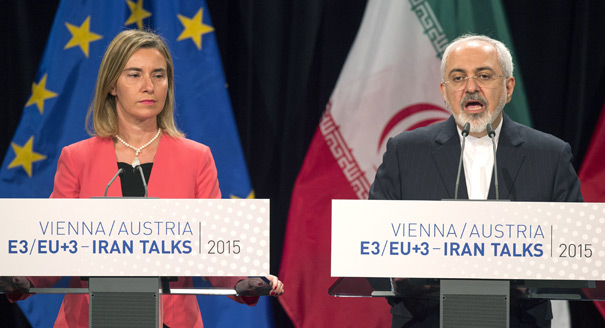
The Iran deal can create a new climate of cooperation and raise the prospect of peace and stability in the Middle East.
Source: Metro
After a decade of negotiations, world powers have reached a deal that will limit Iran’s nuclear activity in exchange for lifting the country’s economic sanctions. Sinan Ulgen, a visiting scholar at the Carnegie Europe think-tank, explains to Metro the implications of the historic agreement.
There are a number of areas where the two sides had to concede compared to their initial negotiating positions. For instance, Iran wanted sanctions to be lifted with the signature of the agreement. The international community had initially wanted Iran to stop all enrichment activity. In the end, Iran obtained the right to keep some enrichment capacity but certainly much less than what it had set up until now.
It is the first time that the Iranian regime commits itself to such intrusive international inspections regarding its nuclear program. Following the ill-fated U.S. intervention in Iraq in 2003, Iran has ascertained itself as a regional power on the basis of a growing sectarian polarisation. Tehran has used this influence to unsettle regional balances. Now with the deal, there is hope that a new climate of cooperation can be created in order to raise the prospect of peace and stability in the Middle East, at a time when the rise of the Islamic State has the potential to upend the regional order.
It is a vastly complicated and technical deal. The P5+1 Group [China, France, Russia, UK, U.S., plus Germany] had not only to negotiate with Iran but they also had to maintain unity with their group. So the dynamics of the negotiations were very difficult. More generally, however, incentives were lacking on the Iranian side. The regime feared a backlash domestically if it was seen to be capitulating to the demands of the West on program that nourishes popular pride. But the severe economic impact of the sanctions changed this calculus and compelled the Iranian leadership to seek and acceptable settlement.
Failure to reach an agreement would have heralded an environment of confrontation and possibly military strikes against Iran to curtail its nuclear program. The threat of military confrontation has thus been averted. The deal opens a new window of opportunity for dialogue between Iran and the West.
The deal has to be implemented. Iran has to start fulfilling its commitments; the International Atomic Energy Agency will monitor the pace and scope of this implementation. It will eventually report back to the United Nations Security Council that Iran is in full compliance with its commitments. In the meantime, the U.S. administration will also need to move ahead with the lifting of its sanctions. That will necessitate Obama to convince a lukewarm Congress.

Senior Fellow, Carnegie Europe
Sinan Ülgen is a senior fellow at Carnegie Europe in Brussels, where his research focuses on Turkish foreign policy, transatlantic relations, international trade, economic security, and digital policy.
Recent Work

Alper Coşkun, Fatih Ceylan, Tacan İldem, …
Carnegie does not take institutional positions on public policy issues; the views represented herein are those of the author(s) and do not necessarily reflect the views of Carnegie, its staff, or its trustees.

But their "principal to principal" model will only be as effective as the political strength of each leader back home.

Damien Ma

U.S. unpredictability has allowed China to capitalize on its positioning as the “responsible great power”. Paradoxically, the more China wins the perception game, the more likely expectations will rise for Beijing to deliver not just words but to demonstrate with its deeds.

Chong Ja Ian

Hanoi and Beijing have long treated each other as distant cousins rather than comrades in arms. That might be changing as both sides draw closer to hedge against uncertainty and America’s erratic behavior.

Nguyễn Khắc Giang

Across Asia, China is better positioned to withstand energy shocks from the fallout of the Iran war. Its abundant coal capacity can ensure stability in the near term. Yet at the same time, the country’s energy transition away from coal will make it even less vulnerable during the next shock.
Damien Ma

Malaysia’s chairmanship sought to fend off short-term challenges while laying the groundwork for minimizing ASEAN’s longer-term exposure to external stresses.

Elina Noor