

Article
C. Raja Mohan, Darshana M. Baruah
{
  "authors": [
    "C. Raja Mohan"
  ],
  "type": "legacyinthemedia",
  "centerAffiliationAll": "dc",
  "centers": [
    "Carnegie Endowment for International Peace",
    "Carnegie India"
  ],
  "collections": [],
  "englishNewsletterAll": "ctw",
  "nonEnglishNewsletterAll": "",
  "primaryCenter": "Carnegie India",
  "programAffiliation": "SAP",
  "programs": [
    "South Asia"
  ],
  "projects": [],
  "regions": [
    "South Asia",
    "India",
    "North America",
    "United States",
    "East Asia",
    "China"
  ],
  "topics": [
    "Technology",
    "Foreign Policy"
  ]
}
Source: Getty
If China, whose cyber philosophy is fundamentally different from that of the United States, can cut deals with American businesses, why has India been so reluctant to seize the opportunities for a deeper digital partnership?
Source: Indian Express
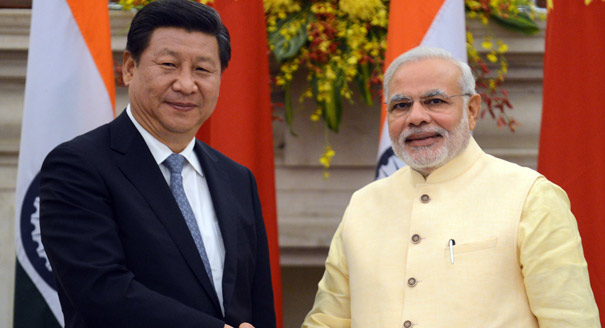
With its focus this week on Prime Minister Narendra Modi’s visit to America, a self-obsessed India may be pardoned for ignoring Chinese President Xi Jinping’s travels in the United States. Whether India pays attention or not, the Sino-US relationship is the single most important factor in international politics today and has the greatest impact on New Delhi’s own ties with Washington.
New developments this week between the US and China in the cyber domain are symbolic of the changing nature of the US-China relationship. They also underline the urgency of more purposeful digital diplomacy from Delhi. As US President Barack Obama hosts Xi at the White House later this week, Delhi must come to terms with the fact that China and America compete and cooperate at the same time. The unfolding dynamic between Washington and Beijing is similar to the one between America and the Soviet Union during the Cold War, when they confronted each other around the world but also carefully regulated their military competitionA code of conduct on cyber behaviour, expected to be signed by Obama and Xi this week, will remind many of the era of nuclear arms control. The New York Times reported last week that Washington and Beijing are close to an agreement stipulating that neither country would be the first to launch cyber attacks on the other’s critical infrastructure, like electric grids and the banking system, during peace time.
Many will question the utility, credibility and effectiveness of such a declaration. But the accord may well go down as the first arms-control agreement of the cyber era. It follows a series of US allegations of Chinese cyber attacks orchestrated by state agencies including the People’s Liberation Army. In May, a US federal grand jury indicted six Chinese on charges of industrial espionage. There was intense speculation in the last few weeks that Washington might follow up with new cyber sanctions against Chinese entities. Washington’s decision to hold back on the sanctions appears to have created the space to wrap up the first cyber agreement between America and China.
Washington, which used to dismiss the nuclear capabilities of China as inconsequential, is now offering a grudging recognition that engagement with Beijing is critical for the management of the emerging cyber challenges. For Xi, the cyber agreement is a vindication of its demand that America show respect for China’s new position as the second most important military power and accept its call to build a new type of great power relationship.
Xi’s cyber diplomacy is not limited to his engagement with Obama. Much like Modi, Xi is spending some quality time on the American west coast. If Modi is catching up with the top guns of Silicon Valley, Xi begins his tour of America at Seattle — another centre of technological innovation in the world. Xi plans to visit a Boeing assembly line near Seattle. China is the top international customer of Boeing, which has deep roots in Seattle. He will address the China-US Internet Industry Forum, hosted by Microsoft and the Internet Society of China. Xi is accompanied by senior officials in charge of Beijing’s internet policy and the CEOs of its top companies. In Seattle, Xi will also have an intensive round of discussions with the leading American businessmen.
The US corporate sector, long the most reliable friend of China in America, has been deeply concerned in recent years about Beijing’s industrial espionage and theft of intellectual property. It has also chafed at the increasing restrictions placed on operations within China. US businesses have been pressing Washington to start acting against China’s cyber incursions. Xi, however, appears confident that he can leverage the size of Beijing’s market to get US companies to accept some of Beijing’s conditions, and persuade those like Google to return to China.
Xi’s cyber diplomacy in America raises a couple of questions about India’s. If China, whose cyber philosophy is fundamentally different from that of the US, can cut deals with Washington and American businesses, why has India been so reluctant to seize the opportunities for a deeper digital partnership with the US? Why does India, despite shared democratic values with America and the deep links between Bangalore and Silicon Valley, play second fiddle to China and Russia in global debates on cyber issues?
To be sure, Modi has signalled some positive reorientation of India’s approach to internet governance in recent months. But he will have to do much more to enthuse Silicon Valley to ramp up its engagement with India. Modi could begin by asking a simple question. Why do American digital entrepreneurs, including those of Indian origin, find it a lot easier to deal with China, with all its harsh new conditions, than to do business with Delhi?
This article was originally published in the Indian Express.
Former Nonresident Senior Fellow, Carnegie India
A leading analyst of India’s foreign policy, Mohan is also an expert on South Asian security, great-power relations in Asia, and arms control.
Recent Work

C. Raja Mohan, Darshana M. Baruah


Alexander Gabuev, Paul Haenle, C. Raja Mohan, …
Carnegie does not take institutional positions on public policy issues; the views represented herein are those of the author(s) and do not necessarily reflect the views of Carnegie, its staff, or its trustees.

China’s banking crisis in the 2000s was resolved by transferring the costs to households through financial repression—a decision that recapitalized the banks while exacerbating the structural imbalances that continue to shape the Chinese economy today.

Michael Pettis

Chinese biotech companies have been on the receiving end of U.S. economic coercion. Yet their responses have differed significantly because firm and state interests are not uniformly aligned. For Washington, treating all Chinese tech firms the same, irrespective of their actual interests, risks pushing them farther into Beijing’s corner.

Xue Gong

China’s latest energy plan explicitly calls for integrating data centers into the electricity system, particularly connecting them to green energy. It appears Beijing wants to use compute as a source of domestic demand to absorb renewables excess capacity.

Damien Ma

But their "principal to principal" model will only be as effective as the political strength of each leader back home.
Damien Ma

U.S. unpredictability has allowed China to capitalize on its positioning as the “responsible great power”. Paradoxically, the more China wins the perception game, the more likely expectations will rise for Beijing to deliver not just words but to demonstrate with its deeds.

Chong Ja Ian