

Commentary
Perry Cammack, Cassia Bardos
{
  "authors": [
    "Perry Cammack"
  ],
  "type": "legacyinthemedia",
  "centerAffiliationAll": "dc",
  "centers": [
    "Carnegie Endowment for International Peace",
    "Malcolm H. Kerr Carnegie Middle East Center"
  ],
  "collections": [
    "Arab Awakening"
  ],
  "englishNewsletterAll": "menaTransitions",
  "nonEnglishNewsletterAll": "",
  "primaryCenter": "Carnegie Endowment for International Peace",
  "programAffiliation": "MEP",
  "programs": [
    "Middle East"
  ],
  "projects": [],
  "regions": [
    "Middle East",
    "Syria",
    "Levant"
  ],
  "topics": [
    "Political Reform",
    "Economy",
    "Security",
    "Military",
    "Foreign Policy"
  ]
}
Source: Getty
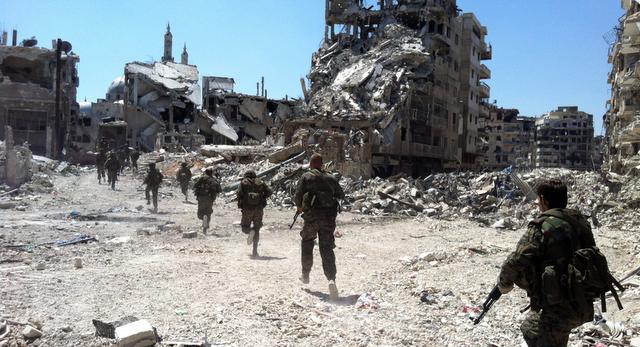
Five years of war in Syria have left large swathes of the country in ruin. While an end to the war is nowhere in sight, a reconstruction bill that is likely to run well over $100 billion means that planning for Syria's eventual rebuilding must start now.
Source: Syria Deeply
Five years of war in Syria have left large swathes of the country in ruin. And with the peace process on the brink of collapse, an end to the war is nowhere in sight. But with a reconstruction bill that is likely to run well over $100 billion, planning for Syria's eventual rebuilding must start now
The cataclysmic destruction of Syria challenges human comprehension. The old city of Aleppo, which like Damascus claims to be the oldest settlement on the planet, has been reduced to rubble. Homs was once the country’s third most populous city, but has mostly beendepopulated.
With the international Syria peace process teetering on the edge of collapse, a political solution seems distant. But every war must end. The rebirth of Dresden, Berlin, and Stalingrad (later renamed Volgograd) after the unthinkable destruction of World War II is a testament to human resiliency and a symbol of what may eventually be possible in Syria. Regardless of whether Syria can be stitched together as a unitary state or is instead permanently partitioned, rebuilding its infrastructure to even modest pre-war levels will require a generational effort...
Former Nonresident Fellow, Middle East Program
Perry Cammack was a nonresident fellow in the Middle East Program at the Carnegie Endowment for International Peace, where he focuses on long-term regional trends and their implications for American foreign policy.
Recent Work
Perry Cammack, Cassia Bardos
Perry Cammack
Carnegie does not take institutional positions on public policy issues; the views represented herein are those of the author(s) and do not necessarily reflect the views of Carnegie, its staff, or its trustees.

The Plaza Accord was not an externally imposed punishment of Japan but part of a broader restructuring that Japanese economists and policymakers themselves recognized was necessary. Its effects were undermined, however, when Tokyo responded to the resulting slowdown with policies that exacerbated investment, credit expansion, and the very imbalances the adjustment was intended to resolve.

Michael Pettis
China’s banking crisis in the 2000s was resolved by transferring the costs to households through financial repression—a decision that recapitalized the banks while exacerbating the structural imbalances that continue to shape the Chinese economy today.
Michael Pettis

But their "principal to principal" model will only be as effective as the political strength of each leader back home.

Damien Ma

U.S. unpredictability has allowed China to capitalize on its positioning as the “responsible great power”. Paradoxically, the more China wins the perception game, the more likely expectations will rise for Beijing to deliver not just words but to demonstrate with its deeds.

Chong Ja Ian

Hanoi and Beijing have long treated each other as distant cousins rather than comrades in arms. That might be changing as both sides draw closer to hedge against uncertainty and America’s erratic behavior.

Nguyễn Khắc Giang