

Article
C. Raja Mohan, Darshana M. Baruah
{
  "authors": [
    "C. Raja Mohan"
  ],
  "type": "legacyinthemedia",
  "centerAffiliationAll": "dc",
  "centers": [
    "Carnegie Endowment for International Peace",
    "Carnegie India"
  ],
  "collections": [],
  "englishNewsletterAll": "ctw",
  "nonEnglishNewsletterAll": "",
  "primaryCenter": "Carnegie India",
  "programAffiliation": "SAP",
  "programs": [
    "South Asia"
  ],
  "projects": [],
  "regions": [
    "Asia",
    "South Asia",
    "India",
    "East Asia",
    "Southeast Asia"
  ],
  "topics": [
    "Foreign Policy",
    "Security"
  ]
}
Source: Getty
Delhi must try and build a stable balance of the power system in the region. That would demand greater military engagement with all the major powers, and not “military neutrality” between them.
Source: Indian Express
Political anxieties about India’s growing defence ties with Washington persist despite the NDA government’s repeated clarifications that the recent logistics support agreement is not about building a military alliance with the US. While the public debate on this issue is centred on high principles, Delhi’s policymakers are under compulsion to adapt to the rapidly evolving power shift in and around India’s neighbourhood. As a result, Indian foreign policy’s military dimension is likely to loom larger than ever before.
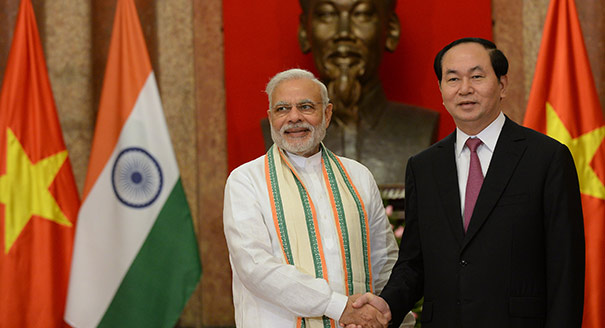
Consider the following developments in the last few days: During his visit to Vietnam last week, Prime Minister Narendra Modi and his interlocutors agreed to elevate their long standing military collaboration to a “comprehensive strategic partnership”. In an intensification of India’s military commitment to Vietnam, the PM announced Delhi’s decision to extend a $500-million credit line to Hanoi for the purchase of Indian defence equipment. This is in addition to the $100-million defence credit offered some years ago.
Another was the Afghan Taliban’s strong public criticism of India’s reported plans to step up military assistance to Kabul. In a statement on Sunday, Zabiullah Mujahid, the main spokesman for the Taliban, demanded that India stop “prolonging the lifespan” of the Kabul regime with its military aid.
Meanwhile, in a report published in Pakistan on Sunday, The Express Tribune said that Islamabad is negotiating a new long-term defence pact with China. The news leak in Islamabad has come days after the signing of the Logistics Exchange Memorandum of Agreement (LEMOA) between India and the US at the end of August during Defence Minister Manohar Parrikar’s visit to Washington.
While Pakistan’s concern about deepening military cooperation between India and the US is understandable, the Congress party’s reaction to the LEMOA captures the continuing confusion in India. It was indeed the UPA government that opened up India to substantive defence cooperation with the US by signing a 10-year framework agreement in May 2005. But the Congress leadership soon developed cold feet and held back from signing agreements like the LEMOA.
In the statement issued in New Delhi on August 30, the Congress declared that the signing of the LEMOA is a “fundamental departure from India’s time-tested policy of “strategic military neutrality”. The surprising phrase, “strategic military neutrality”, however, sits uneasily with the proposition that it is “time-tested”. The drafters of the press release perhaps were probably constructing this neologism as a synonym for the more popular terms “strategic autonomy” and “non-alignment”.
The idea of “neutrality” nevertheless grates. In defining non-alignment as the leitmotif of India’s foreign policy, Pandit Jawaharlal Nehru was not seeking to turn India into a giant Switzerland, the exemplar of “neutrality” in the Westphalian world. For Nehru, non-alignment was about retaining the independence of judgment and freedom of political action. For India’s first PM, non-alignment was not about equidistance between major powers but of taking positions based on India’s interest and building military partnerships when necessary.
The Congress added that the LEMOA will “cause serious misgivings, unless explained and justified, among India’s traditional partners and time-tested allies, regionally and globally”. One wonders how “time-tested strategic military neutrality” squares with the idea of “time-tested allies”? The problem for the Congress, it would seem, is not really with the break from the principle of “non-alignment”, but of a strategic embrace with the US. There might be few objections from it, if Delhi were to sign a LEMOA agreement with say Russia or Japan.
While there are good reasons for this discomfort with the US — its alliance with Pakistan is one of them — India’s apprehensions of Chinese power are even stronger. In the wake of the 1962 war with China, Nehru turned to Washington for military assistance and considered a long-term strategic partnership. As the US drew closer to China at the turn of the 1970s, India aligned with the Soviet Union.
Like the LEMOA now, the Indo-Soviet Treaty of 1971 was criticised by many as a departure from the principles of “non-alignment”. But what India did with Russia was a classic balancing act against the Sino-American entente and their special relations with Pakistan. Forget the formal claims of Delhi and Beijing that they don’t do alliances. India could not but view China’s nuclear and missile cooperation with Pakistan as an “alliance”. China was not going to be impressed by Delhi’s claims that its relationship with Moscow was not an alliance.
Whatever the myth of “strategic military neutrality” might be, Delhi today cannot be neutral between China and Vietnam or between the Taliban and Kabul. As China’s military power radiates into the subcontinent with ever greater vigour, Delhi has begun to react. Relying on old myths is not going to help India avoid a potential conflict with China. Delhi must instead try and build a stable balance of the power system in the region. That would demand greater military engagement with all the major powers, and not “military neutrality” between them.
This article was originally published by the Indian Express.
Former Nonresident Senior Fellow, Carnegie India
A leading analyst of India’s foreign policy, Mohan is also an expert on South Asian security, great-power relations in Asia, and arms control.
Recent Work

C. Raja Mohan, Darshana M. Baruah


Alexander Gabuev, Paul Haenle, C. Raja Mohan, …
Carnegie does not take institutional positions on public policy issues; the views represented herein are those of the author(s) and do not necessarily reflect the views of Carnegie, its staff, or its trustees.

China has showcased its engineering prowess with small modular reactor demonstration projects. But turning these technological achievements into commercial success will be a greater challenge.

Tong Zhao

The Plaza Accord was not an externally imposed punishment of Japan but part of a broader restructuring that Japanese economists and policymakers themselves recognized was necessary. Its effects were undermined, however, when Tokyo responded to the resulting slowdown with policies that exacerbated investment, credit expansion, and the very imbalances the adjustment was intended to resolve.

Michael Pettis

The nuclear relationship between China and the United States is increasingly shaped by widening perception gaps rather than deliberate strategic design.
Tong Zhao
China’s banking crisis in the 2000s was resolved by transferring the costs to households through financial repression—a decision that recapitalized the banks while exacerbating the structural imbalances that continue to shape the Chinese economy today.
Michael Pettis

Chinese biotech companies have been on the receiving end of U.S. economic coercion. Yet their responses have differed significantly because firm and state interests are not uniformly aligned. For Washington, treating all Chinese tech firms the same, irrespective of their actual interests, risks pushing them farther into Beijing’s corner.

Xue Gong