

Commentary
Dmitri Trenin
{
  "authors": [
    "Dmitri Trenin"
  ],
  "type": "legacyinthemedia",
  "centerAffiliationAll": "",
  "centers": [
    "Carnegie Endowment for International Peace",
    "Carnegie China",
    "Carnegie Russia Eurasia Center"
  ],
  "collections": [
    "China’s Foreign Relations"
  ],
  "englishNewsletterAll": "",
  "nonEnglishNewsletterAll": "",
  "primaryCenter": "Carnegie Russia Eurasia Center",
  "programAffiliation": "",
  "programs": [],
  "projects": [],
  "regions": [
    "East Asia",
    "China",
    "Russia"
  ],
  "topics": [
    "Foreign Policy"
  ]
}
Source: Getty
Chinese and Russians now better understand both the potential and the limitations of their relationship. They need to move ahead on concrete issues, making sure that what is agreed upon at the top actually gets implemented.
Source: Global Times
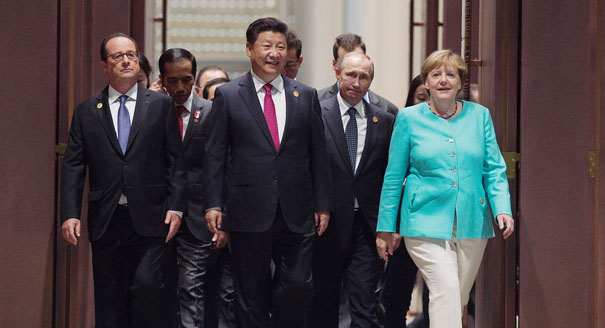
Since the signing in 2001 of the treaty of friendship between China and Russia, Russia-China summits have become routine. Presidents Vladimir Putin and Chinese President Xi Jinping had their latest get-together on the margins of the G20 in Hangzhou, just 10 weeks or so after their talks in Beijing in late June. This time, the two leaders did not sign, as they often do, dozens of agreements on economic and cultural cooperation. Rather, they had a chance to discuss the fast-changing international environment, sought to coordinate their countries' moves, and looked into ways of making their recently signed bilateral agreements work more efficiently.
One issue on the minds of Chinese regarding Russia is whether Moscow's current break with the West and its "turn to the East" represents a genuine long-term reversal in Russia's strategic orientation.
Evidently, Russia is seeking to return to normal economic relations with Europe, and it also continues efforts to bring about a political settlement in Syria in cooperation with Washington. Meanwhile, its loudly proclaimed opening to Asia has been too timid, and the results that the Russians have reaped so far are underwhelming.
There are certainly many Russians who regard the present state of relations with America and Europe as an aberration and want to return to some sort of "business as usual" with the West. Yet, this is highly unlikely in the foreseeable future.
Putin will not change course and make strategic concessions to the US. The new US president will not offer the Kremlin a new "reset" and reach out to Putin for a grand bargain. It is probably safe to say that while Putin is in power - and this is likely to be many more years - US-Russian relations will be at best transactional, and generally adversarial.
The year 2014 saw the demise of two principal concepts that had driven Russia's foreign policy since the breakup of the Soviet Union: Russia's integration into the West and re-integration of the former Soviet states with Russia. The conceptual void has now become a conceptual construction site.
One concept that is gaining prominence is "Greater Eurasia," which sees Russia as a key, though of course not a dominant, element, of a loose geopolitical arrangement which encompasses much of continental Asia. The centerpiece of this arrangement would be the Shanghai Cooperation Organization.
Within the vast and highly diverse "Greater Eurasia," relations with China are certainly a top priority. But over the past two and a half years, these relations have assumed a new quality. Perhaps the best term to describe it would be "entente," a French word that suggests an advanced degree of mutual understanding and empathy, while also allowing successful management of differences.
Most bilateral issues between Russia and China these days are linked to various fairly mundane obstacles hampering their practical economic interaction. To make sure that their agreements do not remain on paper, Putin and Xi need to push to lower trade barriers. They need to focus on protecting investments and expanding infrastructure to allow wider use of national currencies in two-way trade. They would do well to instruct their ministers to allow Chinese companies freer access to infrastructure projects in Russia, and to give Russians greater access to Chinese financial markets.
There are also a number of specific projects, from the long-delayed bridge over the Amur River and the proposed Zarubino grain terminal, to the high-speed rail eventually linking Russia and China across Kazakhstan and joint projects in nuclear energy and aerospace.
The recent Putin-Xi agreement on "harmonizing" the Eurasian Economic Union and the "Belt & Road" initiative is now clearly demanding specifics. China's participation in the development of the Northern Sea Route from East Asia to Northern Europe across the Arctic is another issue waiting for an operational concept.
Chinese and Russians now know better both the potential and the limitations of their relationship. With this knowledge and understanding, they need to move ahead on concrete issues, making sure that what is agreed upon at the top actually gets implemented.
Former Director, Carnegie Moscow Center
Trenin was director of the Carnegie Moscow Center from 2008 to early 2022.
Recent Work
Dmitri Trenin
Dmitri Trenin
Carnegie does not take institutional positions on public policy issues; the views represented herein are those of the author(s) and do not necessarily reflect the views of Carnegie, its staff, or its trustees.

Chinese biotech companies have been on the receiving end of U.S. economic coercion. Yet their responses have differed significantly because firm and state interests are not uniformly aligned. For Washington, treating all Chinese tech firms the same, irrespective of their actual interests, risks pushing them farther into Beijing’s corner.

Xue Gong

China’s latest energy plan explicitly calls for integrating data centers into the electricity system, particularly connecting them to green energy. It appears Beijing wants to use compute as a source of domestic demand to absorb renewables excess capacity.

Damien Ma

But their "principal to principal" model will only be as effective as the political strength of each leader back home.
Damien Ma

U.S. unpredictability has allowed China to capitalize on its positioning as the “responsible great power”. Paradoxically, the more China wins the perception game, the more likely expectations will rise for Beijing to deliver not just words but to demonstrate with its deeds.

Chong Ja Ian

Hanoi and Beijing have long treated each other as distant cousins rather than comrades in arms. That might be changing as both sides draw closer to hedge against uncertainty and America’s erratic behavior.

Nguyễn Khắc Giang