

Q&A
Darshana M. Baruah, Satyendra Prasad, Denghua Zhang
{
  "authors": [
    "Darshana M. Baruah"
  ],
  "type": "legacyinthemedia",
  "centerAffiliationAll": "",
  "centers": [
    "Carnegie Endowment for International Peace",
    "Carnegie India"
  ],
  "collections": [],
  "englishNewsletterAll": "",
  "nonEnglishNewsletterAll": "",
  "primaryCenter": "Carnegie India",
  "programAffiliation": "",
  "programs": [],
  "projects": [],
  "regions": [
    "Asia",
    "South Asia",
    "India",
    "East Asia",
    "Japan"
  ],
  "topics": [
    "Foreign Policy",
    "Security"
  ]
}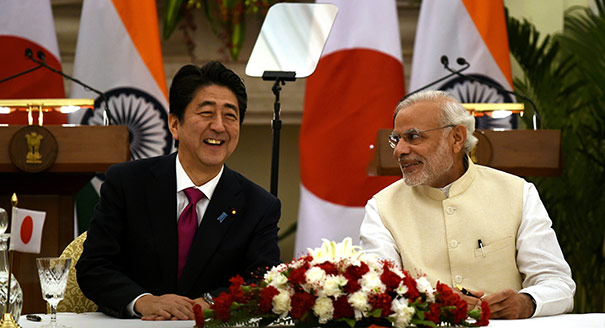
Source: Getty
By addressing strategic concerns beyond the realm of security cooperation, the leaders of India and Japan have found a unique and constructive way to collaborate in the Indian Ocean and beyond.
Source: Asia Maritime Transparency Initiative
The annual summit between Indian prime minister Narendra Modi and his Japanese counterpart Shinzo Abe, held on November 11 in Tokyo, once again underscored the importance of maritime security in the bilateral relationship. Describing the relationship as “unique” and “special,” the two leaders talked of a greater convergence in their visions for Asia. While there have been developments in almost all areas of the relationship, maritime security under Modi and Abe has become one of the most visible areas of cooperation in the strategic partnership. By addressing strategic concerns beyond the realm of security cooperation, the leaders have found a unique and constructive way to collaborate in the Indian Ocean and beyond.
The joint statement issued after the summit taps into the potential of infrastructure investment in the maritime domain which could further New Delhi and Tokyo’s converging strategic maritime interests. India’s goals in the Indian Ocean are clear: to remain a leader and preserve its status as a dominant actor, depending on its capabilities, access, and outreach. Japan wants to increase its role in maintaining the current regional security order and balance the rise of China. Together, their concerns and opportunities converge in the Indian Ocean and outward into the larger Indo-Pacific.
A key recent development has been the inclusion of Japan as a regular participant in MALABAR, a joint naval exercise between the U.S. and Indian navies. India and Japan also conduct their own regular bilateral exercise, JIMEX. India’s growing naval ties with Japan have symbolic and strategic significance given India’s understanding of a changing maritime environment in Asia. A 2007 quadrilateral maritime exercise involving Australia, India, Japan, and the United States drew sharp criticism from China and was viewed as a containment measure. Since then, India has maintained its distance from the idea, and continued engaging at a bilateral level. Inviting Japan to participate in MALABAR was a clear message of intent and political will. While India is still apprehensive of the quadrilateral arrangement, New Delhi and Tokyo are keen to work together and more closely than before.
It is not naval exercises alone that have elevated the strategic level of the Indo-Japanese maritime relationship, however. While exercises facilitate better understanding between the two navies, it is engagement beyond traditional exercises that underscores this emerging relationship. India and Japan are keen to develop infrastructure and increase connectivity in the Indian Ocean region, expanding their spheres of strategic and economic influence. Connectivity projects are rapidly becoming the new sphere of competition, with significant strategic undertones. Chinese actions in and around the Indian Ocean, especially, are a cause for concern in New Delhi. Many developments add to India’s concerns over China’s expansion in the Indian Ocean: deepening relationships between Beijing and island states of the Indian Ocean; the Maritime Silk Road intended to connect Southeast Asia with Europe through the Indian Ocean; the joint venture between China and Pakistan to develop the port of Gwadar; China’s deployment of nuclear submarines for anti-piracy missions; the frequent docking of Chinese submarines in Sri Lanka; and Beijing’s infrastructure development projects in the Maldives, Myanmar, and Mauritius.
While New Delhi is concerned about the strategic implications of Chinese connectivity projects, Tokyo is competing to reinforce its place as a dominant aid donor investing in infrastructure. Together, India and Japan have found common ground to collaborate on and expand their economic and strategic goals.
The joint statement from the November meeting between Modi and Abe reflects on this growing convergence and provides an insight into future joint collaboration between the two nations. Abe talked about a “Free and Open Indo-Pacific Strategy” and Modi welcomed Japan’s deepening engagements under this strategy. One highlight was the announcement of a plan to develop corridors connecting Asia and Africa through the Indian Ocean. Although details are very limited, this project could be a significant strategic counter to China’s Maritime Silk Road. Given India’s current priority on developing infrastructure, this corridor will likely aim to develop ports connecting Asia and Africa. India’s new maritime strategy focuses largely on expanding its reach across the Indian Ocean by increasing domain awareness through a network of radar stations with friendly nations.
New Delhi and Tokyo are likely to find projects which will enhance India’s efforts to build up its capabilities and expand its influence across the region. India and Japan have previously outlined an interest in boosting infrastructure in the strategically located Andaman and Nicobar Islands. The recent joint statement built on that idea with a plan for “smart islands” in the Indo-Pacific. While there is limited clarity on what smart islands will entail, this project will likely aim to build capacity of smaller islands in the region.
The two leaders also announced their intent for joint development in Iran and Afghanistan, specifically identifying development of the Chabahar port in Iran as an area of interest. Such an endeavor is critical in the context of Chinese development in Gwadar, in neighboring Pakistan. Another area where India and Japan have a massive potential for cooperation is the Bay of Bengal. Japan is already investing in a Bay of Bengal Industrial Growth Belt, also known as the Big-B initiative, in an effort to increase connectivity between Southeast Asia and South Asia in the larger Indian Ocean region.
New Delhi and Tokyo are using infrastructure development to advance their strategic maritime goals in the Indo-Pacific. Their cooperation in the Indian Ocean is far more strategic than traditional security collaborations. The proposed corridors and infrastructure investments will reinforce Indian influence in the region. Together with New Delhi’s strategic outreach in the Indian Ocean, cooperation with Japan provides a strong boost to India’s goal of becoming a leader in the Indo-Pacific region.
This article was originally published by the Asia Maritime Transparency Initiative.

Former Nonresident Scholar, South Asia Program
Darshana M. Baruah was a nonresident scholar with the South Asia Program at the Carnegie Endowment for International Peace where she directs the Indian Ocean Initiative.
Recent Work

Darshana M. Baruah, Satyendra Prasad, Denghua Zhang
Darshana M. Baruah
Carnegie does not take institutional positions on public policy issues; the views represented herein are those of the author(s) and do not necessarily reflect the views of Carnegie, its staff, or its trustees.

The nuclear relationship between China and the United States is increasingly shaped by widening perception gaps rather than deliberate strategic design.

Tong Zhao

China’s banking crisis in the 2000s was resolved by transferring the costs to households through financial repression—a decision that recapitalized the banks while exacerbating the structural imbalances that continue to shape the Chinese economy today.

Michael Pettis

Chinese biotech companies have been on the receiving end of U.S. economic coercion. Yet their responses have differed significantly because firm and state interests are not uniformly aligned. For Washington, treating all Chinese tech firms the same, irrespective of their actual interests, risks pushing them farther into Beijing’s corner.

Xue Gong

But their "principal to principal" model will only be as effective as the political strength of each leader back home.

Damien Ma

U.S. unpredictability has allowed China to capitalize on its positioning as the “responsible great power”. Paradoxically, the more China wins the perception game, the more likely expectations will rise for Beijing to deliver not just words but to demonstrate with its deeds.

Chong Ja Ian