

Commentary
Dmitri Trenin
{
  "authors": [
    "Dmitri Trenin"
  ],
  "type": "legacyinthemedia",
  "centerAffiliationAll": "",
  "centers": [
    "Carnegie Endowment for International Peace",
    "Carnegie China",
    "Carnegie Russia Eurasia Center"
  ],
  "collections": [
    "China’s Foreign Relations",
    "U.S.-China Relations"
  ],
  "englishNewsletterAll": "",
  "nonEnglishNewsletterAll": "",
  "primaryCenter": "Carnegie Russia Eurasia Center",
  "programAffiliation": "",
  "programs": [],
  "projects": [],
  "regions": [
    "North America",
    "United States",
    "East Asia",
    "China",
    "Russia"
  ],
  "topics": [
    "Foreign Policy"
  ]
}
Source: Getty
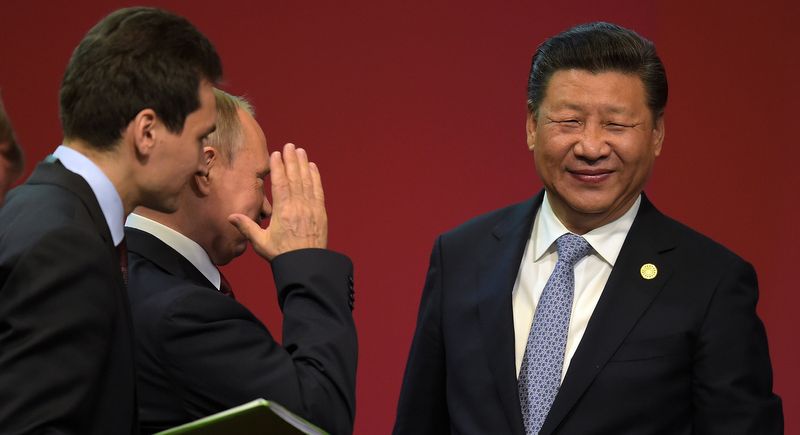
Both China and Russia are led by leaders acting out of the national interest, which should mean that even if President Xi or President Putin will not be able to resolve their differences with President Trump, they will at least speak the same language.
Source: Global Times
In 2017, the triangle of the US, China and Russia, the world's three major powers, is going to see substantial changes. Until this past fall, it appeared that the trends that had been established in the last three years would continue. Donald Trump's victory in the US presidential election nixed that scenario. There are still a lot of uncertainties about exactly where and how Trump and his team would move Washington's foreign policy, but it is clear that a discontinuation with the present administration will be imminent. Trump may also try to revise the entire US approach to the world, which has been in place since the end of the Cold War. If so, China and Russia will be central to that revision.
Barack Obama, the outgoing US president, represents a globalist tradition which puts the emphasis on the world system that runs out of Washington - a modern version of an empire - rather than on the US itself. Trump, by contrast, is an American nationalist who is seeking to correct the excesses of US-inspired, US-led globalism that have impaired parts of the US economy and disadvantaged millions of Americans.While Obama was busy creating new global institutions built on American norms and principles and heavily influenced by the US, Trump will seek better deals with America's global trading partners. This affects TPP and TTIP, and the Paris agreement on climate change. This will also affect relations with China.
While many American liberals hail the fact that China has been a prime beneficiary of globalization, Trump is not amused. He is unlikely to start a major trade war with China by imposing prohibitive tariffs on Chinese imports, or to wreck the one China policy, but he will try to correct the equation, and use all kinds of leverage to force Beijing to make concessions.
China, for its part, is sure to respond with measures of its own. As a result, the balance in the Sino-US relations will probably shift more toward competition, but will not slide toward the sort of confrontation that the US-Russian relations have experienced since 2014.
Trump's tougher stance on China is likely to be accompanied by a certain softening of his attitude toward Russia. Trump rejects the notion of Russia as "the US geopolitical foe No.1," to use the famous quote of Mitt Romney, later turned into the official threat perceptions of Ashton Carter's Pentagon.
Under Trump, the US-Russian relations will hardly resemble a love fest, but at least the currently dangerous confrontation between the two, fraught with a non-negligible possibility of their kinetic collision, can be transformed into a more manageable competition.
Such a rebalancing of the US relations with the two other major powers would improve Washington's position in the triangle. It would create challenges for Beijing, which recently has enjoyed an excellent position at the top of the triangle, maintaining far better ties with both America and Russia than those two have had between themselves. Even if full-scale confrontation with the US is hardly an option, China will have to learn to stand up to the US more directly, while at the same time, limiting the damage to its most important foreign relationship.
Beijing can be assured of one thing, though. Any easing in Russia's tensions with the US and the EU will not lead to Moscow abandoning or slackening its ties with China, which today are closer and more solid than the phrase "strategic partnership" suggests. Russia has finally left behind its hopes of integration into the West and sees itself as a major independent player on the global stage. Moscow's relations with Beijing are founded on the premise that the two will never turn against each other, but neither will they automatically follow each other: a fine combination of reassurance and flexibility.
Critics often call Trump unpredictable, inexperienced and even ignorant about world affairs. His cabinet of billionaires and generals is criticized for their occupational biases. However, if the Trump administration bases its policies squarely on the US national interest, it may become easier to reach an understanding on contentious issues between the US and the other two major powers.
Both China and Russia are led by leaders acting out of the national interest, which should mean that even if President Xi or President Putin will not be able to resolve their differences with President Trump, they will at least speak the same language.
Former Director, Carnegie Moscow Center
Trenin was director of the Carnegie Moscow Center from 2008 to early 2022.
Recent Work
Dmitri Trenin
Dmitri Trenin
Carnegie does not take institutional positions on public policy issues; the views represented herein are those of the author(s) and do not necessarily reflect the views of Carnegie, its staff, or its trustees.

The Plaza Accord was not an externally imposed punishment of Japan but part of a broader restructuring that Japanese economists and policymakers themselves recognized was necessary. Its effects were undermined, however, when Tokyo responded to the resulting slowdown with policies that exacerbated investment, credit expansion, and the very imbalances the adjustment was intended to resolve.

Michael Pettis

The nuclear relationship between China and the United States is increasingly shaped by widening perception gaps rather than deliberate strategic design.

Tong Zhao
China’s banking crisis in the 2000s was resolved by transferring the costs to households through financial repression—a decision that recapitalized the banks while exacerbating the structural imbalances that continue to shape the Chinese economy today.
Michael Pettis

Chinese biotech companies have been on the receiving end of U.S. economic coercion. Yet their responses have differed significantly because firm and state interests are not uniformly aligned. For Washington, treating all Chinese tech firms the same, irrespective of their actual interests, risks pushing them farther into Beijing’s corner.

Xue Gong

China’s latest energy plan explicitly calls for integrating data centers into the electricity system, particularly connecting them to green energy. It appears Beijing wants to use compute as a source of domestic demand to absorb renewables excess capacity.

Damien Ma