

Article
C. Raja Mohan, Darshana M. Baruah
{
  "authors": [
    "C. Raja Mohan"
  ],
  "type": "legacyinthemedia",
  "centerAffiliationAll": "dc",
  "centers": [
    "Carnegie Endowment for International Peace",
    "Carnegie India"
  ],
  "collections": [],
  "englishNewsletterAll": "ctw",
  "nonEnglishNewsletterAll": "",
  "primaryCenter": "Carnegie India",
  "programAffiliation": "SAP",
  "programs": [
    "South Asia"
  ],
  "projects": [],
  "regions": [
    "Asia",
    "South Asia",
    "India",
    "East Asia",
    "China"
  ],
  "topics": [
    "Foreign Policy"
  ]
}
Source: Getty
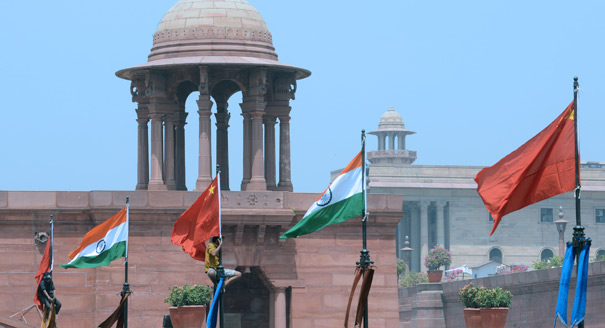
Delhi’s current realism on China is a welcome departure from the past, when India used hide problems in the grandiose rhetoric on global solidarity. Under the new approach, there is no fudging of differences.
Source: Indian Express
Strategic patience is a virtue in statecraft. But it is not about passive and endless waiting. It demands persistent pursuit of one’s goals and seizing the moment when the circumstances turn more favourable. It has certainly come to define India’s recent engagement with China. Foreign Secretary S. Jaishankar’s conversations in Beijing last week with senior Chinese officials offer the first glimmer of hope that India’s patience might begin to pay off. The downturn in bilateral relations over the last year was marked by China’s decision to block India’s campaign for the membership of the Nuclear Suppliers Group (NSG) and putting Pakistan’s Masood Azhar (of the Jaish-e-Mohammed) on the terror list of the United Nations Security Council (UNSC). Delhi was certainly surprised by the intensity and inflexibility of Beijing’s approach to the two issues.
Although Beijing presented its objections in procedural terms, Delhi knew Beijing’s opposition was political. China’s sense of its own rise and a growing political clout in the multilateral arena seemed to convince Beijing that it was under no obligation to make nice with Delhi. After all, the current power differential between the two nations had become too glaring. China’s GDP is now nearly five times larger than that of India and its defence spending is three times bigger. That Delhi and Beijing are peers has long been an unstated assumption of India’s China policy. But Delhi now had to adapt to the political consequences of growing strategic asymmetry.
China’s opposition at the NSG and the UNSC also challenged another long-standing Indian belief. Delhi had also believed that despite deep differences with Beijing on many bilateral issues like the long and contested Himalayan boundary, there was great room for cooperation between India and China on global issues. But the developments at the two multilateral forums, the NSG and the UNSC, seemed to shatter that proposition. Making matters worse was the fact that Pakistan was a critical factor in China’s calculus at the NSG and the UNSC. Whatever the logic of Beijing’s strategic partnership with Islamabad, India had hoped that China will show some sensitivity to India’s concerns and would stay neutral in the disputes between the South Asian rivals. After the NSG and UNSC episodes it was difficult not to conclude that Beijing’s tilt towards Islamabad was absolute and complete.
Delhi, however, held its nerve and chose to persist with a two-fold approach. One was to continue the campaign for the membership of the NSG and putting Masood Azhar on UNSC’s terror list. The other was to take up China’s opposition at every diplomatic encounter — bilateral and multilateral — with Beijing. Despite repeated collisions with the Chinese wall, Delhi refused to give up. Last week’s positive soundings from the first round of the newly instituted strategic dialogue suggest Delhi’s patience and firm persistence on the two issues might have been worthwhile.
On its part, Beijing signaled its readiness to make the first round of strategic dialogue purposeful and the two sides prepared for a substantive discussion. The level of engagement, the breadth of the issues covered and the depth of discussions underlined the new commitment to limit the recent damage to bilateral relations. Setting the stage for last week’s conversation was the Trump factor that threatens to upend all assumptions on where the world is headed. If Delhi and Beijing had thought Trump’s election rhetoric would be mere posturing, they have been taken aback by the determination of the new president to change America’s course. The Trump discontinuity, Delhi and Beijing know, demands some fresh thinking in both capitals. Facile notions of linear and inevitable rise of China and India must now be tempered by the prospect for extraordinary geopolitical disruption.
As Jaishankar told the press in Beijing, “both India and China have been beneficiaries of a stable and open international system” and underlined the importance of limiting the impact of the current international turbulence on their respective national interests. “One thing that we could do together,” Jaishankar added, was to work for a “more stable, substantive, forward looking India-China relationship which would inject a greater amount of predictability into the international system.”
The positive characterisation of last week’s talks by both sides does not mean the multiple divergences can be bridged any time soon. Some issues like the boundary dispute, trade deficit, and the One Belt, One Road initiative, where the differences between the two sides are too deep, are not amenable to easy or early resolution. But others like India’s NSG membership are not too hard to resolve. The hints from Beijing that China is more open on this question are welcome. So are the continuing talks on international terrorism and the discussion on potential for cooperation in stabilising Afghanistan.
Delhi’s current realism on China is a welcome departure from the past, when India used hide problems in the grandiose rhetoric on global solidarity. Under the new approach, there is no fudging of differences. Nor would Delhi throw up its hands in despair. The Indian emphasis is on perseverance with China that puts self-interest above ideology and seeks common ground wherever possible.
This article was originally published in the Indian Express.
Former Nonresident Senior Fellow, Carnegie India
A leading analyst of India’s foreign policy, Mohan is also an expert on South Asian security, great-power relations in Asia, and arms control.
Recent Work

C. Raja Mohan, Darshana M. Baruah


Alexander Gabuev, Paul Haenle, C. Raja Mohan, …
Carnegie does not take institutional positions on public policy issues; the views represented herein are those of the author(s) and do not necessarily reflect the views of Carnegie, its staff, or its trustees.

But their "principal to principal" model will only be as effective as the political strength of each leader back home.

Damien Ma

U.S. unpredictability has allowed China to capitalize on its positioning as the “responsible great power”. Paradoxically, the more China wins the perception game, the more likely expectations will rise for Beijing to deliver not just words but to demonstrate with its deeds.

Chong Ja Ian

Hanoi and Beijing have long treated each other as distant cousins rather than comrades in arms. That might be changing as both sides draw closer to hedge against uncertainty and America’s erratic behavior.

Nguyễn Khắc Giang

Across Asia, China is better positioned to withstand energy shocks from the fallout of the Iran war. Its abundant coal capacity can ensure stability in the near term. Yet at the same time, the country’s energy transition away from coal will make it even less vulnerable during the next shock.
Damien Ma

In the latest Five-Year Plan, the Chinese president cements the shift to an innovation-driven economy over a consumption-driven one.
Damien Ma