

Commentary
But their "principal to principal" model will only be as effective as the political strength of each leader back home.
Damien Ma
{
  "authors": [
    "Constantino Xavier",
    "Garima Mohan"
  ],
  "type": "legacyinthemedia",
  "centerAffiliationAll": "",
  "centers": [
    "Carnegie Endowment for International Peace",
    "Carnegie India"
  ],
  "collections": [],
  "englishNewsletterAll": "",
  "nonEnglishNewsletterAll": "",
  "primaryCenter": "Carnegie India",
  "programAffiliation": "",
  "programs": [],
  "projects": [],
  "regions": [
    "South Asia",
    "India",
    "Western Europe"
  ],
  "topics": [
    "Foreign Policy"
  ]
}
Source: Getty
While traditionally focused on economics and culture, today the EU and India are taking bold steps to also deepen the strategic dimensions of their partnership.
Source: Hindu
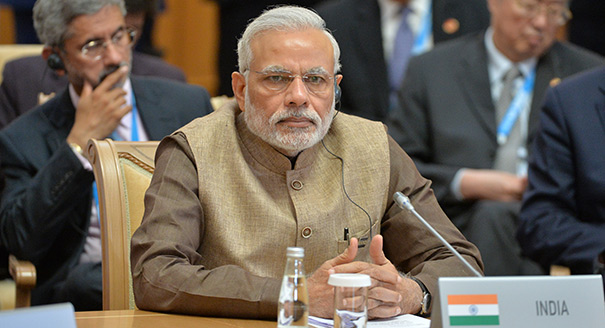
While traditionally focussed on economics and culture, today the EU and India are taking bold steps to also deepen the strategic dimensions of their partnership. This week’s visit to New Delhi of the EU’s High Representative for Foreign Affairs and Security Policy, Federica Mogherini, will likely witness a frank Indo-European dialogue on the changing global and regional security environments.
While the EU and India share similar world views, especially on effective multilateralism, they have rarely found instruments to pursue objectives together and their relationship has stumbled over many impediments in recent years: stalled negotiations over the Free Trade Agreement, mutual recriminations on combating climate change, and divergent positions on Russia’s role during the Crimean crisis. As a result, the strategic partnership has been far from “strategic”.
However, recent developments have shown that there is room for optimism. Prime Minister Narendra Modi’s visit to Brussels and the resumption of the EU-India summit in 2016, after a break of four years, marked a turning point. The summit saw a much stronger focus on security cooperation and the adoption of a joint declaration on counterterrorism.
Pivoting around “principled pragmatism”, the EU’s new Global Strategy (2010) underlines the “direct connection between European prosperity and Asian security”. In their meetings, Ms. Mogherini and Foreign Minister Sushma Swaraj and National Security Adviser Ajit Doval should focus on converging foreign policy priorities into coordinated or common practices. Foremost is dealing with challenges in their shared extended neighbourhood, which stretches from Istanbul to Islamabad and from Moscow to Mauritius. This Eurasian arc of instability is of critical importance to Brussels and New Delhi’s aspirations to stabilise their regional peripheries.
Afghanistan would be the logical starting point. Political coordination through an EU-India-Afghanistan trilateral, with regular security consultations to exchange assessments, could be the first step in this direction. The Indian Ocean region offers another potential area for cooperation.
With uncertainty surrounding American commitments and the formidable rise of China, the EU and India will also have to stop ignoring the dragon in the room. Delhi is keen to counter China’s European offensive, including €50 billion worth of investments since 2000, a dialogue with the EU on the Belt and Road initiative, and the ‘16+1’ mechanism in eastern Europe. As Europe realises the costs of dependence on China, the EU must have a serious dialogue with India and other partners on how to pursue Eurasian connectivity plans that are truly multilateral and sustainable.
Finally, the EU and India also have similar stakes in stronger international institutions and a liberal order that protects global commons cooperatively. If they agree to expand consultations on issues such as climate, trade and space, it is likely that Delhi and Brussels will find themselves agreeing far more times than usually expected.
Former Fellow, Carnegie India
Constantino Xavier was a fellow at Carnegie India, based in New Delhi. His research focus is on India’s foreign policy, with emphasis on relations with its neighboring countries and South Asian regional security.
Former Nonresident Fellow, Carnegie India
Garima Mohan was a nonresident fellow at Carnegie India. Her research focuses on the foreign and security policies of rising powers, particularly that of India, and on Europe-India relations.
Carnegie does not take institutional positions on public policy issues; the views represented herein are those of the author(s) and do not necessarily reflect the views of Carnegie, its staff, or its trustees.

But their "principal to principal" model will only be as effective as the political strength of each leader back home.

Damien Ma

U.S. unpredictability has allowed China to capitalize on its positioning as the “responsible great power”. Paradoxically, the more China wins the perception game, the more likely expectations will rise for Beijing to deliver not just words but to demonstrate with its deeds.

Chong Ja Ian

Hanoi and Beijing have long treated each other as distant cousins rather than comrades in arms. That might be changing as both sides draw closer to hedge against uncertainty and America’s erratic behavior.

Nguyễn Khắc Giang

Across Asia, China is better positioned to withstand energy shocks from the fallout of the Iran war. Its abundant coal capacity can ensure stability in the near term. Yet at the same time, the country’s energy transition away from coal will make it even less vulnerable during the next shock.
Damien Ma

Malaysia’s chairmanship sought to fend off short-term challenges while laying the groundwork for minimizing ASEAN’s longer-term exposure to external stresses.

Elina Noor