

Paper
Constantino Xavier
{
  "authors": [
    "Constantino Xavier"
  ],
  "type": "legacyinthemedia",
  "centerAffiliationAll": "",
  "centers": [
    "Carnegie Endowment for International Peace",
    "Carnegie China",
    "Carnegie India"
  ],
  "collections": [
    "China’s Foreign Relations"
  ],
  "englishNewsletterAll": "",
  "nonEnglishNewsletterAll": "",
  "primaryCenter": "Carnegie India",
  "programAffiliation": "",
  "programs": [],
  "projects": [],
  "regions": [
    "South Asia",
    "India",
    "Bangladesh"
  ],
  "topics": [
    "Foreign Policy",
    "Economy"
  ]
}
Source: Getty
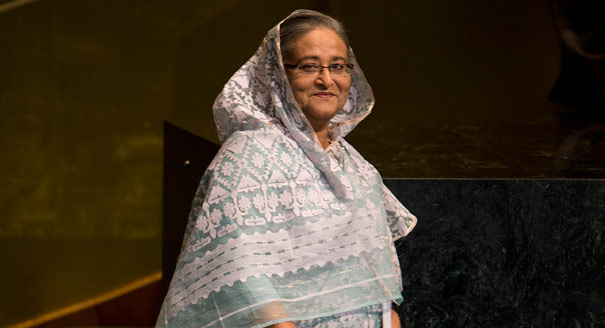
India is focused on making Bangladesh a centerpiece of its Act East policy.
Source: Deutsche Welle
Bangladesh Prime Minister Sheikh Hasina embarked Friday on a four-day visit to India that will see the signing of at least 25 bilateral agreements, including in the key areas of civil nuclear cooperation and defense.
During her visit, which comes after a gap of seven years, Hasina will hold wide-ranging talks with her Indian counterpart Narendra Modi. India is set to announce a $500 million (470 million euro) line of credit to Bangladesh for military supplies.
"The upcoming visit is expected to further expand the cordial and cooperative relationship between India and Bangladesh and build on the strong ties of friendship and trust between the two leaders," a joint statement issued by the two countries said.
The visit comes at a time when policymakers in New Delhi are increasingly worried about China's growing influence in South Asia, a region viewed by India as its backyard.
In a DW interview, Constantino Xavier, a South Asia expert at New Delhi-based Carnegie India, explains the current state of relations between the two countries and its future trajectory.
Constantino Xavier: Relations are at an all-time high. Both countries are committed to transforming the Bay of Bengal region into a hub for connectivity and wealth between South and Southeast Asia. This is an attempt to revive a thriving Bay of Bengal community, which connected the region up until the 1950s, but has disintegrated since then. Creating a cooperative community in the Bay of Bengal will also help stem China's rising influence in the region, including via the Belt and Road Initiative.
India is focused on making Bangladesh a centerpiece of its Act East policy. Whether land-based or maritime, Delhi's connectivity plans for Myanmar and Southeast Asia rely crucially on transit rights and infrastructure development in Bangladesh. It currently takes longer to ship a container from Delhi to Dhaka than to Singapore, so if India wishes to transform its region into an engine for economic growth, it will have to focus on integrating its markets and removing obstacles to cross-border flows of goods, services and people.
India's efforts align with PM Hasina's attempt to give Bangladesh more strategic influence in the region, including assuming a leadership role in the Bay of Bengal. India was a key regional player that supported her controversial government formation in 2014. PM Hasina will also seek New Delhi's continued engagement as she prepares for elections next year.
India's focus on Bangladesh is driven by three key objectives. The first is to rope in Bangladesh as a key stakeholder on increasing connectivity in the Bay of Bengal region and to make it a hub for India's Act East policy in linking up with Myanmar and Southeast Asia. Another objective is to ensure a stable and democratic Bangladesh that is cooperative in stemming Islamic radicalization in the region. Third is to limit China's plans to convert economic assistance into political and security leverage over Bangladesh as it did in Sri Lanka.
As noted by a minister from Bangladesh recently, India's economic assistance is open-ended and less imposing than China's and this lets Dhaka decide which projects best suit its developmental interests. PM Hasina has also focused on countering Islamic radicalization and terrorist organizations, which has led to intense security cooperation with India. There are also strong cross-border cultural links which connect India and Bangladesh, despite occasional tensions.
While some Bangladeshi experts argue for a tit-for-tat balancing strategy with China, the intimate ties of geography, history and culture determine that Bangladesh cannot pursue a blind policy of equidistance between Delhi and Beijing. Attempts to deviate from this have led to occasional tensions in the past, but the current positive bilateral momentum is due to PM Hasina's informal "India first" focus on key issues that impinge on Indian core security and economic interests.
The interview was originally published by Deutsche Welle and was conducted by Srinivas Mazumdaru.
Former Fellow, Carnegie India
Constantino Xavier was a fellow at Carnegie India, based in New Delhi. His research focus is on India’s foreign policy, with emphasis on relations with its neighboring countries and South Asian regional security.
Recent Work
Constantino Xavier
Constantino Xavier
Carnegie does not take institutional positions on public policy issues; the views represented herein are those of the author(s) and do not necessarily reflect the views of Carnegie, its staff, or its trustees.

But their "principal to principal" model will only be as effective as the political strength of each leader back home.

Damien Ma

U.S. unpredictability has allowed China to capitalize on its positioning as the “responsible great power”. Paradoxically, the more China wins the perception game, the more likely expectations will rise for Beijing to deliver not just words but to demonstrate with its deeds.

Chong Ja Ian

Hanoi and Beijing have long treated each other as distant cousins rather than comrades in arms. That might be changing as both sides draw closer to hedge against uncertainty and America’s erratic behavior.

Nguyễn Khắc Giang

Across Asia, China is better positioned to withstand energy shocks from the fallout of the Iran war. Its abundant coal capacity can ensure stability in the near term. Yet at the same time, the country’s energy transition away from coal will make it even less vulnerable during the next shock.
Damien Ma

In the latest Five-Year Plan, the Chinese president cements the shift to an innovation-driven economy over a consumption-driven one.
Damien Ma