

Article
C. Raja Mohan, Darshana M. Baruah
{
  "authors": [
    "C. Raja Mohan"
  ],
  "type": "legacyinthemedia",
  "centerAffiliationAll": "dc",
  "centers": [
    "Carnegie Endowment for International Peace",
    "Carnegie India"
  ],
  "collections": [],
  "englishNewsletterAll": "ctw",
  "nonEnglishNewsletterAll": "",
  "primaryCenter": "Carnegie India",
  "programAffiliation": "SAP",
  "programs": [
    "South Asia"
  ],
  "projects": [],
  "regions": [
    "South Asia",
    "India",
    "Middle East",
    "Türkiye"
  ],
  "topics": [
    "Foreign Policy"
  ]
}
Source: Getty
As he deals with a messy neighborhood in the Middle East, Turkish President Recep Tayyip Erdogan has a desire to find new partners like India that can boost Turkey’s economic prospects and lend its foreign policy greater depth.
Source: Indian Express
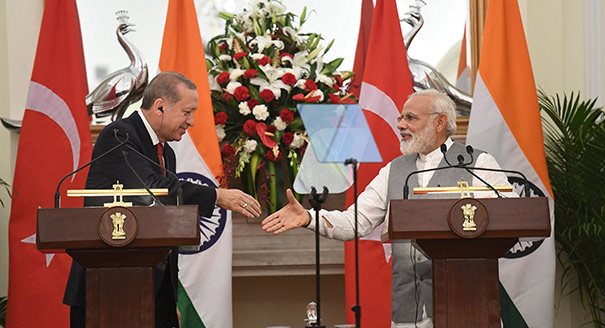
In any list of India’s more difficult bilateral relationships — other than those with Pakistan and China — Turkey will figure prominently. If turning Turkey around has long been a major diplomatic challenge for India, Prime Minister Narendra Modi has been eager to address it. No big breakthroughs were expected during Modi’s talks on Monday with the visiting Turkish President, Recep Tayyip Erdogan. The dialogue between the two leaders is hopefully the first step in the long road towards a more productive partnership.
There is no denying the many bonds between the two old Asian civilisations. After the Partition though, Pakistan seemed to inherit all of Turkey’s historic warmth for the Subcontinent. The Turkish establishment’s uncritical embrace of Pakistan has been unchanging, irrespective of who dominated Ankara — the secular army or the current Islamist leadership.
On global issues, India was non-aligned and Turkey, a member of the Western Cold War alliances. If Ankara was only a member of NATO, it may not have mattered much to Delhi. But Turkey was also part of a regional military bloc — the Baghdad Pact — that Great Britain stitched together in the early 1950s with Turkey, Iraq, Iran and Pakistan. On regional issues, Ankara tilted to Pakistan on the Kashmir question, and Delhi moved closer to Nicosia in Turkey’s dispute with Cyprus.
The friendship treaty with Turkey that Jawaharlal Nehru signed in 1951 underlined India’s hopes for building a lasting partnership in the post-colonial era. Translating those hopes into reality turned out to be a lot harder than any one could have imagined. It is not that there were no major Indian efforts after Nehru. Two strong prime ministers, Rajiv Gandhi and Atal Bihari Vajpayee, tried to end the stalemate in relations with Turkey, but did not succeed.
Why then is Modi embarking on an impossible venture with Turkey? The enormity of the diplomatic challenge was evident in the run-up to Erdogan’s visit. Even as he affirmed a strong desire for the improvement of ties with India, Erdogan was not giving anything away. In an interview to a TV channel, Erdogan called for a de-escalation of the Kashmir violence and urged India to embark on dialogue with Pakistan to resolve the long-standing dispute. He also affirmed that Turkey would like to see both India and Pakistan in the Nuclear Suppliers Group. Erdogan was making it clear that he would not dilute Turkey’s friendship with Pakistan in order to build a new partnership with India.
On its part, Delhi seemed quite unfazed by differences with Erdogan on Pakistan. Unlike previous governments, Delhi was not going to be rattled by the predictable Turkish rhetoric on Kashmir. For Delhi knows that Turkey does not live in a glass house and has its own difficulties with ethnic separatism and inherited disputes with its neighbours — Cyprus and Armenia.
Just before Erdogan arrived in Delhi, India received the president of Cyprus, Nicos Anastasiades, and sent Vice President Hamid Ansari to Armenia. Delhi, however, is prepared to complement this hardball diplomacy with a genuine effort to expand areas of cooperation with Turkey, for example, in security and commerce.
Erdogan faced a coup last July in which more than 240 people died and over 1,500 others were injured. Erdogan had blamed the US-based cleric, Fethullah Gulen, for the failed coup. Erdogan’s highest political priority right now is to wipe out the Gulenists at home and abroad, including in India. Beyond the prospects for cooperation in countering terrorism and extremism, Erdogan is also eager to develop economic and trade ties with India.
As he deals with a messy neighbourhood in the Middle East, Erdogan has a desire to find new partners like India that can boost Turkey’s economic prospects and lend its foreign policy greater depth. For Modi, too, Turkey is an important regional player that must be factored into India’s current recalibration of its Middle East policy.
Turkey is not the only country that has had strong empathy for Pakistan’s position in its disputes with India. Many countries, including the US, UK, Saudi Arabia and the UAE, had tended to side with Pakistan in the past. Delhi’s patient engagement with these countries, however, has made them more sensitive over the years to India’s concerns. The essence of the strategy was to raise their economic and political stakes in India and make Pakistan less salient for the bilateral relationship with Delhi. Modi is trying something similar with Turkey.
Success is not assured in the near term, but Delhi is betting prospects will improve over the longer term. Underlying that bet are three key propositions: One, diplomacy is about making friends into allies, neutrals into friends, and adversaries into neutrals. Second, political will and adroit diplomacy can alter the perspectives of other nations on issues of vital interest to India. Third, as the interests of countries evolve, so will their positions over time.
The diplomatic trick for Delhi lies not in trying to prove the virtue of its positions, but in demonstrating the material benefits of a partnership with India.
This article was originally published in the Indian Express.
Former Nonresident Senior Fellow, Carnegie India
A leading analyst of India’s foreign policy, Mohan is also an expert on South Asian security, great-power relations in Asia, and arms control.
Recent Work

C. Raja Mohan, Darshana M. Baruah


Alexander Gabuev, Paul Haenle, C. Raja Mohan, …
Carnegie does not take institutional positions on public policy issues; the views represented herein are those of the author(s) and do not necessarily reflect the views of Carnegie, its staff, or its trustees.

But their "principal to principal" model will only be as effective as the political strength of each leader back home.

Damien Ma

U.S. unpredictability has allowed China to capitalize on its positioning as the “responsible great power”. Paradoxically, the more China wins the perception game, the more likely expectations will rise for Beijing to deliver not just words but to demonstrate with its deeds.

Chong Ja Ian

Hanoi and Beijing have long treated each other as distant cousins rather than comrades in arms. That might be changing as both sides draw closer to hedge against uncertainty and America’s erratic behavior.

Nguyễn Khắc Giang

Across Asia, China is better positioned to withstand energy shocks from the fallout of the Iran war. Its abundant coal capacity can ensure stability in the near term. Yet at the same time, the country’s energy transition away from coal will make it even less vulnerable during the next shock.
Damien Ma

Malaysia’s chairmanship sought to fend off short-term challenges while laying the groundwork for minimizing ASEAN’s longer-term exposure to external stresses.

Elina Noor