

Paper
Constantino Xavier
{
  "authors": [
    "Constantino Xavier"
  ],
  "type": "other",
  "centerAffiliationAll": "dc",
  "centers": [
    "Carnegie Endowment for International Peace",
    "Carnegie India"
  ],
  "collections": [],
  "englishNewsletterAll": "ctw",
  "nonEnglishNewsletterAll": "",
  "primaryCenter": "Carnegie India",
  "programAffiliation": "SAP",
  "programs": [
    "South Asia"
  ],
  "projects": [],
  "regions": [
    "South Asia",
    "India"
  ],
  "topics": [
    "Foreign Policy",
    "Security"
  ]
}
Source: Getty
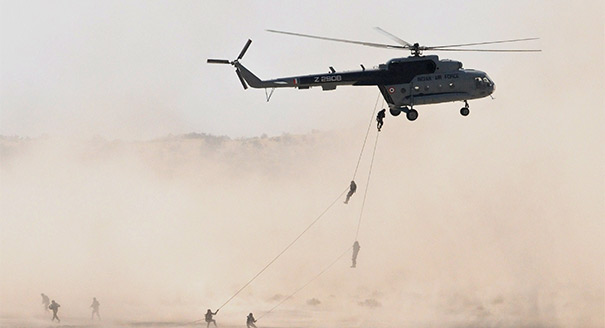
To ensure the safety of Indians abroad, the Indian armed forces will have to develop specific doctrines, procedures and capabilities to deploy expeditionary forces in coordination with civilian authorities.
Source: Force
Over the last few decades, the Indian government conducted dozens of emergency operations to protect and evacuate its distressed citizens abroad. When the lives and assets of overseas Indians are threatened due to war, natural calamities or discriminatory policies, New Delhi is expected to act swiftly and decisively.
As the Indian Diaspora grows in size, dispersion and complexity, and areas of major concentration like the Gulf region witness large-scale destabilisation, the government will have to expand its capacity and expertise to execute such missions. Most importantly, these missions cannot remain an almost exclusively civilian prerogative. While the ministry of external affairs (MEA) will continue to play a lead role, the Indian military must be roped in as a key stakeholder.
To ensure the safety of Indians abroad, the Indian armed forces will have to develop specific doctrines, procedures and capabilities to deploy expeditionary forces in coordination with civilian authorities. Especially in hostile and conflict environments, the Indian military will have to be prepared to use lethal power, including Special Forces, to protect and extricate emigrants....
Former Fellow, Carnegie India
Constantino Xavier was a fellow at Carnegie India, based in New Delhi. His research focus is on India’s foreign policy, with emphasis on relations with its neighboring countries and South Asian regional security.
Recent Work
Constantino Xavier
Constantino Xavier
Carnegie does not take institutional positions on public policy issues; the views represented herein are those of the author(s) and do not necessarily reflect the views of Carnegie, its staff, or its trustees.

But their "principal to principal" model will only be as effective as the political strength of each leader back home.

Damien Ma

U.S. unpredictability has allowed China to capitalize on its positioning as the “responsible great power”. Paradoxically, the more China wins the perception game, the more likely expectations will rise for Beijing to deliver not just words but to demonstrate with its deeds.

Chong Ja Ian

Hanoi and Beijing have long treated each other as distant cousins rather than comrades in arms. That might be changing as both sides draw closer to hedge against uncertainty and America’s erratic behavior.

Nguyễn Khắc Giang

Across Asia, China is better positioned to withstand energy shocks from the fallout of the Iran war. Its abundant coal capacity can ensure stability in the near term. Yet at the same time, the country’s energy transition away from coal will make it even less vulnerable during the next shock.
Damien Ma

Malaysia’s chairmanship sought to fend off short-term challenges while laying the groundwork for minimizing ASEAN’s longer-term exposure to external stresses.

Elina Noor