

Article
C. Raja Mohan, Darshana M. Baruah
{
  "authors": [
    "C. Raja Mohan"
  ],
  "type": "legacyinthemedia",
  "centerAffiliationAll": "dc",
  "centers": [
    "Carnegie Endowment for International Peace",
    "Carnegie India"
  ],
  "collections": [],
  "englishNewsletterAll": "ctw",
  "nonEnglishNewsletterAll": "",
  "primaryCenter": "Carnegie India",
  "programAffiliation": "SAP",
  "programs": [
    "South Asia"
  ],
  "projects": [],
  "regions": [
    "South Asia",
    "Afghanistan",
    "India"
  ],
  "topics": [
    "Foreign Policy",
    "Security"
  ]
}
Source: Getty
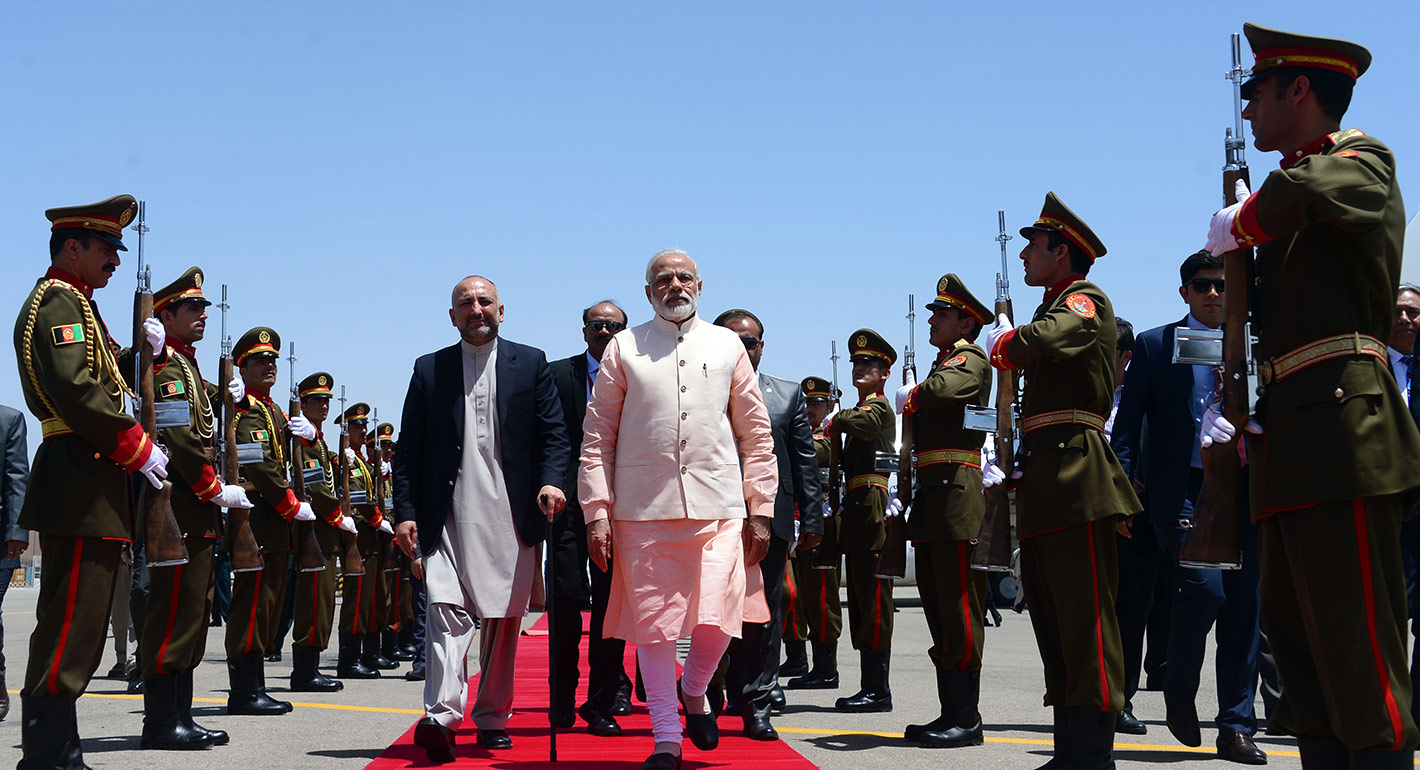
New Delhi’s increased strategic engagement with Kabul is a break with past policies and will enhance India’s influence in the region.
Source: Indian Express
India’s current plans to intensify strategic cooperation with Afghanistan could well mark an inflection point in its regional security politics. If its approach to Afghanistan has long been marked by excessive caution, Delhi now seems ready to make bold.
India’s new activism in Afghanistan could turn out to be of a piece with its much acclaimed management of the recent Doklam crisis on the China frontier. Yet, there is no denying India’s manoeuvre in Doklam was essentially defensive. It was about raising the military and political costs for China and deterring Beijing from escalating the confrontation and persuading it to accept a negotiated settlement.
In Afghanistan, Delhi is entering a very different domain. It is now preparing for involvement in a conflict that is once removed from its own borders. The lack of geographic access has always reinforced independent India’s tentativeness in Afghanistan. The NDA government, led by Narendra Modi, seems open to testing the limits of that geographic constraint.
Delhi’s renewed activism comes at a moment when Kabul and its international partners are fighting with their backs to the wall. The Taliban, with its sanctuaries in Pakistan, has gained considerable ground in Afghanistan over the last few years. On the positive side of the ledger, President Donald Trump has certainly reaffirmed US military and political commitment to Afghanistan last month. But many fear that it might be too late to reverse the negative dynamic in Afghanistan.
The Trump administration is hoping that by mounting pressure on Pakistan to give up its support to the Taliban, it could alter the outcomes in Afghanistan. Unsurprisingly, Pakistan has reacted angrily, and has turned to China to counter the new US policy towards Afghanistan.
Although Delhi got Beijing to sign on to a statement at the BRICS forum last week demanding an end to terror sanctuaries in Pakistan, India knows that one swallow does not a summer make. Beijing is nowhere near abandoning Islamabad. As a rising power, China seeks to shape its periphery. It hopes to have a say in Afghanistan’s long-term political evolution in collaboration with the Pakistan army.
Kabul is certainly enthused by Trump’s decision to try and change Pakistan’s behaviour. But Kabul, like Delhi, will keep its fingers crossed on the tenacity and effectiveness of Trump’s commitment to Afghanistan. Both are deeply wary of the current political turbulence and policy volatility in Washington.
But unlike Delhi, Kabul is eager to enlist China for a larger role in Afghanistan. Given American uncertainties, Afghan leadership believes only China can now restrain Pakistan. Kabul also sees Beijing’s massive resources as critical for Afghanistan’s economic development.
India’s past partners against the Taliban in the late 1990s — Iran and Russia — are today looking at Afghanistan very differently. Both Tehran and Moscow see the Islamic State or Daesh as their main threat and have been engaging the Taliban. All these factors point to the challenging picture in Afghanistan.
Amidst this geopolitical churn, Delhi can no longer put Afghanistan’s economic and security problems in separate compartments. Thanks to a large American military presence in Afghanistan and a relatively peaceful environment after the US military forces ousted the Taliban at the end of 2001, it was possible for India to focus on the economy. Today the deteriorating security situation makes developmental work in Afghanistan harder. Even as it recalibrates India’s economic engagement with Afghanistan, Delhi must necessarily consider greater security cooperation with Kabul.
India had in fact signed a strategic partnership agreement with Afghanistan at the end of 2011 that called for expansive bilateral military cooperation. Despite the clamour from Kabul, Delhi seemed hesitant to move forward. Part of the problem was India’s sensitivity to Pakistan’s neuralgia about Delhi’s expanding role in Afghanistan.
The UPA government seemed to put the normalisation of relations with Islamabad above the logic of deepening military ties with Kabul. The Modi government is aware that its activism in Afghanistan will beget significant reaction from Pakistan. But Delhi may need to develop a new proposition — that substantive strategic engagement with Afghanistan is a necessary component of India’s Pakistan policy.
In the past, India’s regional policy was widely described as “reactive”. To be sure, there were major exceptions — Prime Minister Indira Gandhi’s military intervention to liberate Bangladesh and her son and successor Rajiv Gandhi’s despatch of an Indian Peace-Keeping Force into Sri Lanka in 1987.
The series of weak coalition governments that followed Rajiv Gandhi had, however, made caution the dominant theme of India’s foreign policy. Although India’s potential to play a larger regional security role became a part of the national discourse during the UPA years, the Congress leadership seemed paralysed by self-doubt.
Modi, however, seems less inhibited. If the defiance of China in Doklam was one side of the coin, the new foray into Afghanistan could mark the other. The PM is betting that strategic rewards in Afghanistan might be as large as the risks. Delhi is realistic enough to know that it does not have the power to unilaterally define Afghanistan’s future. But India can certainly hope to develop some leverage and influence the outcomes in Afghanistan and the Subcontinent’s north-west through purposeful actions on the ground.
This article was originally published in the Indian Express.
Former Nonresident Senior Fellow, Carnegie India
A leading analyst of India’s foreign policy, Mohan is also an expert on South Asian security, great-power relations in Asia, and arms control.
Recent Work

C. Raja Mohan, Darshana M. Baruah


Alexander Gabuev, Paul Haenle, C. Raja Mohan, …
Carnegie does not take institutional positions on public policy issues; the views represented herein are those of the author(s) and do not necessarily reflect the views of Carnegie, its staff, or its trustees.

But their "principal to principal" model will only be as effective as the political strength of each leader back home.

Damien Ma

U.S. unpredictability has allowed China to capitalize on its positioning as the “responsible great power”. Paradoxically, the more China wins the perception game, the more likely expectations will rise for Beijing to deliver not just words but to demonstrate with its deeds.

Chong Ja Ian

Hanoi and Beijing have long treated each other as distant cousins rather than comrades in arms. That might be changing as both sides draw closer to hedge against uncertainty and America’s erratic behavior.

Nguyễn Khắc Giang

Across Asia, China is better positioned to withstand energy shocks from the fallout of the Iran war. Its abundant coal capacity can ensure stability in the near term. Yet at the same time, the country’s energy transition away from coal will make it even less vulnerable during the next shock.
Damien Ma

Malaysia’s chairmanship sought to fend off short-term challenges while laying the groundwork for minimizing ASEAN’s longer-term exposure to external stresses.

Elina Noor