

Article
C. Raja Mohan, Darshana M. Baruah
{
  "authors": [
    "C. Raja Mohan"
  ],
  "type": "legacyinthemedia",
  "centerAffiliationAll": "dc",
  "centers": [
    "Carnegie Endowment for International Peace",
    "Carnegie India"
  ],
  "collections": [],
  "englishNewsletterAll": "ctw",
  "nonEnglishNewsletterAll": "",
  "primaryCenter": "Carnegie India",
  "programAffiliation": "SAP",
  "programs": [
    "South Asia"
  ],
  "projects": [],
  "regions": [
    "Asia",
    "South Asia",
    "India",
    "Middle East"
  ],
  "topics": [
    "Foreign Policy"
  ]
}
Source: Getty
The challenge for India lies in finding the right balance between competing imperatives in the volatile Middle East amidst the pursuit of enlightened self-interest.
Source: Indian Express
Congress Member of Parliament Shashi Tharoor had, back in 2010, famously described Jawaharlal Nehru’s foreign policy as a “moralistic running commentary” on international affairs. He was certainly not denigrating India’s first prime minister. Nor was he attacking the government of the day. After all, he was serving as the minister of state for external affairs in it. As a scholar of diplomacy in his own right, Tharoor was reflecting on the complex legacies of India’s diplomatic tradition, especially Delhi’s temptation for moral posturing on international issues.
The end of the Cold War and India’s economic reorientation saw an inevitable recasting of Indian diplomacy after 1991. Although successive governments, of different political colour, have made a bow to pragmatism, the public discourse tends to remain ideological.
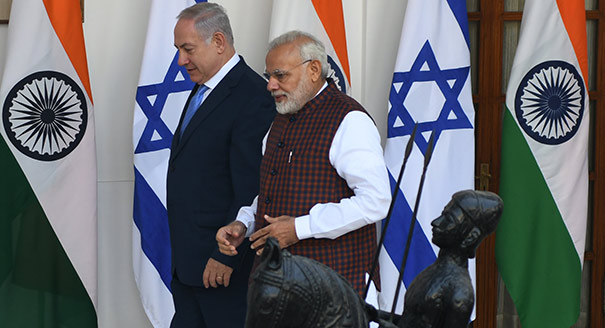
Nowhere is this more true than the Middle East, where India’s domestic politics have always had a huge impact on how Delhi debates the region. This week’s visit to India by the prime minister of Israel, Benjamin Netanyahu, has seen a reprise in India’s internal contestations on the Middle East.
It is not very often that the Israeli PM visits India. The first ever visit by an Israeli PM was in 2003. That it happened under a BJP prime minister was not surprising. Now the second visit too is taking place under a BJP-led government. If Atal Bihari Vajpayee was the first PM to host his Israeli counterpart, Narendra Modi became the first prime minister to travel to Israel last year.
If you think India’s Israel policy was all about BJP, you are mistaken. It was Jawaharlal Nehru, either accused of moralpolitik or praised for it, was the one who extended India’s diplomatic recognition to Israel when its was born in 1948. If Nehru held back from establishing an embassy in Israel, it was a Congress PM, P.V. Narasimha Rao, who normalised relations with Israel in 1992 and expanded security and technological cooperation.
Rao could not have done that, if his predecessor, Rajiv Gandhi, had not begun to end India’s political hostility to Israel that took root in the 1960s and 1970s. The CPI(M), which now declares that Netanyahu is not welcome in India, had no problem with Jyoti Basu, the party’s tallest leader and chief minister West Bengal, making an official visit to Israel in 2000. That kind of elite pragmatism on foreign policy has unfortunately given way to renewed disputation over the Middle East amidst the growing political polarisation within India.
The left accuses Modi of abandoning India’s traditional solidarity with the Palestinians. The right attacks the PM for not voting with Israel when the UN General Assembly strongly criticised the US move to shift its embassy from Tel Aviv to Jerusalem. These rival arguments are probably a good indicator that the South Block may have found a sensible middle path.
Delhi’s interests in Israel have grown rapidly in the last quarter of a century. So have those with the 400 million Arabs. The Arab Middle East is the main source of India’s energy, the home to nearly seven million expatriate workers, and a big market for Indian goods. As we look to India’s growing stakes in the Middle East, Delhi’s problem is not about fidelity to one domestic ideological position or the other.
The challenge for India lies in finding the right balance between competing imperatives in a volatile region amidst the pursuit of enlightened self-interest. The Israelis and Arabs alike have a strong tradition of realpolitik. They might be happier with an open, predictable and interest-based Indian policy towards the region than the one trapped in political posturing for domestic audiences.
Israeli and Arab leaders too view India from the perspective of regional balance, rather than an ideological framework. Israel, for example, will be delighted if Pakistan chooses to establish diplomatic relations with it. The political significance of the diplomatic recognition from the second largest Muslim nation is indeed valuable for Israel.
Pakistan has often debated the option of openly engaging Israel. When he was at the peak of his power last decade, General Pervez Musharraf had reached out to American Jewish groups and sought to inject pragmatism into Pakistan’s policy. But he could not prevail over huge political resistance at home. Pakistan’s domestic politics on the Middle East, after all, are more intense than India’s.
India’s exceptional political warmth certainly does not beget uncritical Israeli support for India in its territorial disputes with Pakistan or China. Similarly the Arab nations don’t back India on Kashmir, just because India extends formal solidarity with the Palestinians. Like all nations, Israelis and Arabs want to maximise possibilities with India, but would want to limit its impact on the relations with Pakistan.
The pursuit of balance is an essential feature of international life; how it gets expressed or couched in a specific context is a matter of diplomatic detail. Israel’s dispute with Palestine is not the only one that India confronts in the Middle East. Delhi, for example, is constantly trying to balance between Israel and Iran, Riyadh and Tehran, the Sunni and Shia, Saudis and Qataris, and between the Kurds and everyone else. Domestic political pieties, on the left and right, are the last thing India needs in navigating the Middle East minefield.
This article was originally published in the Indian Express.
Former Nonresident Senior Fellow, Carnegie India
A leading analyst of India’s foreign policy, Mohan is also an expert on South Asian security, great-power relations in Asia, and arms control.
Recent Work

C. Raja Mohan, Darshana M. Baruah


Alexander Gabuev, Paul Haenle, C. Raja Mohan, …
Carnegie does not take institutional positions on public policy issues; the views represented herein are those of the author(s) and do not necessarily reflect the views of Carnegie, its staff, or its trustees.

China’s banking crisis in the 2000s was resolved by transferring the costs to households through financial repression—a decision that recapitalized the banks while exacerbating the structural imbalances that continue to shape the Chinese economy today.

Michael Pettis

Chinese biotech companies have been on the receiving end of U.S. economic coercion. Yet their responses have differed significantly because firm and state interests are not uniformly aligned. For Washington, treating all Chinese tech firms the same, irrespective of their actual interests, risks pushing them farther into Beijing’s corner.

Xue Gong

But their "principal to principal" model will only be as effective as the political strength of each leader back home.

Damien Ma

U.S. unpredictability has allowed China to capitalize on its positioning as the “responsible great power”. Paradoxically, the more China wins the perception game, the more likely expectations will rise for Beijing to deliver not just words but to demonstrate with its deeds.

Chong Ja Ian

Hanoi and Beijing have long treated each other as distant cousins rather than comrades in arms. That might be changing as both sides draw closer to hedge against uncertainty and America’s erratic behavior.

Nguyễn Khắc Giang