

Paper
Ashley J. Tellis
{
  "authors": [
    "Ashley J. Tellis"
  ],
  "type": "other",
  "centerAffiliationAll": "dc",
  "centers": [
    "Carnegie Endowment for International Peace"
  ],
  "collections": [],
  "englishNewsletterAll": "ctw",
  "nonEnglishNewsletterAll": "",
  "primaryCenter": "Carnegie Endowment for International Peace",
  "programAffiliation": "SAP",
  "programs": [
    "South Asia"
  ],
  "projects": [],
  "regions": [
    "South Asia",
    "East Asia",
    "China",
    "Southeast Asia"
  ],
  "topics": [
    "Economy",
    "Trade",
    "Security",
    "Military",
    "Foreign Policy",
    "Global Governance"
  ]
}
Source: Getty
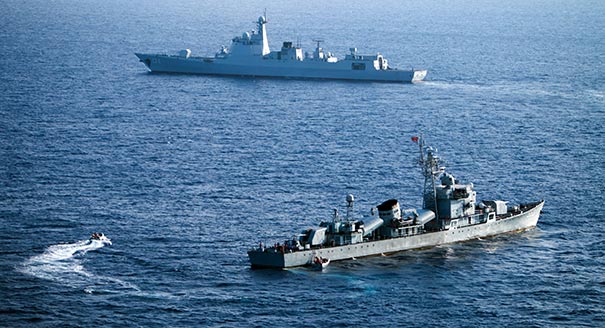
China’s actions in the South China Sea will likely have adverse consequences for the global maritime order. Such actions require a sustained and intentional response on the part of the United States.
Source: Hudson Institute
Speaking at the Hudson Institute, Carnegie’s Ashley J. Tellis addressed the strategic and diplomatic implications of Chinese actions in the South China Sea. Arguing that China’s intention to enforce its ambiguous but expansive claims poses unmistakable danger to the existing international order, Tellis sketched out some of the possible long-term consequences, as well as possible U.S. responses.
Beyond the potential risk to freedom of navigation in the region and economic disadvantages for neighboring countries with conflicting claims in the South China Sea, China’s actions strengthen the shift toward progressively greater “national enclosure” of open international waterways, Tellis warned. He added that, if left unchecked, Chinese militarization would disturb the local military balances and force the United States to commit more resources to the region in order to fulfill its obligations to its local friends and allies.
Tellis called for a coordinated campaign to increase pressure on China through multilateral institutions and other international maritime functional organizations. Sanctions could be applied to specific, Chinese state-owned enterprises engaged in illegal construction in the region, he added. He argued that a regime of routine freedom of navigation operations should be maintained, and a coalition of like-minded nations in Southeast Asia should be assisted to develop their surveillance capacities as well as their naval and air power deterrents.
Former Senior Fellow
Ashley J. Tellis was a senior fellow at the Carnegie Endowment for International Peace.
Recent Work
Ashley J. Tellis
Ashley J. Tellis
Carnegie does not take institutional positions on public policy issues; the views represented herein are those of the author(s) and do not necessarily reflect the views of Carnegie, its staff, or its trustees.

China’s banking crisis in the 2000s was resolved by transferring the costs to households through financial repression—a decision that recapitalized the banks while exacerbating the structural imbalances that continue to shape the Chinese economy today.

Michael Pettis

Chinese biotech companies have been on the receiving end of U.S. economic coercion. Yet their responses have differed significantly because firm and state interests are not uniformly aligned. For Washington, treating all Chinese tech firms the same, irrespective of their actual interests, risks pushing them farther into Beijing’s corner.

Xue Gong
China’s latest energy plan explicitly calls for integrating data centers into the electricity system, particularly connecting them to green energy. It appears Beijing wants to use compute as a source of domestic demand to absorb renewables excess capacity.

Damien Ma

But their "principal to principal" model will only be as effective as the political strength of each leader back home.
Damien Ma

U.S. unpredictability has allowed China to capitalize on its positioning as the “responsible great power”. Paradoxically, the more China wins the perception game, the more likely expectations will rise for Beijing to deliver not just words but to demonstrate with its deeds.

Chong Ja Ian