

Article
C. Raja Mohan, Darshana M. Baruah
{
  "authors": [
    "C. Raja Mohan"
  ],
  "type": "legacyinthemedia",
  "centerAffiliationAll": "",
  "centers": [
    "Carnegie Endowment for International Peace",
    "Carnegie India"
  ],
  "collections": [],
  "englishNewsletterAll": "",
  "nonEnglishNewsletterAll": "",
  "primaryCenter": "Carnegie India",
  "programAffiliation": "",
  "programs": [],
  "projects": [],
  "regions": [
    "United States",
    "South Asia",
    "Afghanistan",
    "North America"
  ],
  "topics": [
    "Foreign Policy",
    "Security",
    "Military"
  ]
}
Source: Getty
While the outrage against outsourcing the Afghan war is real, the tragic reality is that the growing role of private armies is very much part of the modern hybrid wars.
Source: Indian Express
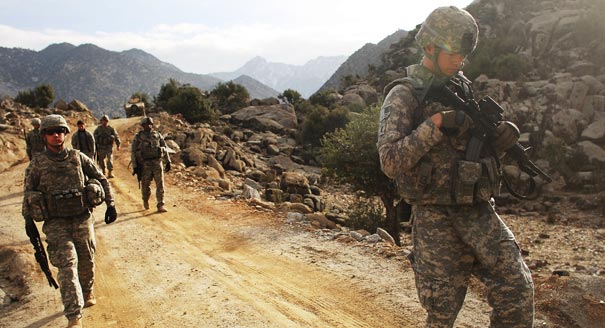
As America reflects on the deteriorating security situation in Afghanistan, the idea of “privatising” the war is making the rounds in Washington. The Pentagon is hostile to the scheme, and very few in the Administration or the US Congress have expressed support for it. Although President Donald Trump has denied that he is reviewing any plan to privatise the Afghan war, analysts believe that his penchant for trying the unconventional may yet prevail. While the outrage against outsourcing the Afghan war is real, the tragic reality is that the growing role of private armies is very much part of the modern hybrid wars.
But first to Afghanistan. Trump’s initial instinct was to end the US military involvement in a war that started 17 years ago under President George W Bush — his predecessor once removed. But the security establishment, including the then National Security Adviser General H R McMaster and the Secretary of Defence, General James Mattis, persuaded Trump to give the US another shot at turning the tide.
In a major speech on Afghanistan last year in August, Trump announced a decision to increase the number of troops deployed to Afghanistan, refused to set a deadline for their withdrawal, eased the rules of military engagement, and threatened Pakistan with dire consequences if it did not stop playing both sides of the terror street. Although the US military leadership is claiming significant progress since then, there is growing political scepticism in Washington about the prospects for a real turnaround in the situation.
That has set the stage for Erik Prince, the former head of Blackwater, a private security company that earned much notoriety in the Iraq war, to present the idea on outsourcing the war. Prince, a former US Navy Seal, had pitched the idea last year to senior figures in the Trump Administration. The president’s chief strategist then, Steve Bannon, was said to be supportive. But Prince was dismissed out of hand by General McMaster and General Mattis. Sensing that the Trump Administration might be ready to entertain second thoughts, Prince is at it again.
In essence, Prince claims that a small army of 6,000, backed by 2,000 US Special Forces, and by a private air wing of 90 planes could make a big difference to the battlefield situation. He says his operation would cost the US Treasury a small fraction of the current bill for running the Afghan War.
The US is said to be spending more than $50 billion a year on the war in Afghanistan and the total expenditure since 2001 is close to a trillion US dollars. Prince, who now heads a consulting firm called Frontier Resources Group, claims that his approach will cost only $4 billion a year and could produce the desired result in a short period of time. Asked how a small force like the one he proposes can defeat the Taliban when more than 1,10,000 US troops, at the peak of President Barack Obama’s military surge in the early 2010s, could not do the job, Prince said the key to success is not in numbers but in the strategy adopted.
He insists that Washington must return to strategy that helped oust the Taliban government soon after the attacks on New York and Washington on September 11, 2001. “What worked after 9/11 were a few CIA officers, a few special forces, some air support, and they decimated the Taliban in a matter of weeks,” Prince said in a recent TV interview. “We have been losing ever since,” he said and cited the conventional approach adopted by the US military leadership. He also argues that working with a small force in Afghanistan would reduce the US dependence on Pakistan for logistics and allow Washington to mount some real pressure against Rawalpindi.
Prince’s plan is a hard-sell not only in Washington, but also in Kabul, where the initial reactions are said to be negative. Many military analysts fear that outsourcing the war would raise questions about accountability and increase danger of civilian casualties as well as human rights abuses.
For all the hand-wringing, Afghanistan is not new to the privatisation of the war. The US currently employs nearly 27,000 “contractors” — or non-government personnel — that perform a range of military duties from logistics to security and from translation to training. The US Central Command, which runs the wars in Afghanistan and beyond in the Middle East, employs nearly 50,000 contractors. Only 20,000 of these are US citizens, about 23,000 are third-country nationals and 8,000 are locals. The US had earlier made extensive use of private companies in the war against drugs in Colombia.
The US armed forces are not alone in hiring “contractors”. Russia too is reported to employ the services of private military companies in Syria and elsewhere. Private militias are now very much part of the modern battlefields. In many places, armed groups that set out in pursuit of ambitious political goals end up as mercenaries and available for hire.
In the end, the US debate on Afghanistan may be less about a radical expansion of the private component of the war. The real question is whether Erik Prince’s plan can prevail over Pakistan army’s more tenacious hybrid war in Afghanistan — through its support for the Taliban.
This article was originally published in the Indian Express.
Former Nonresident Senior Fellow, Carnegie India
A leading analyst of India’s foreign policy, Mohan is also an expert on South Asian security, great-power relations in Asia, and arms control.
Recent Work

C. Raja Mohan, Darshana M. Baruah


Alexander Gabuev, Paul Haenle, C. Raja Mohan, …
Carnegie does not take institutional positions on public policy issues; the views represented herein are those of the author(s) and do not necessarily reflect the views of Carnegie, its staff, or its trustees.

But their "principal to principal" model will only be as effective as the political strength of each leader back home.

Damien Ma

U.S. unpredictability has allowed China to capitalize on its positioning as the “responsible great power”. Paradoxically, the more China wins the perception game, the more likely expectations will rise for Beijing to deliver not just words but to demonstrate with its deeds.

Chong Ja Ian

Hanoi and Beijing have long treated each other as distant cousins rather than comrades in arms. That might be changing as both sides draw closer to hedge against uncertainty and America’s erratic behavior.

Nguyễn Khắc Giang

Across Asia, China is better positioned to withstand energy shocks from the fallout of the Iran war. Its abundant coal capacity can ensure stability in the near term. Yet at the same time, the country’s energy transition away from coal will make it even less vulnerable during the next shock.
Damien Ma

Malaysia’s chairmanship sought to fend off short-term challenges while laying the groundwork for minimizing ASEAN’s longer-term exposure to external stresses.

Elina Noor