

Commentary
Alexander Gabuev
{
  "authors": [
    "Alexander Gabuev"
  ],
  "type": "legacyinthemedia",
  "centerAffiliationAll": "",
  "centers": [
    "Carnegie Endowment for International Peace",
    "Carnegie Russia Eurasia Center"
  ],
  "collections": [],
  "englishNewsletterAll": "",
  "nonEnglishNewsletterAll": "",
  "primaryCenter": "Carnegie Endowment for International Peace",
  "programAffiliation": "",
  "programs": [],
  "projects": [],
  "regions": [
    "North America",
    "South America",
    "Russia"
  ],
  "topics": [
    "Foreign Policy"
  ]
}
Source: Getty
Rosneft’s deep ties to Venezuela and Russia’s efforts to insert itself into the crisis there together raise questions about whether the country’s leadership is acting to preserve national or corporate and private interests.
Source: Financial Times
With the Kremlin offering to send in advisers to help embattled Venezuelan leader Nicolás Maduro as the US imposes sanctions, it is clear that the US and Russia are engaging in a new sort of proxy conflict in America’s backyard.
But this is more than Vladimir Putin’s version of payback for years of US involvement in places like Ukraine and Georgia or the US’s withdrawal from the mid-range nuclear arms treaty.
Russia’s policy on Venezuela is heavily influenced by Igor Sechin, the head of Rosneft, Russia’s national oil company. It is not only owed $3bn by Caracas, but also owns two offshore gasfields in the country and stakes in assets boasting more than 20m tonnes of crude.
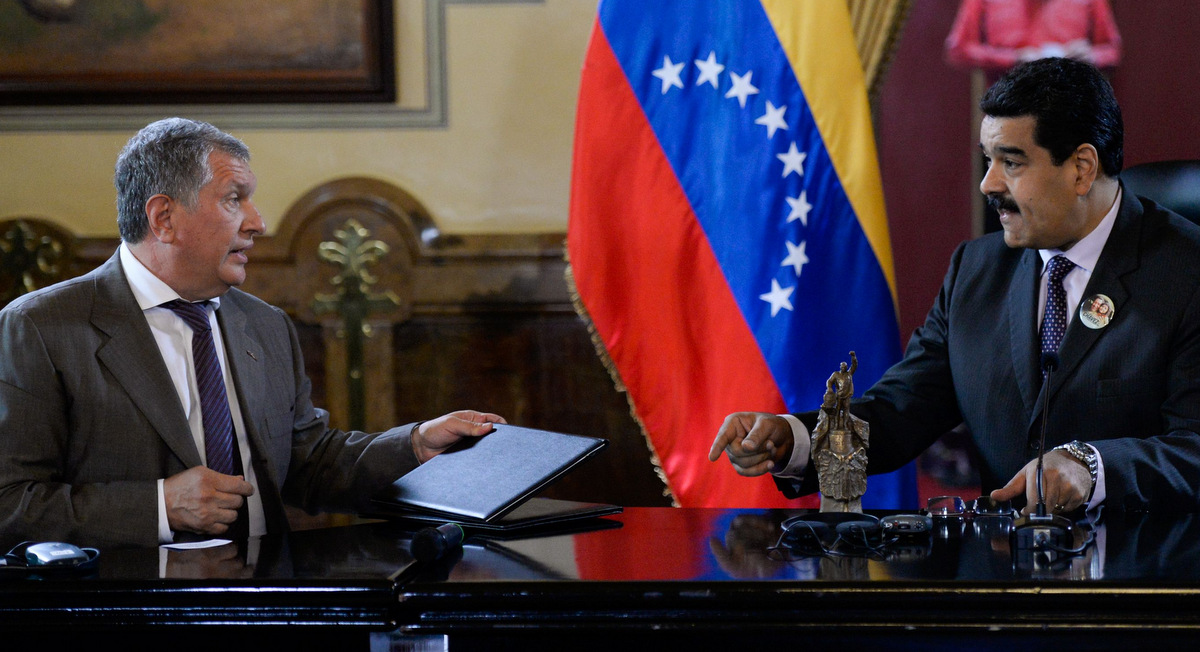
The involvement of Mr Sechin, who met with Mr Maduro in Moscow in September and flew to Caracas in November, suggests that Russia’s national security policymaking is increasingly driven by a combination of corporate interests and ambitions of powerful members of Mr Putin’s inner circle.
A former military interpreter for Soviet troops in Angola, Mr Sechin has been at Mr Putin’s side since his days as deputy mayor of St Petersburg. He is arguably the most powerful man in Mr Putin’s entourage and responsible for overseeing the energy sector. Back in 2008 he cajoled Kremlin-friendly governments in Latin America to recognise two breakaway regions of Georgia, Abkhazia and South Ossetia.
After Nicaragua became the first state to do so, Mr Sechin visited Managua and pledged investments. The reward for Hugo Chávez, who recognised the two new “states” in 2009, was more than $2bn in loans to purchase Russian arms. Before long Mr Sechin established a consortium of the five largest Russian oil companies to invest in Venezuela.
But Russia did not have technology to process the heavy crude the fields produced, so the consortium would have to pay western companies billions to build additional facilities. Though senior Russian oil executives expressed reservations about the commercial viability of these projects, Mr Sechin, who had Mr Putin’s ear, went ahead with the idea and in 2013 became the official head of the consortium. Several private Russian companies have since left the consortium, selling out to Rosneft.
As the Venezuelan economy tanked, Caracas struggled to repay its Russian loans: more than $17bn since 2006 with more than $6bn still due. Half is owed to the Russian state. The other half is owed to Rosneft by PDVSA, Venezuela’s state-owned oil company.
When Caracas fell behind on debt payments in autumn 2017, voices in the Russian government questioned Mr Sechin’s approach. With Russia facing western sanctions, why should it throw away billions in a far away corner of Latin America? But Moscow became Venezuela’s lender of last resort.
Mr Sechin has more than Russian ideological and geopolitical needs at stake. In recent years, Rosneft expanded its stake in multiple oil and gas assets in Venezuela and took over a lucrative role marketing Venezuelan oil.
Russia is now so deeply invested in the Maduro regime that the only realistic option is to double down. Although Spanish group Repsol is weighing whether to quit oil-for debt schemes with PDVSA because of US sanctions, Rosneft is showing no sign of changing course. US support for regime change in Venezuela also serves Mr Sechin’s interests: if Mr Maduro is forced out and the new authorities publish damaging information on Russia’s deals with his regime, it will be easier to slough them off as a dirty trick by Washington.
Mr Sechin is not only the Putin ally whose interests may benefit from Russian foreign policy. Yevgeniy Prigozhin has parlayed his role as a Kremlin caterer into other lucrative state contracts overseas.
Evidence seems to be mounting that powerful individuals close to Mr Putin can all too easily sideline the country’s more careful bureaucrats. Rosneft’s deep ties to Venezuela and Russia’s efforts to insert itself into the crisis there together raise questions about whether the country’s leadership is acting to preserve national or corporate and private interests.

Director, Carnegie Russia Eurasia Center
Alexander Gabuev is director of the Carnegie Russia Eurasia Center. Gabuev’s research is focused on Russian foreign policy with particular focus on the impact of the war in Ukraine and the Sino-Russia relationship. Since joining Carnegie in 2015, Gabuev has contributed commentary and analysis to a wide range of publications, including the Financial Times, the New York Times, the Wall Street Journal, and the Economist.
Recent Work
Alexander Gabuev
Alexander Gabuev
Carnegie does not take institutional positions on public policy issues; the views represented herein are those of the author(s) and do not necessarily reflect the views of Carnegie, its staff, or its trustees.

But their "principal to principal" model will only be as effective as the political strength of each leader back home.

Damien Ma

U.S. unpredictability has allowed China to capitalize on its positioning as the “responsible great power”. Paradoxically, the more China wins the perception game, the more likely expectations will rise for Beijing to deliver not just words but to demonstrate with its deeds.

Chong Ja Ian

Hanoi and Beijing have long treated each other as distant cousins rather than comrades in arms. That might be changing as both sides draw closer to hedge against uncertainty and America’s erratic behavior.

Nguyễn Khắc Giang

Across Asia, China is better positioned to withstand energy shocks from the fallout of the Iran war. Its abundant coal capacity can ensure stability in the near term. Yet at the same time, the country’s energy transition away from coal will make it even less vulnerable during the next shock.
Damien Ma

Malaysia’s chairmanship sought to fend off short-term challenges while laying the groundwork for minimizing ASEAN’s longer-term exposure to external stresses.

Elina Noor