

Other
François Godement, Ashley J. Tellis
{
  "authors": [
    "François Godement"
  ],
  "type": "legacyinthemedia",
  "centerAffiliationAll": "dc",
  "centers": [
    "Carnegie Endowment for International Peace"
  ],
  "collections": [],
  "englishNewsletterAll": "asia",
  "nonEnglishNewsletterAll": "",
  "primaryCenter": "Carnegie Endowment for International Peace",
  "programAffiliation": "AP",
  "programs": [
    "Asia"
  ],
  "projects": [],
  "regions": [
    "East Asia",
    "China",
    "Western Europe",
    "Germany"
  ],
  "topics": []
}
Source: Getty
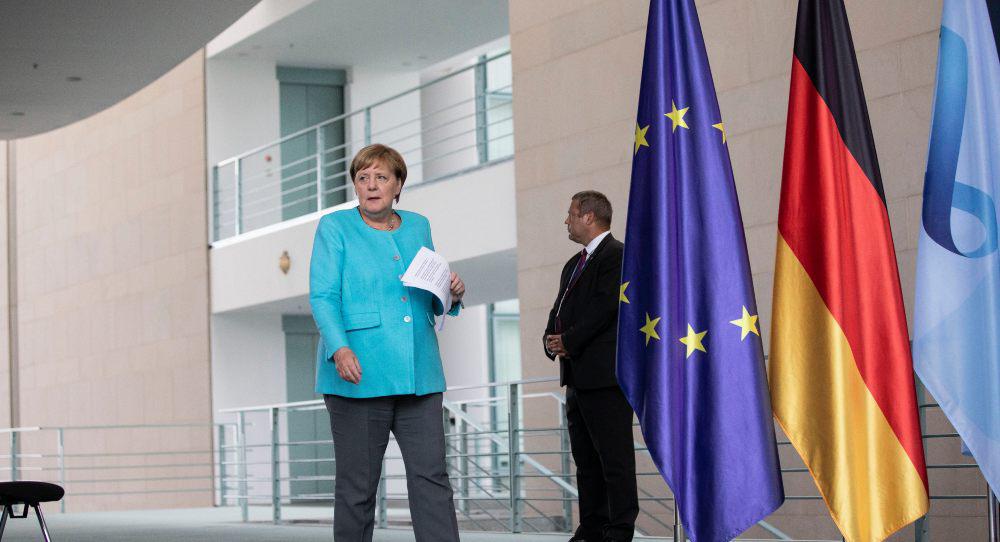
Who would have predicted that Angela Merkel might endorse turning away China, as happened with the EU’s refusal to grant Beijing market economy status, the EU’s new investment screening law, as well as new trade defense measures?
Source: Körber Stiftung
In their relations with China, France once owned politics, Germany economics. While de Gaulle and Chirac led strong declarative policies towards China, for parts of the 1980s Siemens alone sold more to China than did all of France. While German Chancellor Kurt Kiesinger had rather inchoately shouted “Kina, Kina, Kina!” as his vision for the future, the French thought they could be taken seriously in Beijing. Schröder went farthest towards China, as he did with Russia, while open disillusion broke out under Sarkozy’s watch. France has since diversified its partnerships in Asia, and its former illusions about China have not returned.
The surprise is Merkel. She initially had a very Kohl-like position: engagement focused on business goals, while leaving room for criticism – after all, Helmut Kohl had sacked a state secretary for the mistake of embracing then-Prime Minister Li Peng. Angela Merkel’s room for criticism has become wider – also depending on the political affiliation of any given foreign minister (were this France, one would have written “of her foreign minister”) and on the personality of the incumbent Federal President: none have ever spoken so strongly in China about human rights as Joachim Gauck in 2016.
Who would have predicted that Mrs Merkel might endorse turning away China, as happened with the EU’s refusal to grant Beijing market economy status, the EU’s new investment screening law, as well as new trade defence measures? This remains a real surprise to the French, who had become only too accustomed to being alone and singled out in this type of venture, and for the Chinese, who had decided to take German human rights criticism in their stride so long as business ran as usual.
The article was originally published in The Berlin Pulse 2019 by Körber Stiftung.

Former Nonresident Senior Fellow, Asia Program
Godement, an expert on Chinese and East Asian strategic and international affairs, was a nonresident senior fellow in the Asia Program at the Carnegie Endowment for International Peace.
Recent Work
François Godement, Ashley J. Tellis

François Godement, Abigaël Vasselier
Carnegie does not take institutional positions on public policy issues; the views represented herein are those of the author(s) and do not necessarily reflect the views of Carnegie, its staff, or its trustees.

China’s banking crisis in the 2000s was resolved by transferring the costs to households through financial repression—a decision that recapitalized the banks while exacerbating the structural imbalances that continue to shape the Chinese economy today.

Michael Pettis

Chinese biotech companies have been on the receiving end of U.S. economic coercion. Yet their responses have differed significantly because firm and state interests are not uniformly aligned. For Washington, treating all Chinese tech firms the same, irrespective of their actual interests, risks pushing them farther into Beijing’s corner.

Xue Gong

China’s latest energy plan explicitly calls for integrating data centers into the electricity system, particularly connecting them to green energy. It appears Beijing wants to use compute as a source of domestic demand to absorb renewables excess capacity.

Damien Ma

But their "principal to principal" model will only be as effective as the political strength of each leader back home.
Damien Ma

U.S. unpredictability has allowed China to capitalize on its positioning as the “responsible great power”. Paradoxically, the more China wins the perception game, the more likely expectations will rise for Beijing to deliver not just words but to demonstrate with its deeds.

Chong Ja Ian