

Commentary
But their "principal to principal" model will only be as effective as the political strength of each leader back home.
Damien Ma
{
  "authors": [
    "Yauheni Preiherman"
  ],
  "type": "commentary",
  "centerAffiliationAll": "dc",
  "centers": [
    "Carnegie Endowment for International Peace"
  ],
  "collections": [
    "Coronavirus"
  ],
  "englishNewsletterAll": "ctw",
  "nonEnglishNewsletterAll": "",
  "primaryCenter": "Carnegie Endowment for International Peace",
  "programAffiliation": "russia",
  "programs": [
    "Russia and Eurasia"
  ],
  "projects": [],
  "regions": [
    "Russia",
    "Eastern Europe",
    "Belarus"
  ],
  "topics": [
    "Foreign Policy"
  ]
}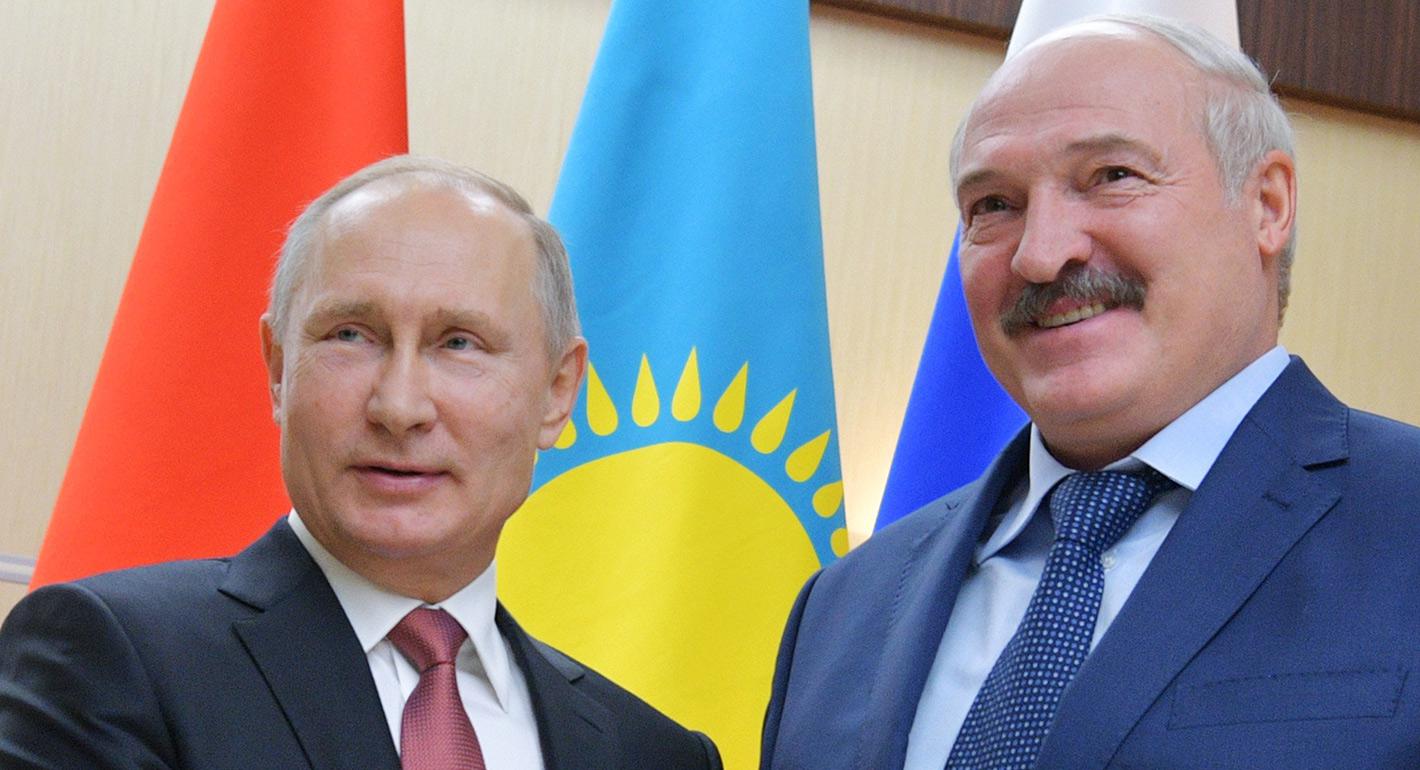
Source: Getty
The old rules of Belarus and Russia’s alliance may no longer apply. Will the two neighbors find a way to update them?
Among its many victims, the coronavirus pandemic is about to claim yet another: the unwritten understanding that has for the past quarter century helped Belarus and its vastly bigger and more powerful neighbor Russia manage their relationship. Formally the closest of allies, Belarus and Russia are the two members of a union state set up in 1999 to help mitigate the consequences of the breakup of the Soviet Union.
Yet the two nations have struggled for years to balance Russia’s ambitions to maintain its privileged sphere of influence and control its neighbors’ foreign policy against Belarus’s desire to preserve both its independence and its privileged ties with the Russian economy. In recent years, Minsk has rejected a number of proposals from Moscow for closer integration, including a single currency, common legislative initiatives, and various supranational governing bodies.
The pandemic has dealt a severe blow to this uncertain arrangement. Its old rules—geopolitical loyalty in exchange for privileged economic relations—may no longer apply. What makes matters worse is that current frictions come amid extraordinary global tensions.
Throughout his two decades at the helm, Russian President Vladimir Putin has made increasing demands on the former Soviet republics. He expects greater political and geopolitical loyalty, even fealty, from Russia’s neighbors in exchange for economic aid. For example, Putin suggested as early as 2002 that Belarus should either become part of Russia or prepare for economic benefits to be curtailed.
Since then, Belarusian-Russian relations have suffered multiple setbacks, including a series of energy and trade disputes. During periods of escalation, Moscow blocks imports of certain Belarusian goods or cuts oil and gas deliveries to its neighbor—the latter being particularly harmful considering Belarus’s energy dependence on Russia, the inefficient economic system it inherited from the Soviet Union, and the key role oil refining plays in its economy. The Belarusian government typically responds by signaling that its geopolitical loyalty should not be taken for granted and that it is fully capable of reaching accommodation with the West. This goes on for a while, until Minsk strikes a mutually acceptable deal with Moscow and drops talk of better relations with Brussels and Washington.
That dynamic changed after 2014, when events in Crimea and Donbas triggered a major confrontation between Russia and the West. As geopolitical tensions rose, Minsk remained neutral, resisting pressure from Moscow to unequivocally take the Kremlin’s side. While Russia tends to see any Belarusian policy short of full support of its position as abandonment, Minsk fears that Moscow’s actions could entrap Belarus—wedged between Russia and NATO—in a security conflict at odds with its own interests.
Russia and Belarus’s old grand bargain has now lost its value for both sides. Moscow cannot get the degree of geopolitical loyalty that it wants, and Minsk has little else to offer Moscow to sustain the economic relationship from which it has benefited so much. This is not to say that Belarus is about to suffer the same fate as Ukraine, but Moscow and Minsk will now have to redefine the meaning of their union.
The coronavirus pandemic has already taken a further toll on the relationship between the two allies. Their border is closed for the first time in almost three decades. Their uncoordinated responses to the outbreak have fueled new tensions, and their main television channels have engaged in a war of words, accusing each other of failing to deal with the pandemic and spreading disinformation. The economic fallout from the pandemic is bound to leave everyone worse off. Moscow will expect more from Minsk in exchange for economic aid, while Europe and the United States will be distracted with their own problems.
Yet neither Russia nor Belarus is eager to break with the old relationship completely. For Minsk, the risk of being seen as another Ukraine would carry catastrophic consequences. Moscow’s interests would also be poorly served by worse relations with a neighbor on NATO’s already tense Eastern flank.
The best alternative may be to hammer out a new bargain—not necessarily a grand one—through a series of smaller deals, relying on the wisdom of the two countries’ leaders, who between them have over fifty years of experience managing the bilateral relationship. To many in the West, this will seem like a highly unsatisfactory arrangement, but does anyone have a better one?
Yauheni Preiherman is the founder and director of the Minsk Dialogue Council on International Relations.
Yauheni Preiherman
Carnegie does not take institutional positions on public policy issues; the views represented herein are those of the author(s) and do not necessarily reflect the views of Carnegie, its staff, or its trustees.

But their "principal to principal" model will only be as effective as the political strength of each leader back home.

Damien Ma

U.S. unpredictability has allowed China to capitalize on its positioning as the “responsible great power”. Paradoxically, the more China wins the perception game, the more likely expectations will rise for Beijing to deliver not just words but to demonstrate with its deeds.

Chong Ja Ian

Hanoi and Beijing have long treated each other as distant cousins rather than comrades in arms. That might be changing as both sides draw closer to hedge against uncertainty and America’s erratic behavior.

Nguyễn Khắc Giang

Across Asia, China is better positioned to withstand energy shocks from the fallout of the Iran war. Its abundant coal capacity can ensure stability in the near term. Yet at the same time, the country’s energy transition away from coal will make it even less vulnerable during the next shock.
Damien Ma

Malaysia’s chairmanship sought to fend off short-term challenges while laying the groundwork for minimizing ASEAN’s longer-term exposure to external stresses.

Elina Noor