

In The Media
Lilia Shevtsova
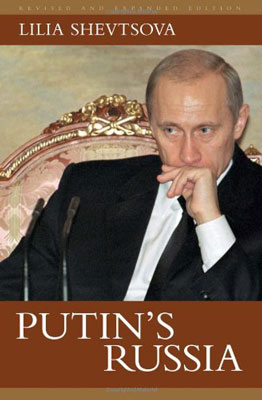
This revised edition explores the true nature of Putin’s leadership and how far he is willing to go and capable of going with further transformation. The book includes an examination of the recent presidential and parliamentary elections and their effects on Putin’s leadership and Russia.
Source: Washington

Lilia Shevtsova, one of the most respected political analysts in Russia and the West, examines President Putin’s achievements as well as his failures. She explores the true nature of Putin’s leadership and how far he is willing to go and capable of going with further transformation.
This revised edition includes an examination of the recent presidential and parliamentary elections and their effects on Putin’s leadership and Russia.
About the Author
Lilia Shevtsova is one of Russia’s top political analysts, an award-winning journalist, and a regular commentator for major world television and radio networks. She is senior associate in the Russian and Eurasian Program at the Carnegie Endowment.
Praise For The First Edition
"Out of [Shevstova's] blunt, often acerbic, account comes shrewd insights into Putin’s transformation from an implausible, contrived successor into a dominator unchallenged by oligarchs, legislators, or regional bosses, let alone a democratic opposition."
—Foreign Affairs
"Shevtsova is one of the most astute and independent-minded observers of the Russian political scene."
—Times Literary Supplement
"Offers many insights into Kremlin court politics, as well as Mr. Putin and his foes."
—The Economist
"An insightful account of how the Russian president is swaying on a pendulum between reform and stability."
—Survival
"Provides an insightful analysis of the political maneuvering inside the Moscow beltway."
—CHOICE
"This well-informed Russian observer offers a straightforward situation report. Shevtsova’s scorecard will interest serious Russia watchers."
—Booklist
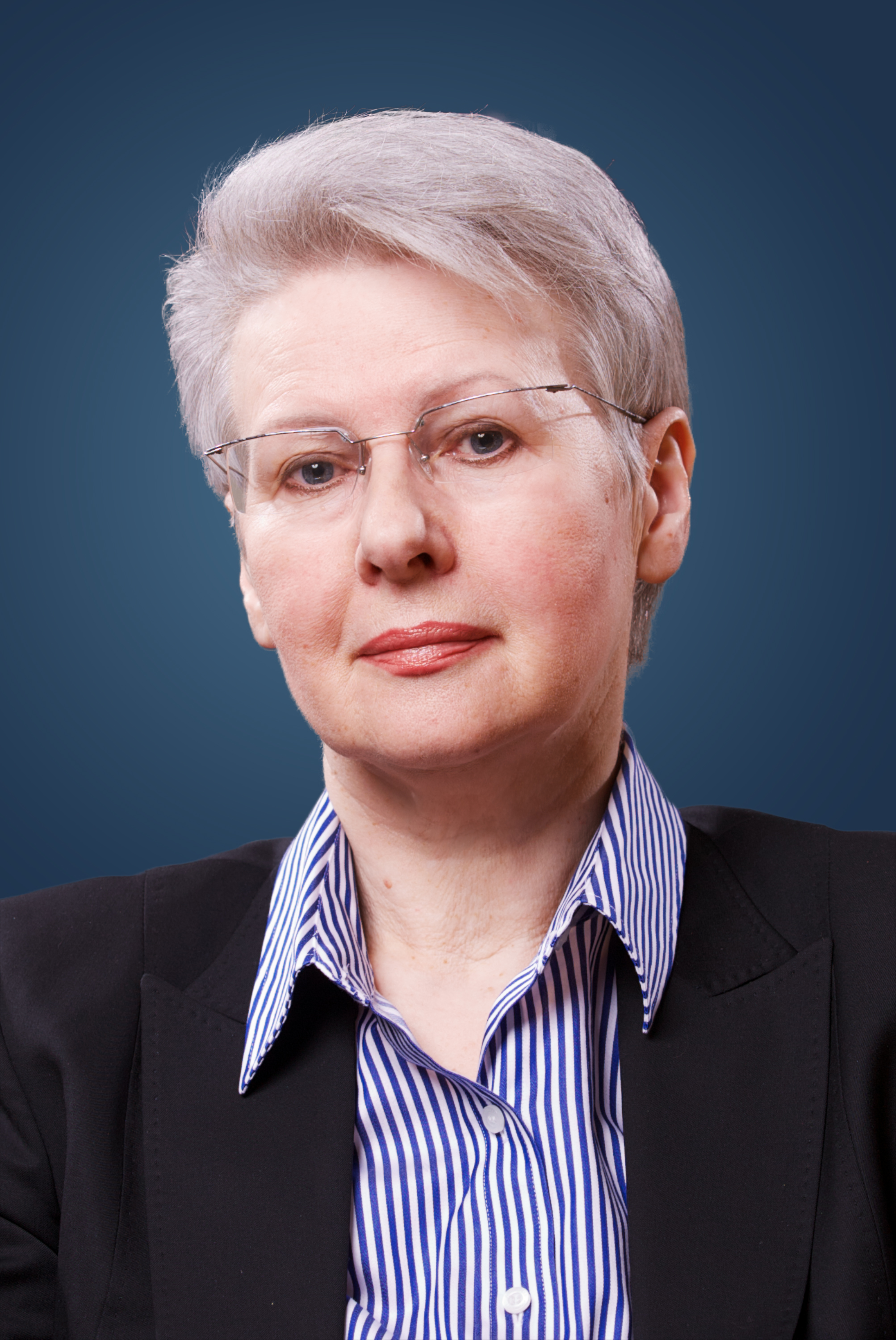
Former Senior Associate, Russian Domestic Politics and Political Institutions Program, Moscow Center
Shevtsova chaired the Russian Domestic Politics and Political Institutions Program at the Carnegie Moscow Center, dividing her time between Carnegie’s offices in Washington, DC, and Moscow. She had been with Carnegie since 1995.
Recent Work
Lilia Shevtsova
Lilia Shevtsova
Carnegie does not take institutional positions on public policy issues; the views represented herein are those of the author(s) and do not necessarily reflect the views of Carnegie, its staff, or its trustees.

The Plaza Accord was not an externally imposed punishment of Japan but part of a broader restructuring that Japanese economists and policymakers themselves recognized was necessary. Its effects were undermined, however, when Tokyo responded to the resulting slowdown with policies that exacerbated investment, credit expansion, and the very imbalances the adjustment was intended to resolve.

Michael Pettis
China’s banking crisis in the 2000s was resolved by transferring the costs to households through financial repression—a decision that recapitalized the banks while exacerbating the structural imbalances that continue to shape the Chinese economy today.
Michael Pettis

But their "principal to principal" model will only be as effective as the political strength of each leader back home.

Damien Ma

U.S. unpredictability has allowed China to capitalize on its positioning as the “responsible great power”. Paradoxically, the more China wins the perception game, the more likely expectations will rise for Beijing to deliver not just words but to demonstrate with its deeds.

Chong Ja Ian

Hanoi and Beijing have long treated each other as distant cousins rather than comrades in arms. That might be changing as both sides draw closer to hedge against uncertainty and America’s erratic behavior.

Nguyễn Khắc Giang