Malaysia’s chairmanship sought to fend off short-term challenges while laying the groundwork for minimizing ASEAN’s longer-term exposure to external stresses.
Elina Noor
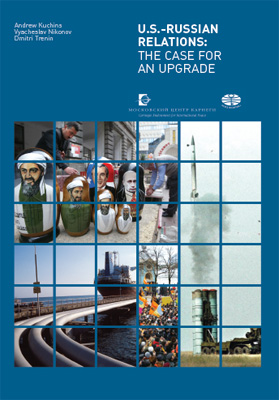
Highly touted in both Washington and Moscow as a "strategic partnership" in 2001, the relationship has drifted and the gap between glowing rhetoric and thin substance has grown. When major policy differences emerge, as over war in Iraq in 2002-2003 and recently over Ukraine, all too easily the U.S.-Russian relationship spirals into "crisis," and the threat of a "new Cold War" looms.
"The recent sharp dispute over the Ukrainian presidential elections vividly illustrated the fragile and shallow nature of the U.S.-Russian relationship. Highly touted in both Washington and Moscow as a "strategic partnership" in 2001, the relationship has drifted and the gap between glowing rhetoric and thin substance has grown. When major policy differences emerge, as over war in Iraq in 2002-2003 and recently over Ukraine, all too easily the U.S.-Russian relationship spirals into "crisis," and the threat of a "new Cold War" looms."
Click on the link above for full text of this Carnegie report in English and Russian.
About the Authors
Andrew C. Kuchins is Director of the Carnegie Moscow Center. He conducts research and writes widely on Russian foreign and security policy. He is a member of the governing council of the Program on Basic Research and Higher Education in Russia, the advisory committee of Washington Profile, and the editorial board of the journal, Demokratizatsiya.
Vyacheslav Nikonov is the President of the Polity Foundation in Moscow. He is the author of "Contemporary Russian Politics" (2003), "The Age of Change: Russia of the 1990s through Conservative's Eyes" (1999), "Conservative Manifesto" (1994), "The Republicans: From Nixon to Reagan" (1988), "Iran-Contra Affair" (1987), "The Republicans : From Eisenhower to Nixon" (1984).
Dmitri Trenin is Deputy Director of the Carnegie Moscow Center, where he also co-chairs the Program on Foreign and Security Policy. He is the author of numerous articles and books on Russian security issues, including, most recently, Russia’s Restless Frontier: The Chechnya Factor in Post-Soviet Russia (Carnegie, 2004)
Former Senior Associate and Director, Russian & Eurasian Program
Vyacheslav A. Nikonov
Polity Foundation
Former Director, Carnegie Moscow Center
Trenin was director of the Carnegie Moscow Center from 2008 to early 2022.
Carnegie does not take institutional positions on public policy issues; the views represented herein are those of the author(s) and do not necessarily reflect the views of Carnegie, its staff, or its trustees.
Malaysia’s chairmanship sought to fend off short-term challenges while laying the groundwork for minimizing ASEAN’s longer-term exposure to external stresses.
Elina Noor
For Malaysia, the conjunction that works is “and” not “or” when it comes to the United States and China.
Elina Noor
In July 2025, Vietnam and China held their first joint army drill, a modest but symbolic move reflecting Hanoi’s strategic hedging amid U.S.–China rivalry.
Nguyễn Khắc Giang
Rather than climate ambitions, compatibility with investment and exports is why China supports both green and high-emission technologies.
Mathias Larsen
“Involution” is a new word for an old problem, and without a very different set of policies to rein it in, it is a problem that is likely to persist.
Michael Pettis