

Article
Henri J. Barkey
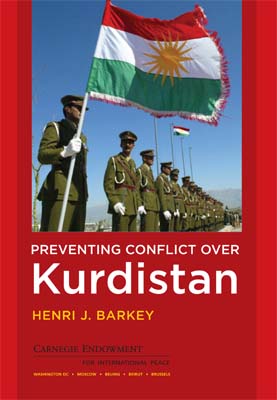
The invasion of Iraq has surfaced long-suppressed nationalist aspirations among the Kurds. If ignored or mishandled, Kurdish aspirations have the potential to ignite violence and instability in Iraq and the region.
The invasion of Iraq has surfaced long-suppressed nationalist aspirations among the Kurds, most notably the emergence of the federal Kurdistan Regional Government (KRG). If ignored or mishandled, Kurdish aspirations have the potential to ignite violence and instability in Iraq, as well as the region, at a particularly delicate time, a new report by the Carnegie Endowment concludes.
Henri Barkey calls for renewed attention to the Kurdish issue to prevent conflict and prescribes a fresh U.S. approach. The United States must move quickly—as American forces withdraw from Iraq, U.S. influence in the region will wane.
U.S. policy recommendations:
Barkey concludes:
“The United States has to take the lead, because it remains, despite its mistakes, the only power with the requisite capacities to cajole, convince, and pressure governments and groups to act. Left to their own devices, none of the parties has shown much ability to move forward, even if the right ideas and solutions are apparent, or sustain progress once achieved. The United States can approach matters with a broader outlook and vision concerning the linkages among the issues, attributes often missing in local parties.”

Former Visiting Scholar, Middle East Program
Barkey served as a member of the U.S. State Department Policy Planning Staff, working primarily on issues related to the Middle East, the Eastern Mediterranean, and intelligence from 1998 to 2000.
Recent Work
Henri J. Barkey
Henri J. Barkey
Carnegie does not take institutional positions on public policy issues; the views represented herein are those of the author(s) and do not necessarily reflect the views of Carnegie, its staff, or its trustees.

The nuclear relationship between China and the United States is increasingly shaped by widening perception gaps rather than deliberate strategic design.

Tong Zhao

But their "principal to principal" model will only be as effective as the political strength of each leader back home.

Damien Ma

U.S. unpredictability has allowed China to capitalize on its positioning as the “responsible great power”. Paradoxically, the more China wins the perception game, the more likely expectations will rise for Beijing to deliver not just words but to demonstrate with its deeds.

Chong Ja Ian

Hanoi and Beijing have long treated each other as distant cousins rather than comrades in arms. That might be changing as both sides draw closer to hedge against uncertainty and America’s erratic behavior.

Nguyễn Khắc Giang

Across Asia, China is better positioned to withstand energy shocks from the fallout of the Iran war. Its abundant coal capacity can ensure stability in the near term. Yet at the same time, the country’s energy transition away from coal will make it even less vulnerable during the next shock.
Damien Ma