

Commentary
But their "principal to principal" model will only be as effective as the political strength of each leader back home.
Damien Ma
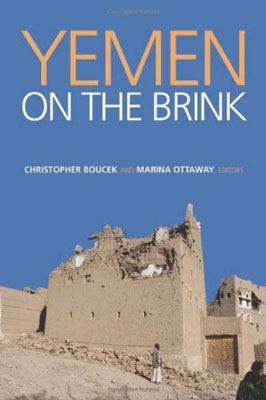
Without addressing Yemen's immediate security challenges—including a civil war in the North, a secessionist movement in the South, and a resurgent al-Qaeda organization—the country's long-term economic and governance issues cannot be resolved.
Source: Washington

“A compelling study on the part of Carnegie to help explain the complexities of Yemen to increasingly concerned Western policy makers.”
—Nabeel Khoury, U.S. Department of State
“Political, economic, and security developments in Yemen increasingly affect the European Union, and this book will serve as a valuable resource for policy makers as they work to address the many challenges facing Yemen.”
—Gilles De Kerchove, EU Counter-Terrorism Coordinator

Former Associate, Middle East Program
Boucek was an associate in the Carnegie Middle East Program where his research focused on security challenges in the Arabian Peninsula and Northern Africa.
Former Senior Associate, Middle East Program
Before joining the Endowment, Ottaway carried out research in Africa and in the Middle East for many years and taught at the University of Addis Ababa, the University of Zambia, the American University in Cairo, and the University of the Witwatersrand in South Africa.
Carnegie does not take institutional positions on public policy issues; the views represented herein are those of the author(s) and do not necessarily reflect the views of Carnegie, its staff, or its trustees.

But their "principal to principal" model will only be as effective as the political strength of each leader back home.

Damien Ma

U.S. unpredictability has allowed China to capitalize on its positioning as the “responsible great power”. Paradoxically, the more China wins the perception game, the more likely expectations will rise for Beijing to deliver not just words but to demonstrate with its deeds.

Chong Ja Ian

Hanoi and Beijing have long treated each other as distant cousins rather than comrades in arms. That might be changing as both sides draw closer to hedge against uncertainty and America’s erratic behavior.

Nguyễn Khắc Giang

Across Asia, China is better positioned to withstand energy shocks from the fallout of the Iran war. Its abundant coal capacity can ensure stability in the near term. Yet at the same time, the country’s energy transition away from coal will make it even less vulnerable during the next shock.
Damien Ma

Malaysia’s chairmanship sought to fend off short-term challenges while laying the groundwork for minimizing ASEAN’s longer-term exposure to external stresses.

Elina Noor