

Commentary
But their "principal to principal" model will only be as effective as the political strength of each leader back home.
Damien Ma
Source: Getty
If Russia continues to support Syrian leader Bashar al-Assad, it does not bode well for cooperation between Russia and the West on missile defense or any other security matter of a strategic nature.
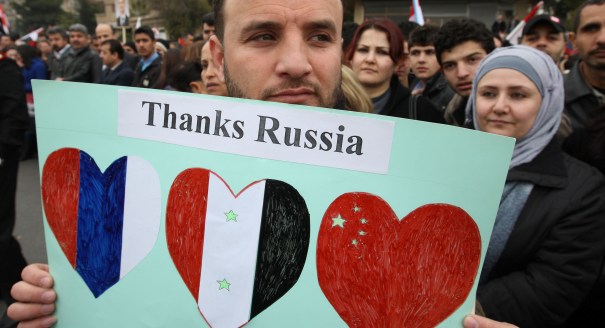
Speaking at the Munich Security Conference this past weekend, Russian Foreign Minister Sergei Lavrov complained of the current “patchwork” character of Euro-Atlantic security mechanisms and the need for a more comprehensive system built on trust. He singled out the difficulties in finding agreement on ballistic missile defense as “driving a wedge” between different branches of European civilization. But, on the very same day Lavrov was highlighting the need for “equal and indivisible” security in Europe, something else was widening those divisions: the Russian and Chinese ambassadors to the United Nations vetoed a United Nations Security Council (UNSC) resolution condemning and calling for an end to the violence in Syria and supporting an earlier Arab League proposal which foresaw the “formation of a unity government.” In doing so, the two countries demonstrated a clear departure from the values that are shared by not only Euro-Atlantic society, but by a wide representation of the global community as the measure was approved by all other UNSC members, ranging from Colombia to Guatemala to India and Pakistan.
Russia indicated on Saturday that specific language in the resolution would have amounted to taking sides in a domestic issue, necessitating a Russian veto, but there were also certainly underlying motives for the positions of both sides, translating into a competition for influence that is in no way compatible with the type of cooperation that Lavrov articulated in his speech in Munich. Not only that, it is as if there were two different Russian Federation’s present that day in two different locations: a forward-looking, progressive, and eager to modernize one present in Munich, and a zero-sum-minded Russia of the past, vying for influence on the world stage in New York City. The failure of the Russian leadership in this instance was its inability to understand that standing in opposition is not the only way to gain influence. This game is positive sum, with the outcome being an international effort to condemn the violence in Syria and begin work to address the conditions that caused it in the first place.
Impossible to disregard in this context are the multiple interests that Russia has in ensuring that the Assad regime stays intact. Those interests are both concrete and philosophical and could be jeopardized if there is a change in authority in Syria—even more so after Saturday’s UNSC vote. If the Assad regime falls, Russia is sure to lose lucrative defense contracts, its warm-water naval base at Tartus, and a portion of its already diminished influence in the Middle East. Illustrating the mood among Arab countries, Sunday saw the sacking of the Russian embassy in Tripoli by Libyan revolutionaries, who according to Reuters indicated their willingness to travel to Syria to fight “with their brothers.”
Moscow has also been waging an uphill battle against foreign interventions writ large in the internal affairs of sovereign countries, with NATO’s intervention in Libya being the most recent iteration. There is a notion among some in Russia that NATO involvement is centered on securing resources, and the language of human rights is nothing but a Trojan horse. Certain officials at the highest levels of the Russian government have nothing but suspicion of U.S. intentions, fearful that a weak Russia will become “victim” to a world that “is rapidly losing its mind” and “respects only force…real brutal armed physical force, rather than some ‘smart’ and ‘soft’ force.” Russia is pursuing a dual-track approach to checking the power of the United States and NATO: exercising its UNSC veto and bolstering its military strength so that, according to Deputy Prime Minister Dmitry Rogozin, Russia doesn’t become the next victim.
Russia missed an opportunity on Saturday to stand with the international community in opposing oppressive and violent answers to domestic discontent. To be sure, Moscow is engaged with the Syrian issue as exhibited by Tuesday’s trip by Lavrov and Director of the Foreign Intelligence Service Mikhail Fradkov when they delivered a letter from President Medvedev and held consultations with the Syrian leadership. And the issue is surely not settled as the UNSC is likely to take the issue up again in the form of another resolution, possibly giving Russia an additional chance to demonstrate its commitment to end the violence and side with the rest of the international community.
At the end of the day, it will be the outcome of events like Syria that will either enable or prevent joint action on strategic security issues. If Russia continues to uphold Assad by selling weapons and providing diplomatic cover, it does not bode well for cooperation on missile defense or any other security matter of a strategic nature. If Russia truly sees the United States as a hegemon in search of another victim, reaching the “new level of trust” that Foreign Minister Lavrov spoke about in Munich as the key to addressing contemporary threats is not likely to be realized.
Andrew Riedy is a visiting researcher at the Carnegie Moscow Center.
Andrew Riedy
Carnegie does not take institutional positions on public policy issues; the views represented herein are those of the author(s) and do not necessarily reflect the views of Carnegie, its staff, or its trustees.

But their "principal to principal" model will only be as effective as the political strength of each leader back home.

Damien Ma

U.S. unpredictability has allowed China to capitalize on its positioning as the “responsible great power”. Paradoxically, the more China wins the perception game, the more likely expectations will rise for Beijing to deliver not just words but to demonstrate with its deeds.

Chong Ja Ian

Hanoi and Beijing have long treated each other as distant cousins rather than comrades in arms. That might be changing as both sides draw closer to hedge against uncertainty and America’s erratic behavior.

Nguyễn Khắc Giang

Across Asia, China is better positioned to withstand energy shocks from the fallout of the Iran war. Its abundant coal capacity can ensure stability in the near term. Yet at the same time, the country’s energy transition away from coal will make it even less vulnerable during the next shock.
Damien Ma

Malaysia’s chairmanship sought to fend off short-term challenges while laying the groundwork for minimizing ASEAN’s longer-term exposure to external stresses.

Elina Noor