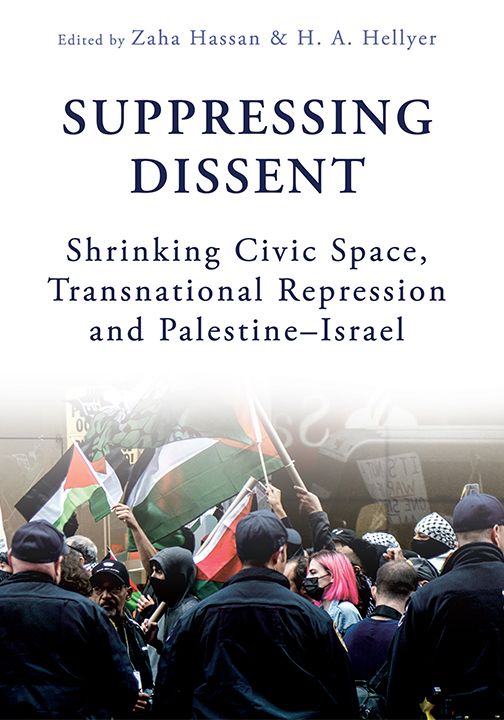
In the occupied Palestinian territories, civil society actors face mass surveillance, movement restrictions, arrests, and physical assaults. In Israel, various legal mechanisms are used to restrict speech and protest, and an organized campaign is under way to limit review of these measures by the judiciary. Meanwhile, in the United States, public and private efforts have been deployed to prohibit advocacy in support of human rights for Palestinians on college campus, in the public square, and online.
This edited volume gathers leading scholars to shed light on the various mechanisms being used to suppress dissent related to Palestine-Israel at home and abroad and explains why this presents an existential threat to global civil society.
Praise for Suppressing Dissent
An urgent and compelling read…A must-read that envisions a future grounded in the self-determination and human rights of both Palestinians and Israelis.
—Tess McEnery, Executive Director, Middle East Democracy Center, former director for Democracy and Human Rights at the White House National Security Council
Repressing speech is never the end of a problem, but rather the beginning of a bigger one... Suppressing Dissent fills a gap in the policy community’s understanding of how shutting down discussion only fuels anger, limits cooperation, and undermines possibilities for peace.
—Sarah Yager, Washington Director, Human Rights Watch
No issue since the Cold War has tested our society’s commitment to free expression like the Palestine/Israel conflict. This timely anthology — examining censorship campaigns against dissidents and civil society groups in the United States, Israel, and Palestine, and the Arab world — is essential reading for anyone who wants to understand how the tactics of McCarthyism have been refurbished for a globalized Twenty-First Century.
—Brian Hauss, Senior Staff Attorney, ACLU Speech, Privacy, and Technology Project
The Oct 7, 2023 attack and subsequent brutal war have catalyzed a series of remarkable changes in politics and civil society in Israel, Palestine, and the United States. This volume—in which a diverse intergenerational group of experts offer brisk, well-researched essays exploring recent developments and their less-known roots—is exactly the tool to help you understand those changes.
—Michele Dunne, Former Director of Middle East programs at the Carnegie Endowment for International Peace and the Atlantic Council and former U.S. diplomat based in Jerusalem and Cairo.
It should be clear by now that the Palestinians will never reconcile themselves to the continued occupation and expropriation of their land, nor renounce their claim to statehood and national independence. Never has the need for a healthy, tolerant, and respectful dialogue to resolve the Palestinian question been greater. If we cannot engage in public discourse without fear of censorship or retaliation, the dream of a durable and just peace in Palestine-Israel slips further away. “Suppressing Dissent” shines a critical light on the shrinking civic space surrounding one of the most consequential political issues of our times.
—Martin Griffiths, United Nations Under-Secretary-General for Humanitarian Affairs and Emergency Relief Coordinator (2021-2024)
This seminal collection of essays by knowledgeable analysts outlines the shrinking civic space that increasingly constrains human rights activists, academics, students, social media influencers and others who express opposition to the oppression of the Palestinian people.
—Sana Abed-Kotob, Former Deputy Director at the U.S. Department of State’s Bureau of Educational and Cultural Affairs
Every scholar who works in or on the Middle East and North Africa will benefit from this important book. For those of us who spend our professional lives trying to understand and explain what shapes life in this region (including all readers of this journal), a vague and disquieting sense that we are being stifled, our ideas muffled and our impact diminished, has become almost second nature. It is both deeply disheartening and at the same time oddly reassuring to be reminded that these circumstances are neither the natural order of things nor a consequence of individual delusions; they are, in fact, the artifact of a deliberately designed and manufactured constriction of the intellectual space in which we work. This book accomplishes that important task by careful accumulation of data, cases, and documentation and a tone of sober, analytical composure that makes its case even more damning.
—Lisa Anderson, International Journal of Middle East Studies
Suppressing Dissent is a seminal work for understanding the profound shift in the relationship between freedom and power in the post-truth era.By tracing the case of Palestine, the authors reveal an unprecedented entanglement of liberal censorship, the political economy of propaganda, and digital power.It is a work that transcends Palestine as a geographical location, making it a metaphor for our times.
—Beirut News Center
Scholars of MENA, and of authoritarianism more specifically, are all too familiar with the elaborate playbook of authoritarian tactics used to suppress opposition, from politicizing independent institutions, packing courts with party loyalists, stifling the media, redrawing district maps, spreading disinformation, and to scapegoating vulnerable communities etc…Suppressing Dissent, however, goes well beyond nationally-based authoritarian mechanisms, and illustrates how the emergent transnational architecture of repression operates and can be deployed by the strong and more resource-endowed against less the powerful and marginalized to quell dissent globally.
—Professor Manal Jamal, Professor of Political Science, James Madison University